The compact flagship space is heating up, and manufacturers are no longer compromising on power just to slim things down. With performance becoming just as much a priority as portability, compact smartphones are starting to punch well above their weight. We put three of the most talked-about options—the OnePlus 13s, iPhone 16e, and Google Pixel 9a—through a series of rigorous performance tests to see which one justifies its premium price tag and delivers a well-rounded performance. Here’s what we found.
Testing Criteria
Before jumping to conclusions, let’s walk through how we approached this performance test. All three smartphones were updated to the latest software versions, charged to full capacity, and set to 50% brightness. Airplane mode was switched on, and all devices were connected to the same Wi-Fi network to maintain consistency.
To level the playing field, we locked each phone to its highest available refresh rate: 120Hz for the OnePlus 13s and Pixel 9a, and 60Hz for the iPhone 16e. The phones were then put through a series of benchmarks, followed by a gaming session using the same title across the board.
We also tracked thermal performance using an IR camera to see how evenly and efficiently heat was managed during the test. For context, the room temperature was a steady 23.1°C. At the start, the iPhone 16e measured 25.4°C, the OnePlus 13s was at 25.7°C, and the Pixel 9a started at 24.9°C.
The results, along with thermal imaging data, give us a clearer picture of how each phone performs under sustained pressure.
Testing Processor Performance
We kicked things off with a 10-minute Geekbench run to gauge how each phone handles core performance under typical loads. The iPhone 16e took the lead in single-core processing, showing strong individual thread performance, while the OnePlus 13s pulled ahead in multi-core, flexing its strength in more demanding, multi-threaded tasks. You can check out the detailed scores in the table below.
| Smartphone | Single-core Score | Multi-core Score |
| iPhone 16e | 3389 | 8250 |
| OnePlus 13s | 3005 | 8952 |
| Google Pixel 9a | 1736 | 4494 |

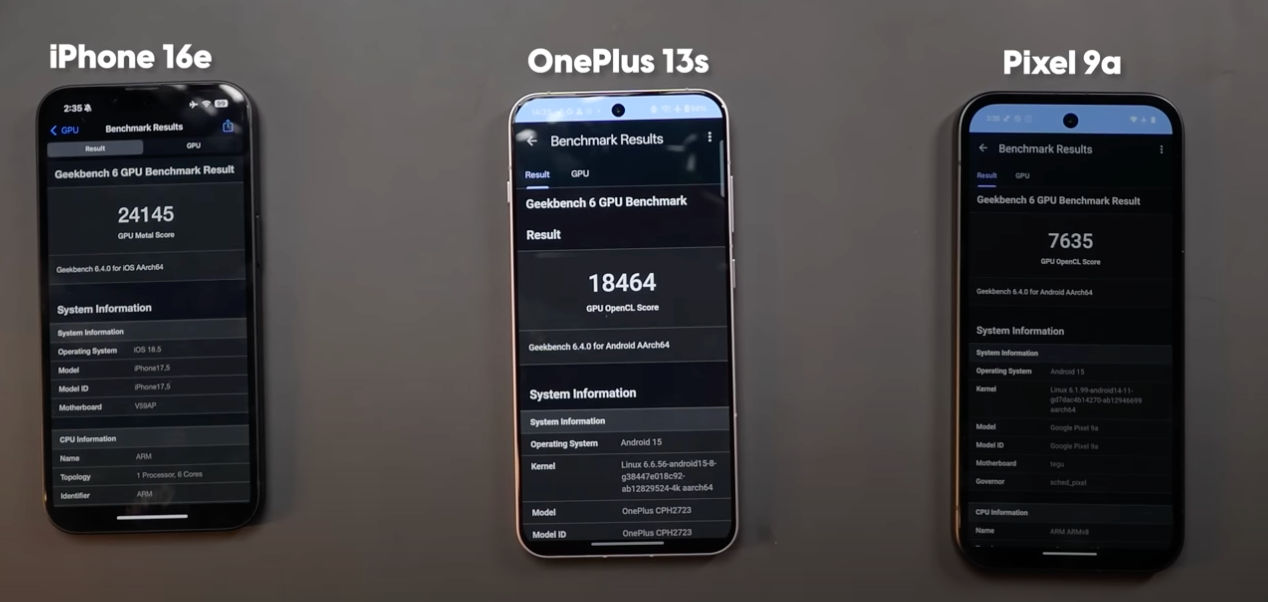
To test GPU performance, we ran Geekbench 6 on OpenCL. This benchmark focuses on graphics-heavy tasks such as rendering and advanced photo processing. The iPhone 16e breezed through the test and came out on top. The OnePlus 13s followed closely behind, while the Pixel 9a lagged in both completion time and score. You’ll find the numbers in the table below.
| Smartphone | Geekbench 6 on OpenCL Score |
| iPhone 16e | 24145 |
| OnePlus 13s | 18464 |
| Google Pixel 9a | 7635 |
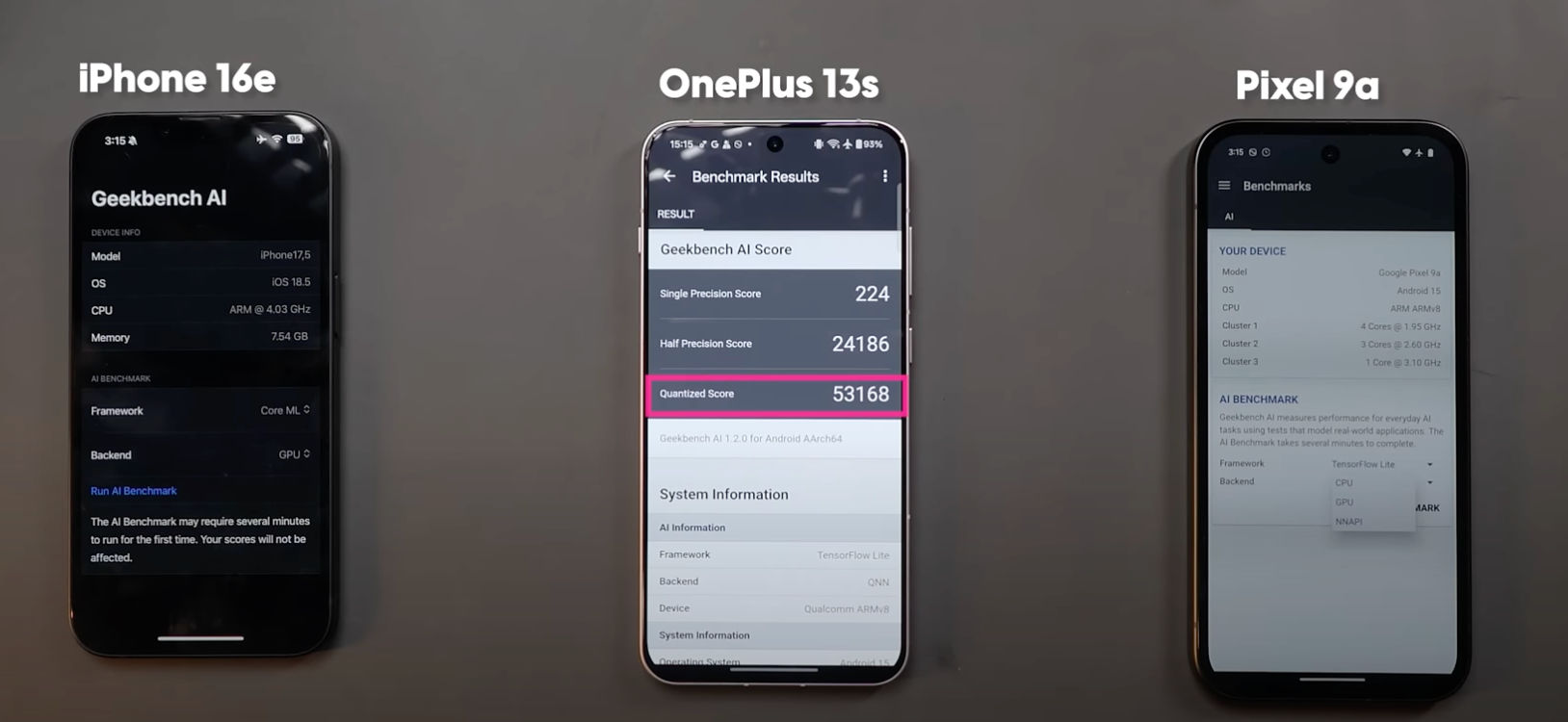
AI is playing a bigger role in smartphones than ever in 2025, so testing each phone’s NPU was a key part of our evaluation. At first glance, the OnePlus 13s delivered a surprisingly low quantised score, which raised some eyebrows. Oddly enough, the Pixel 9a didn’t finish last for once. It claimed the second spot ahead of the 13s. You can find the scores in the table below.
| Smartphone | Quantised Score |
| iPhone 16e | 46016 |
| OnePlus 13s | 552 |
| Google Pixel 9a | 7913 |

Digging deeper, we noticed a few interesting things in the settings. The iPhone 16e clearly labels its neural engine. On the other hand, the OnePlus 13s and Pixel 9a list NNAPI, short for Neural Networks API. However, the OnePlus 13s includes a fourth option called QNN, which likely refers to Qualcomm’s own neural processing system. Our initial benchmark used NNAPI on the 13s, but we ran it again using QNN, and that made a big difference. The 13s then pulled in a score of 53,168, comfortably surpassing the iPhone 16e.
To get a broader sense of AI performance, we also tested how these phones handled AI tasks using their CPU and GPU. When run on the CPU, the iPhone 16e delivered the top score, with the Pixel 9a following close behind and the OnePlus 13s trailing. Switching to GPU-based testing, the iPhone 16e remained in the lead. This time, the OnePlus 13s outperformed the Pixel 9a, pushing it to the bottom of the list.
| Smartphone | GPU Quantised Score | CPU Quantised Score |
| iPhone 16e | 4253 | 5919 |
| OnePlus 13s | 1689 | 2061 |
| Google Pixel 9a | 849 | 2966 |


AI performance clearly tilts in favour of the iPhone 16e, especially when stacked against the OnePlus 13s.
With the tests wrapped up, the next thing worth noting is battery consumption. Take a look at the table below to see where each device stands.
| Smartphones | Remaining Battery |
| iPhone 16e | 95% |
| OnePlus 13s | 92% |
| Google Pixel 9a | 93% |
Once the tests wrapped up, we checked the temperatures again. The room held steady at 23.5°C. The iPhone 16e hovered around 26.2°C, the Pixel 9a at 27.6°C, and the OnePlus 13s at 29.1°C. Despite the intense testing, none of the phones showed major heat spikes, which was also confirmed by our thermal imaging.
Testing System Performance
AnTuTu, on the other hand, takes a broader approach by measuring everything from processing power to memory and storage speeds. It’s a solid indicator of how well a phone can handle everyday workloads. The scores are listed in the table below.
| AnTuTu Benchmark | |
| Smartphone | Total Score |
| OnePlus 13s | 2,519,949 |
| iPhone 16e | 1,311,353 |
| Google Pixel 9a | 1,226,643 |
No surprises here; the OnePlus 13s leads the pack, powered by Qualcomm’s Snapdragon 8 Elite SoC, and its AnTuTu score reflects just that.
Post-AnTuTu, we took another look at how warm things got. The room held steady at 23.7°C. The iPhone 16e climbed to 31.6°C, the Pixel 9a reached 32.5°C, and the OnePlus 13s came in the hottest at 38.3°C. Despite that, the 13s didn’t cross any red lines. It was still operating within thermally acceptable limits.
Here’s how the battery levels stood once the test wrapped up. Take a look at the breakdown below.
| Smartphones | Remaining Battery |
| iPhone 16e | 85% |
| OnePlus 13s | 79% |
| Google Pixel 9a | 83% |
Testing Graphics Performance
To kick things off, we ran the Steel Nomad Light test, a GPU stress test built around game-style graphics without ray tracing. The OnePlus 13s breezed through it ahead of the iPhone 16e and Pixel 9a. The full numbers are in the table below.
| Smartphone | Steel Nomad Light Score |
| iPhone 16e | 1160 |
| OnePlus 13s | 2410 |
| Google Pixel 9a | 1052 |

We then moved on to the Wildlife Extreme Stress Test, a tough 20-minute session designed to push each phone to its limits. Among the three, the OnePlus 13s stood out, driven by its Snapdragon 8 Elite chipset, and handled the pressure better than the rest.
| Smartphone | Wildlife Extreme Stress Test Score |
| iPhone 16e | 2976 |
| OnePlus 13s | 6125 |
| Google Pixel 9a | 2628 |

Post-test temperatures showed the room at 21.7°C. The iPhone 16e and Pixel 9a both registered around 31°C, while the OnePlus 13s ran warmer at 36.4°C.
Here are the remaining battery life statistics.
| Smartphones | Remaining Battery |
| iPhone 16e | 73% |
| OnePlus 13s | 63% |
| Google Pixel 9a | 72% |
The iPhone 16e seems to be playing the long game, choosing to keep things cool and steady rather than chasing high scores. It’s a deliberate move, even if it means not showing off everything the A18 chip can really do.
Meanwhile, the OnePlus 13s does not hold back. It pushes the Snapdragon 8 Elite to its limits, and it shows. This is the kind of performance muscle you expect to flex in a stress test.
Testing Browser Performance
To see how these phones handle real-world web usage, we fired up Chrome and ran a few browser benchmarks. First up was JetStream 2, which evaluates how fast and efficiently a browser starts, runs code, and handles complex web tasks. The iPhone 16e scored the highest, followed by the OnePlus 13s, while the Pixel 9a came in last.
| Smartphone | JetStream2 test Score |
| iPhone 16e | 313.782 |
| OnePlus 13s | 141.575 |
| Google Pixel 9a | 102.460 |

Next, we used Speedometer 3.1 to test how responsive each browser is during common web app interactions. The results followed a similar pattern: the iPhone 16e led again, with the OnePlus 13s in second place and the Pixel 9a in third.
| Smartphone | Speedometer 3.1 Score |
| iPhone 16e | 27.3 |
| OnePlus 13s | 16.4 |
| Google Pixel 9a | 11.6 |

Testing Gaming Performance
To push these phones a little, we played BGMI with Ultra HDR graphics and Ultra frame rate settings for 30 minutes. This setup maxes out at 40fps, and we’re happy to report there were no hiccups or lags, just smooth gameplay across the board. Frame counters on all three devices hovered steadily around 39 to 40fps.
Post-game, the room held steady at 23°C. Whereas, the phones were all chilling around 30°C. Pretty impressive thermal control, especially considering the demanding graphics. Our thermal camera echoed the same results with balanced heat distribution all around.
Now, check out the table below to see how much battery was drained after running all these tests.
| Smartphones | Remaining Battery |
| iPhone 16e | 63% |
| OnePlus 13s | 55% |
| Google Pixel 9a | 62% |
Who’s Offering the Best Value Among Premium Compact Phones?
After a series of rigorous performance and battery tests, it is clear that all three smartphones follow distinct priorities. Yet when evaluating the overall value, the OnePlus 13s emerges as the most complete offering.
Powered by the Snapdragon 8 Elite, it consistently delivered the highest benchmark scores and sustained performance across tasks. It also maintains stable thermals and manages power well under load. Users who prioritise speed, multitasking efficiency, and gaming will find the 13s well suited to their needs. The phone is currently available at a discounted price of Rs 49,748 during the Amazon Prime Day sale, down from Rs 54,999 with select bank offers, which further strengthens its value proposition.
In comparison, the iPhone 16e appears more focused on long-term stability and efficiency. Although the A18 chip is capable of more, Apple seems to have tuned it for thermal balance and consistent battery performance. For users invested in the iOS ecosystem or those who value a reliable daily driver, it remains a strong contender. The current sale price of Rs 50,499 improves its appeal, though it feels less competitive when viewed purely through a performance lens.
On the other hand, the Pixel 9a positions itself as the middle ground. It does not excel in peak performance, but it offers clean software, capable image processing, and dependable day-to-day use. It is a good choice for those who prefer simplicity and software refinement over raw numbers.
Ultimately, the OnePlus 13s combines powerful hardware with OxygenOS 15, a clean and responsive Android skin that now includes a suite of useful AI features. These additions make the overall experience smarter and more efficient. For users seeking flagship-level performance in a compact device without breaking the bank, it delivers the best value.