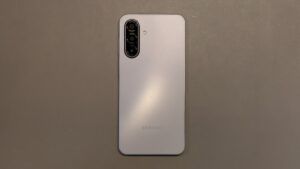
The POCO X7 has added a new twist to the design narrative in the ‘X’ series. The stunning dual-tone back and sleek golden camera bezels can captivate anyone at first glance, marking a significant departure from its previous designs. While that’s just one aspect of the smartphone, what else does POCO do to make the X7 an exceptional device? And, how well does it perform against bigwigs in its price range like the Motorola Edge 50 Fusion and the iQOO Z9s? Read my review to find out.
POCO X7
Rs 21,999
What Is Good?
- Gorgeous exterior with sturdy frame
- Consistent performance
- Immersive multimedia experience
- Long battery life
What Is Bad?
- Bloatware apps
- Underwhelming ultra-wide camera
Pricing and Availability in India
You can grab the X7 from POCO’s online store and Flipkart. It is available in two storage options, which are listed below:
| Variant | Price |
| 8GB+128GB | Rs 21,999 |
| 8GB+256GB | Rs 23,999 |
Design and Build Quality
With the POCO X7, the brand has deviated greatly from its previous belief in functionality over form and blended them to the T instead.
| Design | Specifications |
| Colour Options | Black (reviewed), Silver, and Green |
| Weight | 190g |
| Thickness | 8.63 mm |
| IP Rating | IP68 |
| Port and Button Placements | Bottom: Primary microphone, USB port, speaker grille, and SIM card tray
Top: Secondary microphone, IR blaster, and speaker grille Right Side: Power button and volume button |
Let’s address the elephant in the room: the POCO X7 is essentially a repackaged version of the Redmi Note 14 Pro. However, POCO has rescued the phone from the latter’s shadow by giving it a distinctive identity through its black colour variant. Three key design elements make this possible: golden bezels around the cameras, a bold black strip running across the yellow body, and a slightly stretched logo.

While the first two design choices intrigued me, I can understand the brand’s intent behind the enlarged logo—it does add to the phone’s overall aesthetic. However, I’m not sure everyone will feel the same way. Hopefully, POCO will take a more subtle approach in its next iteration, much like it did with the X7 Pro, its elder sibling.
Everyone can agree that the X7’s build quality is something to admire. Despite housing a sizable 5,110mAh battery, its sleek, curved edges make it surprisingly easy to hold—so much so that I might need a new way to test my grip strength. Plus, carrying it never strained my wrist, unlike the weight of my future. That said, no matter what lies ahead, I trust the X7 will hold up just as well. With an IP68 rating, it ensures you won’t break a sweat using it near water.
Display and Audio
The POCO X7 Pro stood out in the sub-Rs 30,000 segment with its flat display, but the brand took a different route with the X7, opting for a curved screen—some might see it as a downgrade, but I’m not complaining.

| Display | Specifications |
| Size | 6.67-inch |
| Type | AMOLED |
| Resolution | 1.5K resolution (1220 x 2712) |
| Refresh Rate | 120Hz |
| Peak Brightness | Claimed: 3000 nits, Tested: 1538 nits |
| Minimum brightness | 16 nits |
| Pixel Density | 446ppi |
| Display Protection | Corning Gorilla Glass Victus 2 |
Here’s why: First, this decision lends the phone a premium look. Second, it offers a terrific viewing experience. Watching Sung Jin-Woo slay monsters in Solo Leveling felt incredibly immersive, thanks to the X7’s crisp picture quality with vibrant colours—though the hair-raising action scenes also played a role. The availability of Widevine L1 certifications ensured I could watch movies at Full HD resolution on streaming services like Netflix. Moreover, the duo of Dolby Vision and HDR10+ doubled my enjoyment.

Indoors, I comfortably enjoyed watching videos for almost a quarter of the full brightness while I doom-scrolled on Instagram without much difficulty outdoors under the direct sunlight.
Speaking of the audio quality, the dual stereo speakers were pretty loud with a balanced sound signature. I especially experienced loudness when I was playing songs alone in my room and got shouted at by my parents to lower it, but the volume was really at 60 per cent.
Performance and Software
The Mediatek Dimensity 7300-Ultra oversees all operations in the POCO X7. While it is an amazing chipset capable of managing complex calculations, it is important to highlight that the CMF Phone 1 features the same one at a relatively lower price.
| Hardware | Specifications |
| Processor | Mediatek Dimensity 7300-Ultra |
| RAM | 8GB LPDDR4X |
| Storage | Up to 512GB UFS 2.2 |
| Storage Test | 60802 |
| CPU Throttling Test | 84 per cent of its max performance |
| Software Version | Xiaomi HyperOS based on Android 14 |
| Connectivity Details | Wi-Fi 6, Bluetooth 5.4 |
In my usage, the phone regularly glided through tasks, ranging from endless scrolls on social media apps to some casual gaming, without breaking much sweat.

At the lowest graphical setting, BGMI ran with a frame rate of around 60fps but my frame rate meter showed frame drops right when I decided to goof around in a car during gameplay.
While playing games, I encountered a strange issue: Whenever I tried to bring up the game mode overlay, the frame rate meter was straight up erased from the background, so I either had to give up on my testing or fully enjoy the game. I picked the rational one and continued my testing.
I experienced its ripple effect while playing Call of Duty: Mobile. While I had the option to play at 120fps, I couldn’t take advantage of it as I needed to activate the game mode, which was not an option for me.
The POCO X7 runs on Xiaomi HyperOS, which is based on Android 14. However, since almost every new phone, including the POCO X7 Pro, comes with Android 15, it is odd to see the company treating each product differently.
 Another strange aspect is that its feature-loaded UI felt sluggish during my testing. Regularly, lags or jitters would pop up in unexpected locations, dampening my mood. However, a software update is all this phone needs to iron out this issue. What the software update can’t fix is the presence of bloatware and the phone’s capacity to annoy you with a barrage of spammy notifications. In the Motorola Edge 50 Fusion, one of many phones I tested, I barely faced any of these issues. In fact, I never spent my day grinding my teeth from getting bombarded with spammy notifications.
Camera
While the POCO X7 seems like it offers better value than the X7 Pro due to its additional camera, the extra one is just a 2-megapixel macro camera that few users will find beneficial. The remaining cameras didn’t shine as brightly as other aspects of the phone as some underlying issues trimmed my excitement right when I photographed beautiful moments.

| Cameras | Specifications |
| Primary camera | 50-megapixel, f/1.5 (OIS) |
| Ultra-wide camera | 8-megapixel, f/2.2 |
| Macros camera | 2-megapixel, f/2.4 |
| Selfie camera | 20-megapixel, f/2.2 |
| Video capabilities | 4k at 30fps for the rear and 1080p at 60fps for the front camera |










Under bright sunlight, the primary camera delivers detailed images with vibrant colours and proper exposure. However, when photographing human subjects, a peculiar quirk emerges—a noticeable warm tint often alters skin tones, making them look slightly off. This issue is also apparent in portrait shots, though they benefit from accurate edge detection. On the contrary, the iQOO Z9s always had my back as its dependable primary camera allowed me to capture some of the nicest portrait photos.
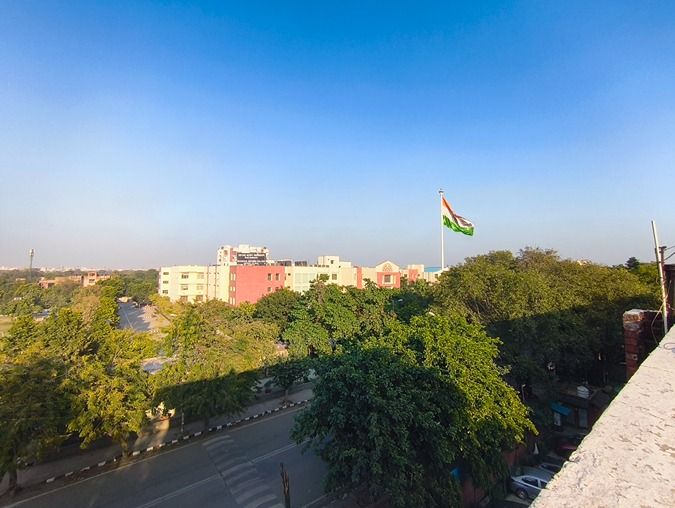






While the ultra-wide camera often replicates the former’s colour reproduction, its lower resolution prevents it from achieving the same level of detail as the primary camera. Moreover, it struggles to set exposure appropriate for the setting, causing the brightest parts of some images to go haywire.












In low-light conditions, the primary camera performs as effectively as it does in daylight. The photos remain crisp, while the colours stay poppy. However, it operates at a slower shutter speed so that any sudden movement can result in blurry photographs. On the contrary, the ultra-wide camera doesn’t carry its daylight performance here. Its struggle with the dynamic range intensifies even more, and the photographs have a greater noise.
The front camera functioned satisfactorily by generating images that were good enough to post on Instagram stories with some tweaks.
Battery and Charging
The 5,110mAh battery inside the X7 has consistently powered through my moderate daily usage while conserving energy for the next-day shenanigans. For context, I typically spend my time experiencing the lives of others on Instagram, watching lengthy essay videos on YouTube, and indulging in a bit of casual gaming.

| Battery | Specifications |
| Battery | 5,110mAh |
| Charging Adapter | 45W turbocharging, charger in the box |
| Charging Time | 51 minutes |
| PCMark Battery Test | 13 hours and 39 minutes |
In our PCMark battery test, the phone lasted 13 hours and 39 minutes. This is an acceptable score, but it is not enough to outperform the Vivo T3 Pro, its similarly priced competitor, which ran almost eight extra hours.
The 45W charger takes 51 minutes to juice the X7’s battery from zero to 100 per cent.
Verdict
At Rs 21,999, consider the POCO X7 if you are searching for a stylish, sleek phone with a terrific multimedia experience. Despite its slender structure, its speakers pack a punch. Its big battery prevents interruptions during long movie marathons. Most importantly, it adequately manages your routine tasks.
But before making the purchase, you should take note of its weak points: While the primary camera is reliable for taking pictures, the ultra-wide camera needs POCO’s utmost attention to correct its shortcomings. The OS contains many customisation options but acts roughly and annoys you with spammy notifications.
If the camera is your priority, the iQOO Z9s is a no-brainer, and the Motorola Edge 50 Fusion suits those who want a clean UI experience.