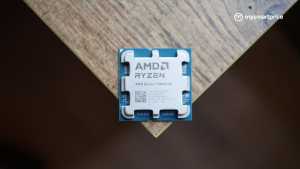
As the calendar hit the month of August, AMD woke up from its two-year-long slumber and decided to refresh its CPU architecture from its Zen 4 to the all-new Zen 5. Besides the increase in number, the Zen 5 architecture promises a huge leap in gaming and productivity tasks, a bigger boost in power efficiency, and better performance in AI computing. The Ryzen 7 9700X CPU was among the first to come with this architecture in the launch month. On the contrary, the Ryzen 7 9800X3D joined the party a little late as it was unveiled in October.
Ryzen 7 9800X3D and Ryzen 7 9700X: Specifications
The Ryzen 7 9800X3D packs 8 cores and 16 threads. Fortunately, it is the first X3D processor to be fully unlocked, so enthusiasts and gamers can adjust its performance according to their needs (we will come to this shortly). Similarly, the Ryzen 7 9700X has 8 cores and 16 threads. It is unlocked and supports overclocking out of the box as well.

| Specification | AMD Ryzen 7 9800X3D | AMD Ryzen 7 9700X |
| Cores | 8 | 8 |
| Threads | 16 | 16 |
| Architecture | Zen 5 | Zen 5 |
| Base Clock | 4.7GHz | 3.8 GHz |
| Boost Clock | 5.2GHz | 5.5 GHz |
| Base TDP | 120W | 65W |
| iGPU | AMD Radeon Graphics | AMD Radeon Graphics |
| iGPU Xe Cores | 2 | 2 |
| iGPU Max Speed | 2.2GHz | 2.2GHz |
| NPU | NA | NA |
| NPU Max Performance | NA | NA |
| RAM Supported | DDR5, Up to 5400MHz,
Up to 192GB capacity, Dual Channel Supported |
DDR5, Up to 5600MHz,
Up to 192GB capacity, Dual Channel Supported |
Ever since they were unveiled in 2022, the X3D processors have been a huge hit among the herd of gamers in the PC community thanks to their 3D V-Cache technology. This technology ensures that people from every walk of life enjoy gaming with deliciously high frame rates while drawing relatively less power.

It enables AMD to stack cache memory directly on top of the CPU, helping mitigate the cache memory bottleneck. Previously, the cache memory was placed on top of CPU cores leading to a thermal bottleneck as the cores were no longer in direct contact with the heat spreader. As a result, enthusiasts and gamers were restrained from overclocking these processors.
But now the newer X3D processors have brought a much-needed improvement in heat dissipation. The cache memory is now placed underneath the CCDs, reuniting the CPU cores with the heat spreader. This change empowers these processors to handle higher frequencies and voltages.
Ryzen 7 9800X3D and AMD Ryzen 7 9700X: Benchmarks and Comparison
| Benchmark | Ryzen 7 9700X | Ryzen 7 9800X3D | |
| Cinebench R23 | Multi-core | 20065 | 22553 |
| Single core | 2184 | 1945 | |
| Cinebench R20 | – | 7255 | 8828 |
| Cinebench 2024 | Multi-core | 1113 | 1194 |
| Single core | 129 | 122 | |
| Geekbench 6 | Multi-core | 15488 | 16837 |
| Single core | 3259 | 3171 | |
| CrossMark | Overall | 2240 | 2245 |
| Productivity | 2102 | 2053 | |
| Creativity | 2460 | 2511 | |
| Responsiveness | 2048 | 2100 | |
| 3DMark CPU Profile | Max Threads | 9065 | 9873 |
| 16-threads | 9045 | 9871 | |
| 8-threads | 7873 | 7698 | |
| 4-threads | 4783 | 4268 | |
| 2-threads | 2499 | 2301 | |
| 1-thread | 1264 | 1195 | |
| PCMark10 | Overall | 10793 | 10377 |
| Essentials | 13091 | 12425 | |
| Productivity | 12319 | 11451 | |
| Digital | 21152 | 21311 | |
| JetStream2 | – | 408 | 442 |
| 3DMark TimeSpy (CPU) | – | 12041 | 14672 |
| POV-Ray (Lower is better) | – | 39.17 seconds | 35.04 seconds |
| Blender 4.0 | Monster | 116 | 153 |
| Junkshop | 80 | 98 | |
| Classroom | 62 | 79 | |
| WebXPRT 4 | – | 419 | 443 |
During the testing, the Ryzen 7 9800X3D was embedded in the MSI X670E Gaming Plus WiFi motherboard, just like the Ryzen 7 9700X.

The results from the Cinebench R23, Cinebench 2024, and Geekbench 6 benchmarks have uncovered some fascinating facts. While the Ryzen 7 9800X3D processor has outdone the Ryzen 7 9700X by gaining better multi-core scores on all three fronts, it instantly loses its ground against the Ryzen 7 9700X processor in single-core scores of all three benchmarks.
We ran the CPU profile test to measure each processor’s endurance and the Ryzen 7 9800X3D came out on top, performing better than the Ryzen 7 9700X in the test. As mentioned before, the new Zen 5 CPU architecture and the change in placement of the cache memory have enabled the Ryzen 7 9800X3D chipset to sustain long durations of intense workload with no hit on its performance.
The Ryzen 7 9800X3D’s amazing streak in other benchmarks has carried over to 3DMark’s TimeSpy, which revealed that the Ryzen 7 9800X3D delivers better performance in the game mechanics than the Ryzen 7 9700X.
Since practically all human beings dwell on the internet lately, we ran the WebXPRT 4 benchmark to test which processor will better suit this new virtual lifestyle. The PCMark 10 testing highlighted that the Ryzen 7 9700X serves ordinary users slightly better in their typical routines.
Another surprising revelation is that the Ryzen 7 9800X3D’s TDP reached 141W mid-way through the Cinbench R23 benchmark, while the Ryzen 7 9700X’s TDP just touched 87W. This indicates that the Ryzen 7 9700X was nearly on par with the Ryzen 7 9800X3D in performance, despite consuming less power.
Verdict
The Ryzen 7 9800X3D performed exceptionally well in almost all benchmarks, preserving the honour of X3D processors. It excelled in multi-core performance, as revealed in Cinebench R23, Cinebench 2024, and Geekbench 6, showcasing that it serves the best content creators, video editors and 3D artists. The cherry on top is its 3D V-Cache technology that lets gamers enjoy a high frame rate in their games while drawing less power.
On the contrary, the Ryzen 7 9700X is a no-brainer for folks who want efficiency without sacrificing performance and want an all-rounder chip. Even though it draws significantly low power, it has stayed on par with the Ryzen 7 9800X3D in performance.
Ultimately, due to its cache stacking technology, the Ryzen 7 9800X3D processor suits gamers who desire beastly performance without opposing its relatively high pricing. However, it is important to note that you might not unlock its full potential in non-gaming rigs. So, the Ryzen 7 9700X makes more sense if versatility is your top priority.