We were in Taipei for Computex 2026, and within the first hour on the show floor, a robot handed us coffee. Not a gimmick. Not a concept. A fully autonomous barista kiosk running Intel silicon, making real drinks for real people, in public commercial service. That set the tone for everything that followed.
Intel came to Computex with a clear and specific message for the robotics industry: stop building around fragmented, multi-vendor stacks and start building on a single, unified foundation. The company announced the OpenVINO Physical AI framework alongside more than 130 design engagements on its Core Ultra Series 3 processor family, positioning itself as the full-stack platform of choice for the physical AI era. Robots, drones, industrial automation, autonomous machines: all of it running on one coherent hardware-software stack, from the silicon upward.
What made this feel different from prior-year announcements is that the robots were actually there, actually running, and doing things that matter beyond the trade show floor.
Intel's Full-Stack Advantage
Intel's edge AI pitch for robotics is built around a problem the industry knows well: Physical AI (a robot's ability to perceive and act) and Agentic AI (the reasoning layer that decides what to do) have historically lived on separate platforms, requiring custom integration work for every new robot type. Intel's answer is to run both on the same silicon, coordinated through the same OpenVINO inference runtime, so the robot's control loop and its AI reasoning layer share a foundation and communicate without translation overhead.
The rapid shift of agentic AI workloads toward CPU-based compute, driven by cost, efficiency, and fleet scalability, is one of the structural tailwinds Intel is riding right now. For robotics specifically, it means a fleet of 500 robots doesn't need 500 expensive discrete GPUs. It needs 500 Core Ultra Series 3 SoCs, and that's a very different unit economics conversation.
As per Intel’s media briefings at Computex, its Core Ultra Series 3 platform claims competitive performance against Nvidia’s Jetson Thor T5000 on vision-language-action models, at roughly half the system cost. The real argument isn’t performance, it’s total cost of ownership at fleet scale. OpenVINO Physical AI is in preview on GitHub now, with general availability expected in H2 2026.
Intel-Powered Robots, Doing Their Thing on the Show Floor
Ella, the Robot Barista
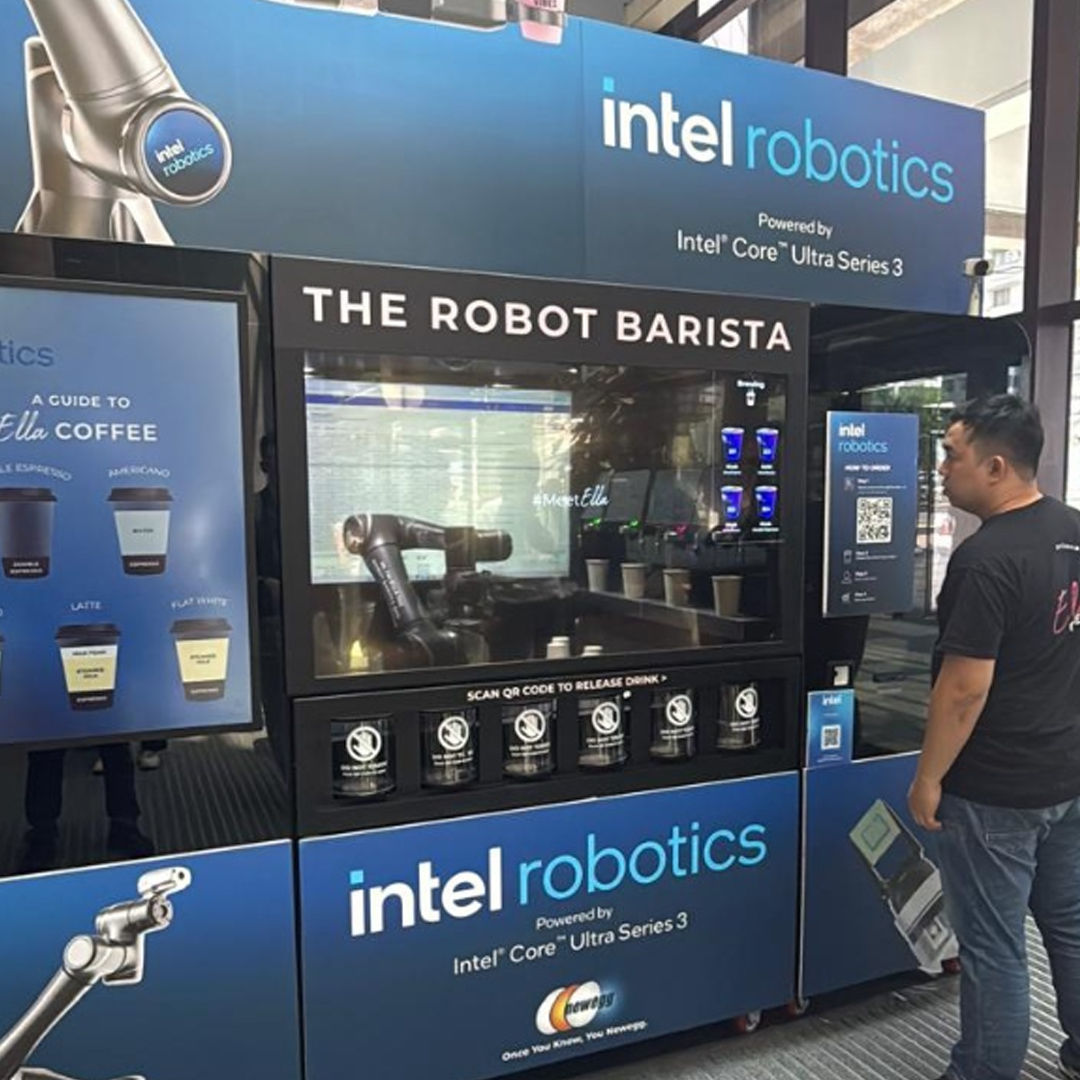
Built by Sensory AI (formerly Crown Digital), Ella has been commercially deployed for six years across airports and transit hubs in Singapore. What's new is the silicon: a single Intel Core Ultra Series 3 SoC now runs three AI agents concurrently. Avatar handles customer conversation, Guardian manages system safety, and the Ella Agent runs store-level business intelligence, all coordinated by a deterministic orchestrator commanding the robot arm. According to Intel, the previous Sensory AI setup relied on a discrete GPU that cost more than the rest of the system combined. A single Core Ultra Series 3 SoC replaced that entirely. Intel describes it as the first multi-agent Physical AI store in public commercial service. The robot arm itself has "Hi, I'm Ella the Robot Barista" printed on it. Based on the flat white we ordered, that checks out.
Pion Humanoid by Circul.us
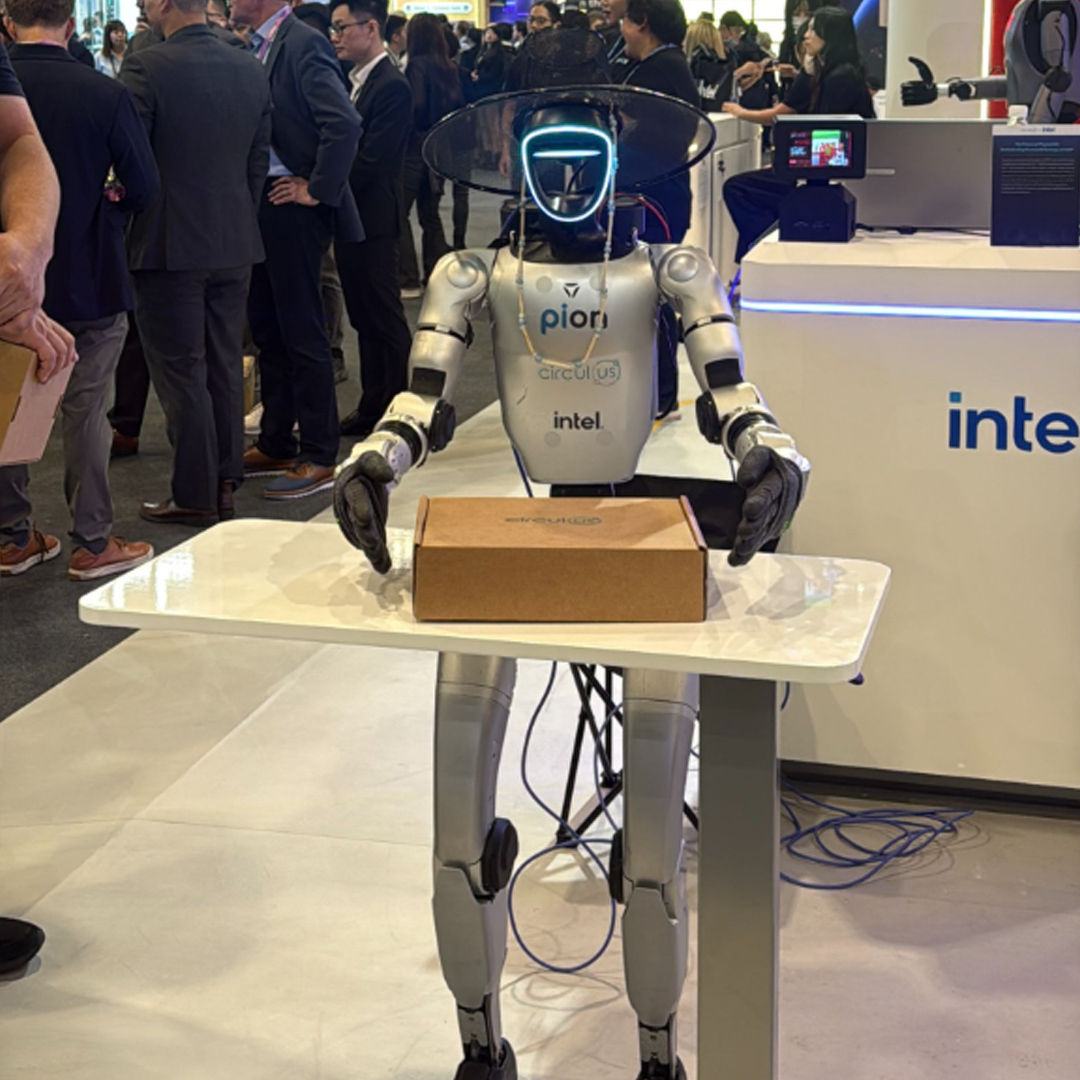
A full-body bipedal humanoid co-developed by Pion and Circul.us, dressed with a wide-brimmed hat because apparently robots can have a sense of occasion. At the demo station, it handled packages with multi-jointed gloved hands, steadily and precisely. It runs on Intel Core Ultra Series 3 for perception and motion control, with the Intel Arc Pro B70 handling heavier multimodal inference for multi-agent task execution. The same unified OpenVINO stack means the physical control loop and the AI reasoning layer talk to each other without cross-platform friction. The booth referenced global deployment readiness and mass-production targets. The robot was live, doing real tasks, on Intel's Edge AI solution.
AAEON AI-Driven PCB Inspector
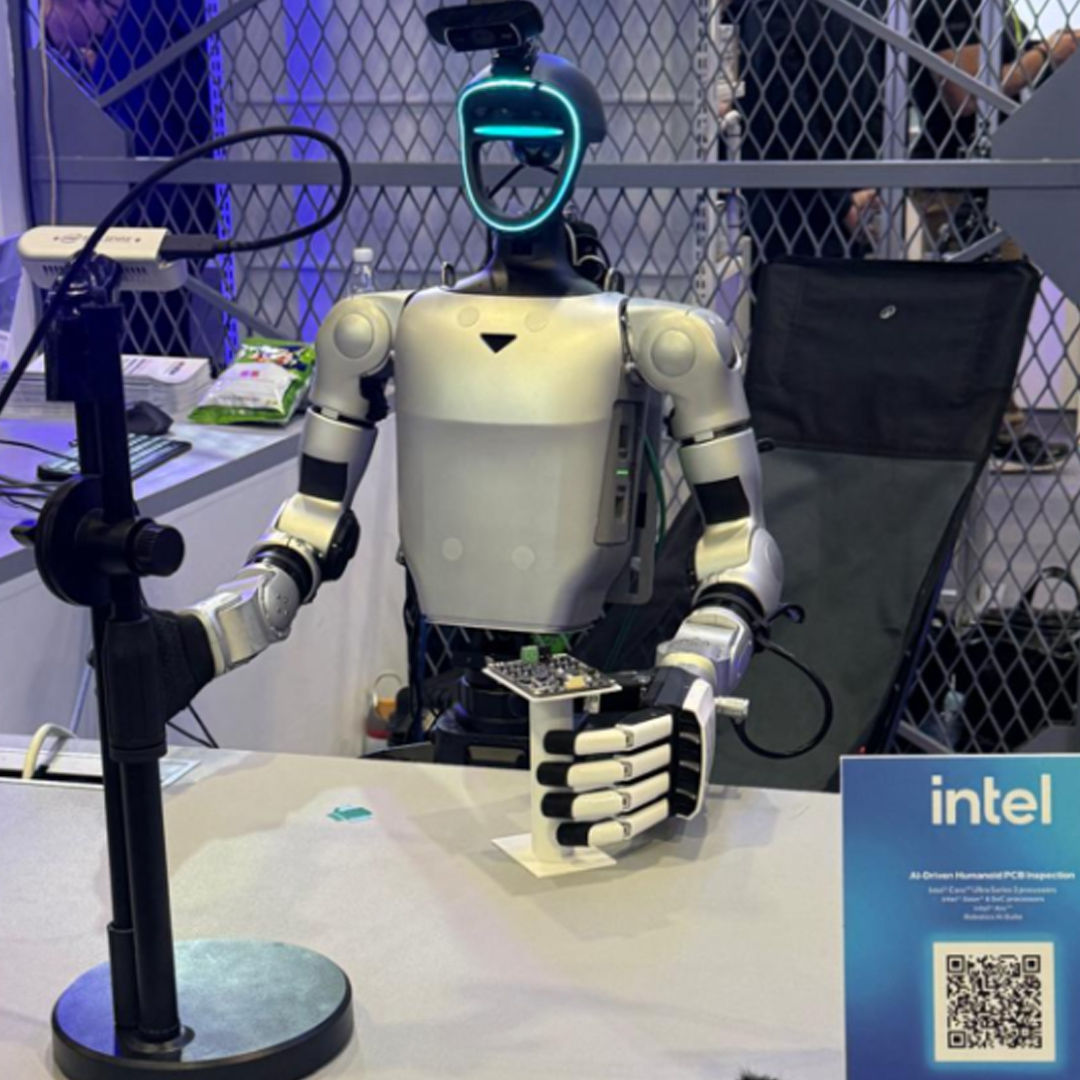
The most technically layered demo at the show. AAEON's humanoid PCB inspector runs on Intel's UP Xtreme PTL board (Panther Lake) for on-device perception, with cameras on its head and hands conducting real-time quality checks on circuit boards. Anomalies route to a second Intel Xeon 600 plus Arc Pro B70 station running an LLM-driven diagnostic agent, and from there to a third Core Ultra Series 3 edge node that converts raw data into actionable insights. Three Intel compute tiers, one OpenVINO stack connecting them. Physical AI at the robot, Agentic AI at the hub, both talking to each other without cross-vendor middleware. We watched it flag a fault, route the data, and return a diagnostic in real time.
VinRobotics VR-H3
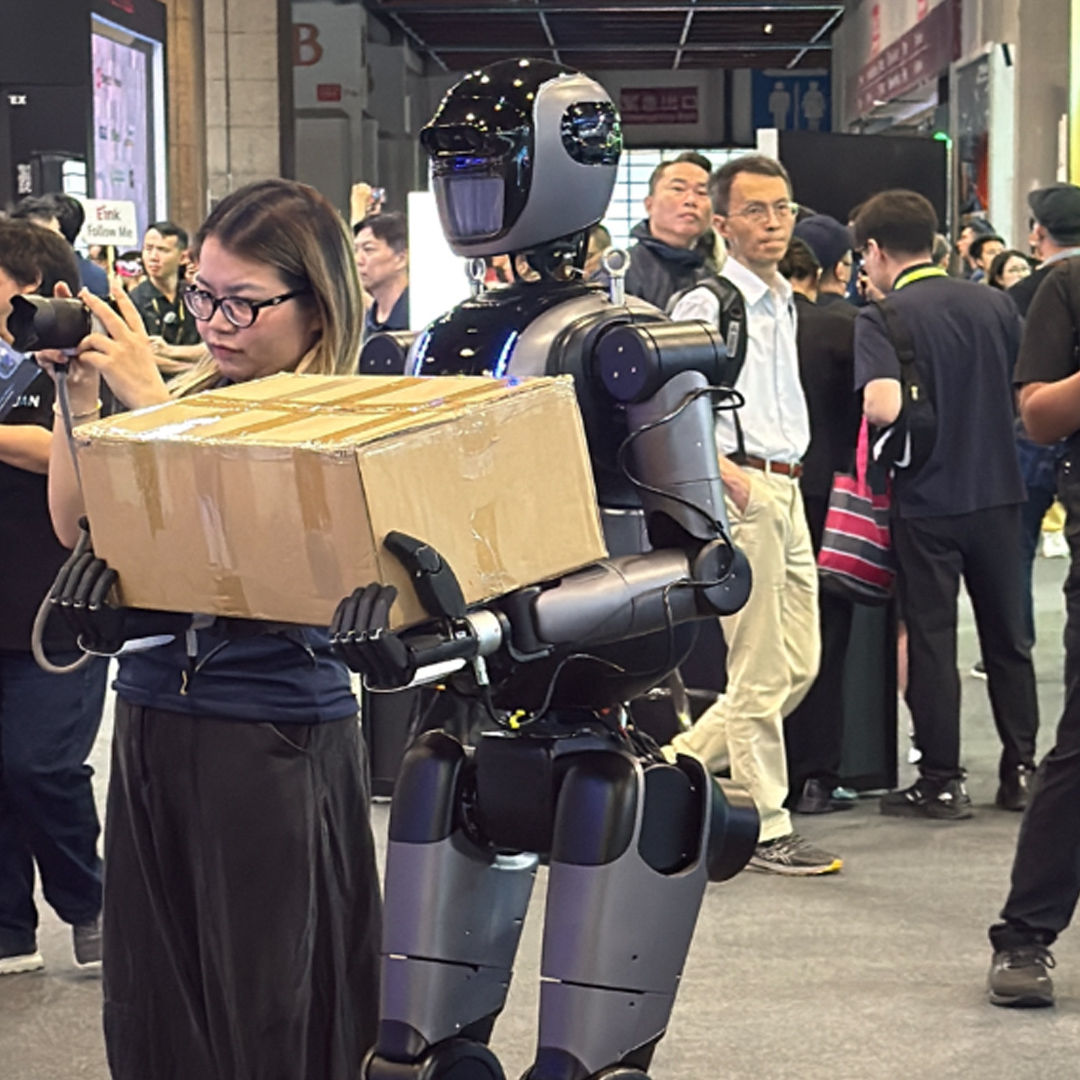
Built by VinRobotics, a Vingroup subsidiary making its global debut at Computex, the VR-H3 stopped the entire hall. This is a Vietnamese-engineered third-generation humanoid, and it wasn't standing at a demo station. It walked bipedally through the crowded exhibition floor, carrying a cardboard box in both hands, navigating past camera crews and attendees, smooth and unhesitating. The motion quality was striking: stable, natural, purposeful. Its RL-powered whole-body control stack, trained sim-to-real, delivered the kind of balance and coordination that draws a crowd and keeps it. VinRobotics exhibited inside Intel's "Robotics and Edge AI, Powered by Intel" pavilion. We're not specifying the internal chip. What we can say is that it was the most compelling physical AI demonstration on the floor all week.
Intel’s Edge Is Real. So Is the Competition
Intel's vision for robotics is holistic, and it showed. A single silicon family, one open-source inference runtime, and a scalable software stack that takes the integration burden off the robot builders, letting them focus on what they're actually good at: the mechatronics, the mechanical design, the sensor fusion, the actuator systems that make a robot actually work in the physical world. That's the right pitch. And at Computex 2026, for the first time, it was backed by robots that were real, running, and doing things that matter.
The competition is serious. NVIDIA's Isaac GR00T ecosystem has 2 million developers and a humanoid reference design backed by Stanford and ETH Zurich. Qualcomm's Dragonwing IQ10 makes the same full-stack pitch with proven power efficiency credentials. Intel's edge is cost, openness, and the CPU-native agentic AI advantage as the industry shifts away from discrete GPU dependence. Whether that edge holds as the market matures is the real question.
But right now, in June 2026, on the show floor in Taipei? The robots were there. The stack was real. And the coffee was genuinely good.