When I first got a taste of NVIDIA’s RTX Spark platform at Computex 2026 in Taipei, Jensen Huang had just unveiled it and NVIDIA was showing us pre-production laptops during an RTX Spark Walkthrough session. I came away impressed, but also puzzled. Blackwell graphics, a Grace CPU, vast unified memory capacity and the ability to run large AI models locally sounded more like workstation specifications than something intended for a backpack. As a conventional Windows laptop, it seemed almost excessive. I understood why the engineering was impressive; I wasn’t yet convinced why an individual needed that much compute.
NVIDIA’s RTX Spark Editors Day in San Francisco, just ahead of the first laptops reaching customers, made the reason clearer. The hardware wasn’t designed simply to shorten rendering times or improve game performance. NVIDIA is betting that the next generation of software will demand much more from a personal computer because increasingly capable AI agents will perform tasks that users previously handled themselves. That shift, from operating tools to directing work, changed how I understood RTX Spark.
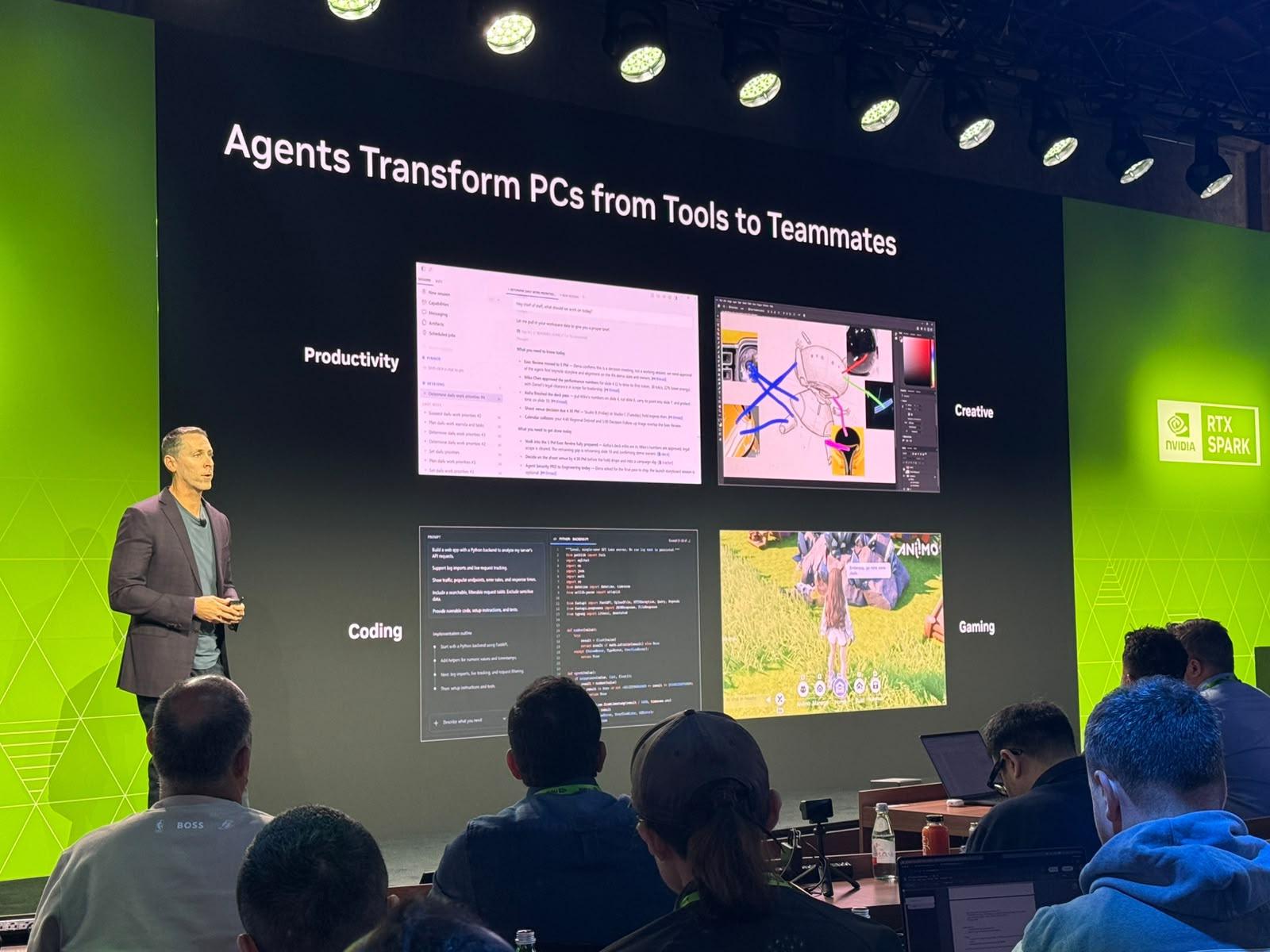
NVIDIA’s vision is centred on private AI agents that can run locally, work with our files and use applications on our behalf. Rather than opening several programs, moving assets between them and manually executing every step, we could increasingly describe the result we want and review what the agents produce. I don’t believe traditional application interfaces are about to disappear; precise editing, debugging and creative judgement will still demand direct control. But agents could take over a meaningful share of the routine work between those decisions.
The hardware makes that vision more credible. Blackwell is also the architecture behind NVIDIA’s large AI installations, although the N1X is emphatically not a data-centre accelerator repackaged as a laptop chip. It brings fifth-generation Tensor Cores, the CUDA software ecosystem, an Arm-based Grace CPU and a large pool of unified memory to Windows. In the full configuration, that means 6,144 CUDA cores, a claimed one petaflop of NVFP4 AI compute and up to 128GB of memory. What impressed me in San Francisco was less the headline specification than how those resources could change which AI workloads are practical on a personal computer.
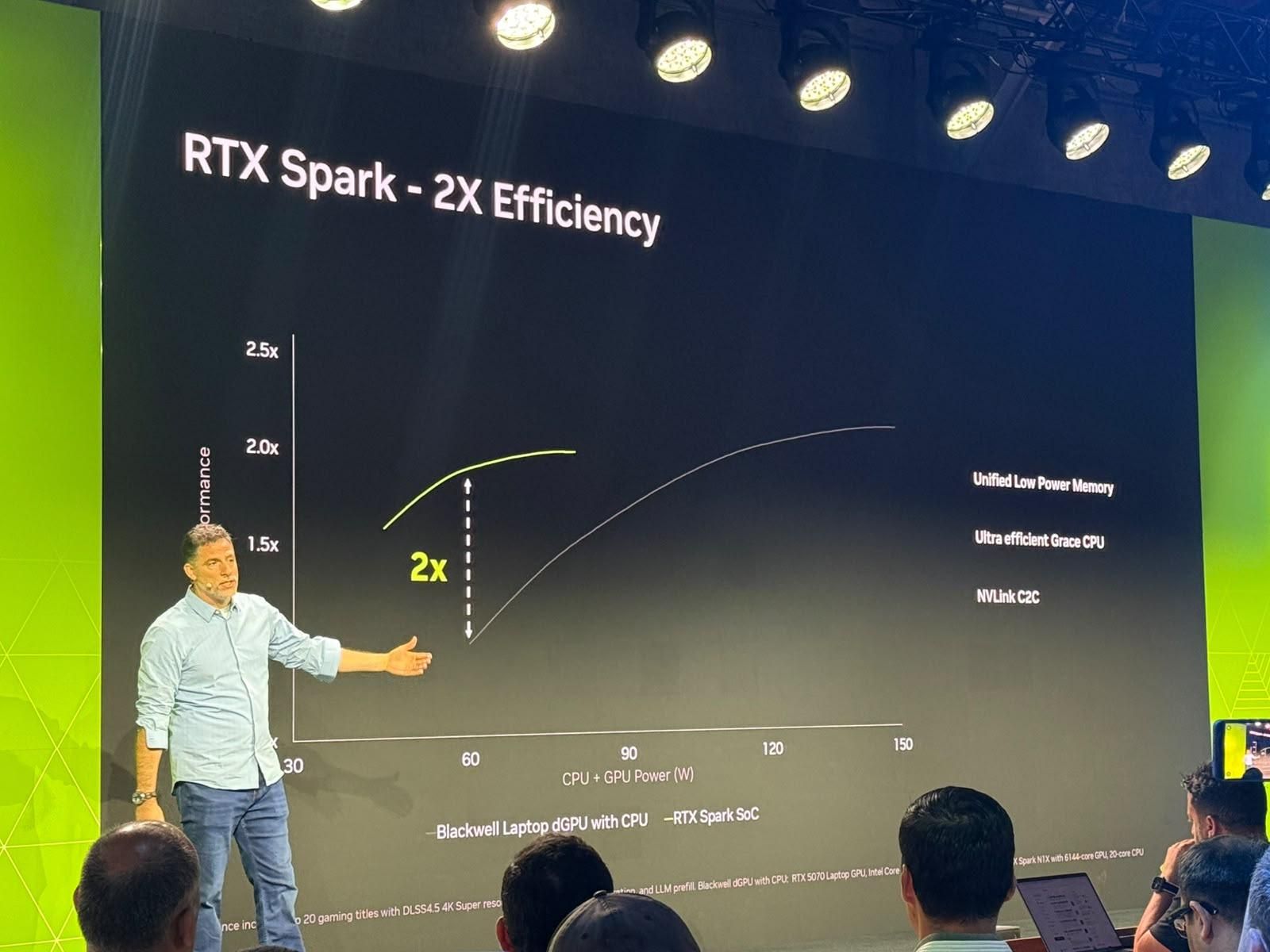
This is not an AI-only machine. NVIDIA also promises serious 1440p gaming, RTX creator acceleration and approximately twice the efficiency of a laptop pairing an RTX 5070 Laptop GPU with an Intel processor in its selected tests. It showed near-plugged-in performance on battery across several workloads. Those claims still require testing on shipping devices, but they explain the appeal of combining a capable gaming laptop, mobile workstation and everyday thin-and-light computer. Just as important, NVIDIA has put its RTX and CUDA stack on Windows running an Arm CPU, giving Microsoft and its OEM partners a more credible high-performance response to the MacBook Pro.
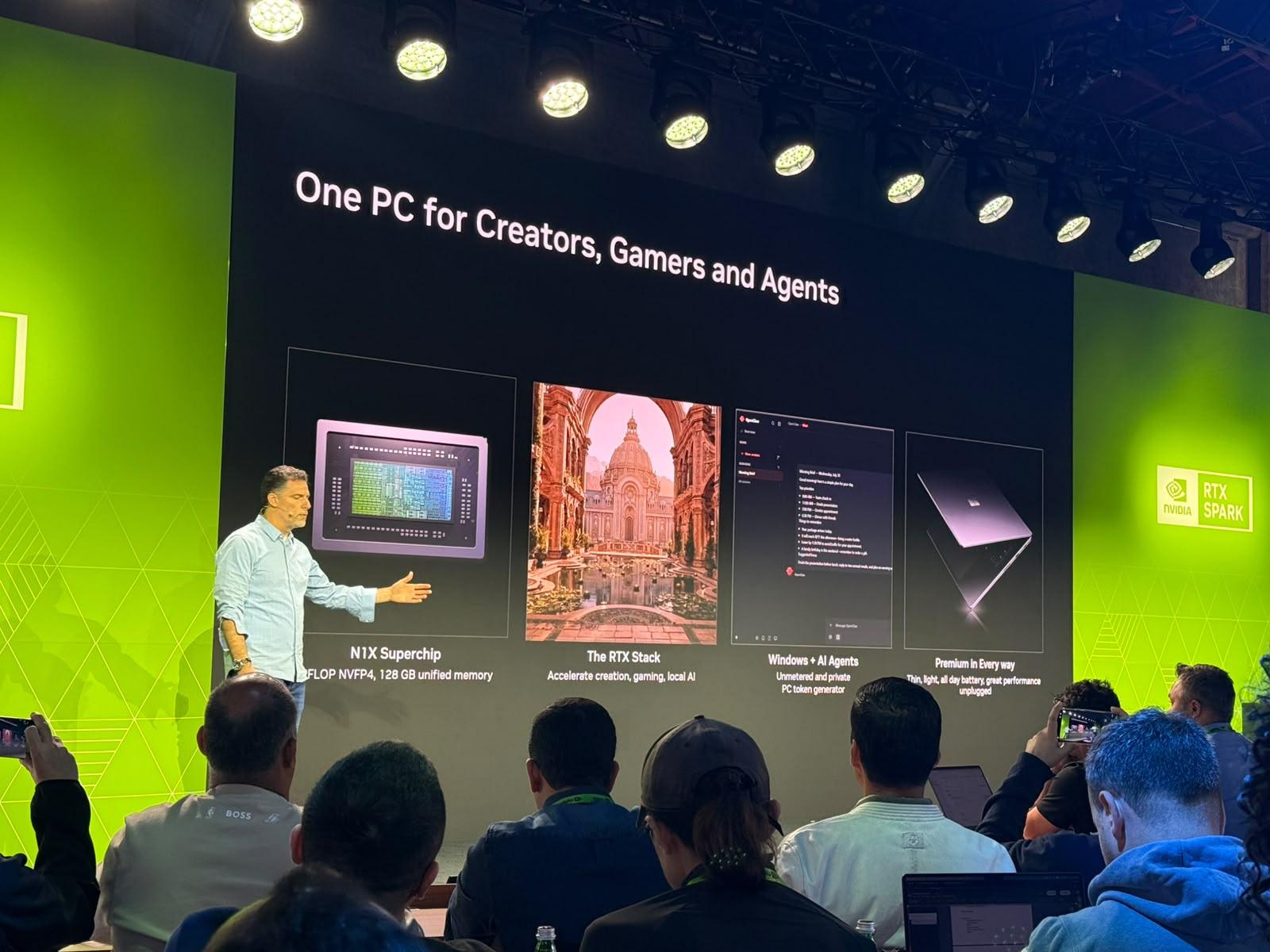
The opportunity comes with two serious qualifications. RTX Spark starts at $2,599, and the most capable configurations cost far more; for ordinary office work, this is difficult hardware to justify. Its natural audience is developers, creators and AI practitioners whose workloads already strain conventional laptops. And Windows on Arm must be more than a good demonstration: native applications, Prism’s x86 translation, drivers and gaming anti-cheat support all need to work reliably. NVIDIA has a compelling answer to the hardware question. Whether Microsoft and the wider software industry can remove the remaining friction will decide if this becomes a successful PC platform rather than an impressive niche product.
The Platform Architecture: Inside the N1X Superchip
Every RTX Spark device uses the N1X, which NVIDIA calls a superchip and presents, with Microsoft, as part of a broader effort to expand what Windows PCs can do. At his GTC Taipei keynote, Jensen Huang said the N1X is manufactured on TSMC’s 3nm process and contains approximately 70 billion transistors. That gives some perspective to the scale of processing capability NVIDIA has integrated into a laptop chip. The N1X is built from two tiles: a Blackwell GPU tile, and a CPU, I/O and memory tile custom-built with MediaTek. The two are linked by NVLink Chip-to-Chip (C2C), a technology NVIDIA also uses in its Grace-based data centre systems, rated at 600 GB/s with full coherency. This lets the CPU and GPU share a consistent view of one memory pool, rather than relying on separate system RAM and discrete GPU memory. The 600 GB/s figure describes the interconnect, not the memory’s own bandwidth.
The GPU tile carries 6,144 CUDA cores in the top configuration, fifth-generation Tensor Cores with a claimed peak of one petaflop of NVFP4 AI performance, fourth-generation RT Cores with twice the ray-triangle intersection rate, and 24 MB of L2 cache. One petaflop sounds like a supercomputer specification, but it is peak compute in NVIDIA’s 4-bit NVFP4 format on compatible AI operations, not general-purpose performance. The tile also houses the Blackwell video engine, with native 4:2:2 encode and decode, AV1 UHQ and twice the H.264 decode throughput. That matters to creators, because 4:2:2 is the format many professional cameras record in, and native support for it has long been a sore point on Windows laptops.
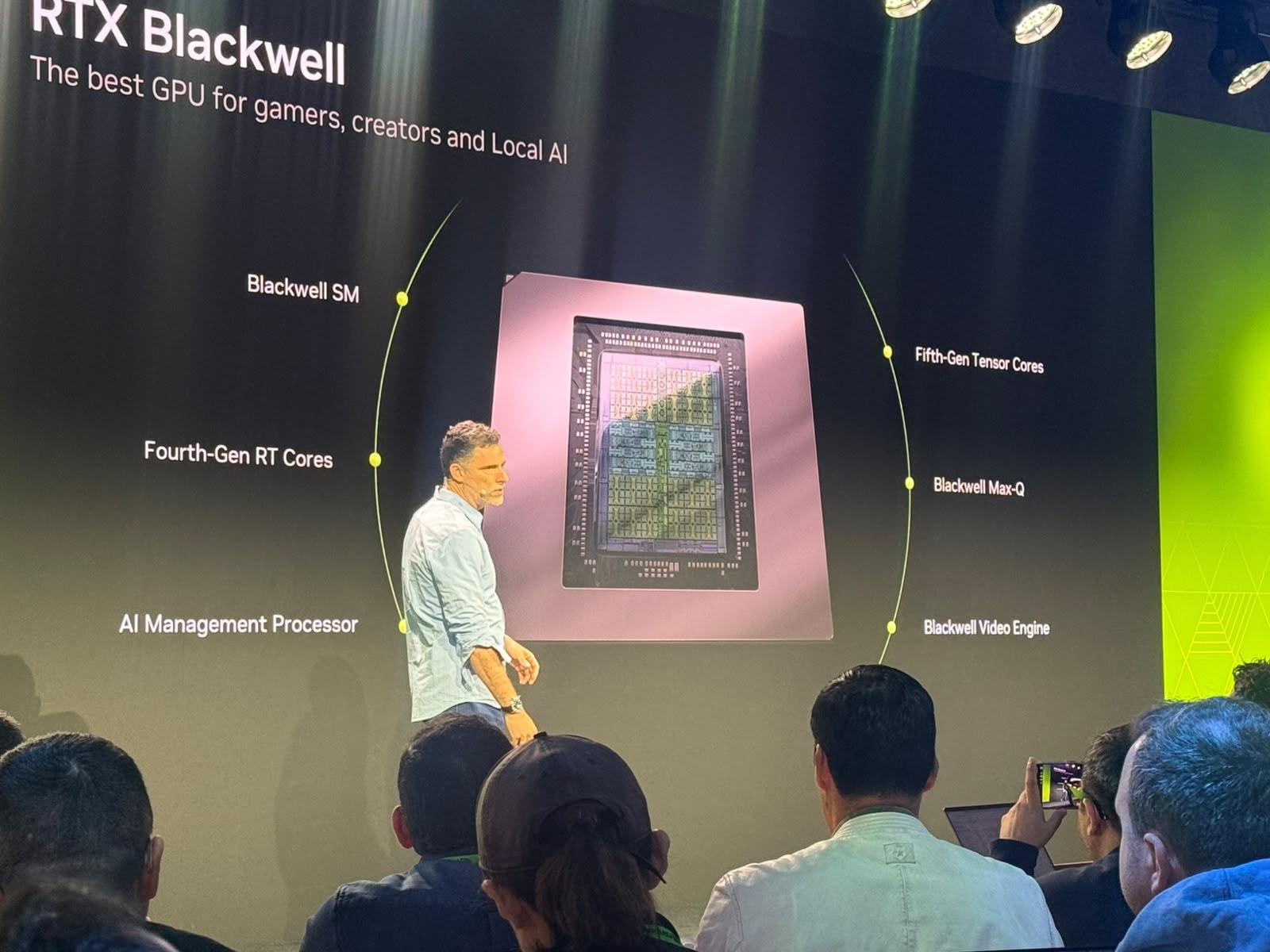
The connection to NVIDIA’s AI servers is architectural, not a claim of equivalent performance. Data-centre Blackwell accelerators use different silicon and high-bandwidth memory and operate in installations that link many GPUs for training and serving frontier models. RTX Spark cannot do that work at the same scale. But NVIDIA demonstrated a 125-billion-parameter mixture-of-experts model running locally and positioned well-equipped N1X systems as able to accommodate models of roughly 200 billion parameters under suitable quantisation and memory conditions. The important advance is that a class of inference workloads once associated with remote GPU machines can now be attempted on a Windows laptop—though fitting a model in memory does not guarantee fast responses.
The second tile houses a 20-core Grace CPU with ten performance and ten efficiency cores, an NPU, and the platform’s I/O: PCIe Gen 5, up to four USB4 ports at 40Gbps, MediaTek Wi-Fi 7, HDMI 2.1a and DisplayPort 2.0, with each manufacturer deciding which ports to expose. Its memory interface supports up to 128GB of LPDDR5X unified memory at about 300 GB/s of bandwidth.
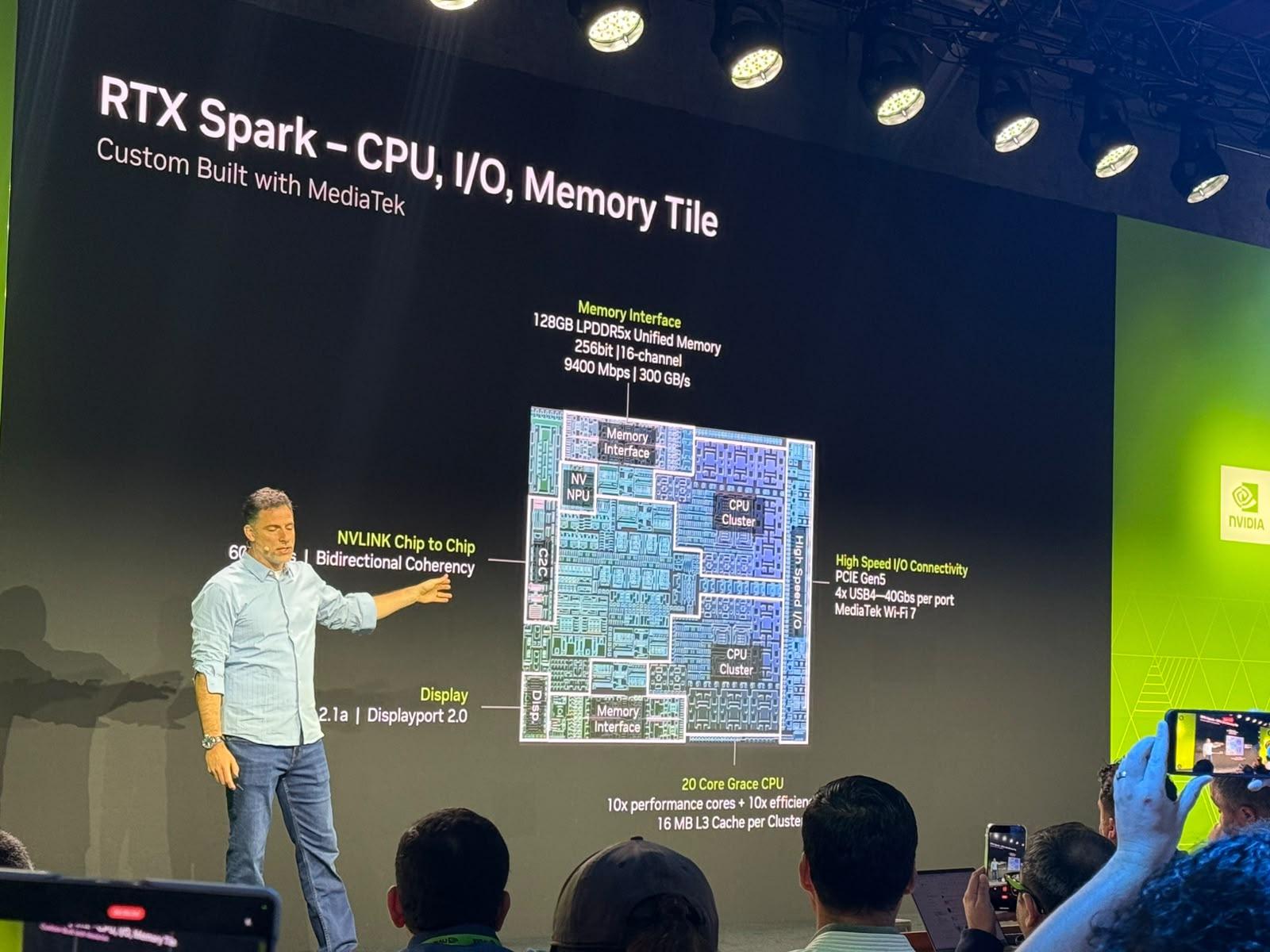
Unified memory is the N1X’s most consequential design choice. NVIDIA contrasts its 128GB shared pool with the 8GB of dedicated VRAM in Dell’s previous RTX 4070-powered XPS 16, using an illustrative 16-billion-parameter local-model limit for the older system. That is not a universal ceiling: quantisation and CPU offloading change what is possible. Still, much greater addressable GPU memory helps with large models, complex 3D scenes and high-resolution creative projects. The compromise is bandwidth. At approximately 300GB/s, the LPDDR5X pool offers far less raw bandwidth than the GDDR7 on a high-end discrete GPU, which can limit token-generation speed. This is a design optimised for memory capacity and efficiency, not an outright replacement for the fastest discrete GPUs. NVIDIA supports it with the established CUDA, TensorRT, DLSS, Reflex and G-SYNC software stack.
NVIDIA showed two configurations of the N1X, sold across memory tiers from 24GB to 128GB.
| Configuration | GPU cores | CPU cores | Memory | NVIDIA’s positioning |
|---|---|---|---|---|
| RTX Spark N1X (laptop) | 5,120 | 18 | 24GB / 32GB tiers | RTX gaming and content creation; agents using cloud models |
| RTX Spark N1X (laptop) | 6,144 | 20 | Scales up to 128GB | Lower tiers for gaming, creation and cloud agents; higher tiers for local-model agents, large 3D scenes and image/video generation |
| RTX Spark N1X (compact desktop) | 6,144 | 20 | Up to 128GB | Always-on intelligence, gaming and creation, large 3D scenes, local agents, image/video generation |
For local AI buyers, memory may matter more than the CUDA-core headline. A 24GB machine can be an excellent gaming and creative laptop, but the larger models and longer-running agent workflows shown at Editors Day require careful choices about memory, quantisation and software support. NVIDIA’s 128GB demos should not be mistaken for entry-level capabilities.
Performance and Efficiency: What NVIDIA Promises
NVIDIA’s most interesting performance argument concerns what can be done within a laptop’s power and memory limits, not simply which processor wins a benchmark. Its chart plots available memory against CPU-plus-GPU power and positions RTX Spark where selected large-model and rendering workloads fit in memory at much lower system power than conventional GPU configurations. The chart is not proof that an N1X executes those workloads as quickly as an RTX PRO 6000. Loading a model and generating useful results at a competitive speed are different achievements, and all the figures in this section come from NVIDIA’s own tests.
For a portable PC, the efficiency and unplugged-performance results are potentially more important than the peak performance multipliers. Against an RTX 5070 Laptop GPU paired with an Intel Core Ultra 9 285H, NVIDIA claims approximately twice the efficiency in a chosen mix of games and LLM prefill. It also shows battery performance remaining close to AC performance in selected gaming, Blender, DaVinci Resolve and ComfyUI tests. The figures do not tell us battery life under sustained AI inference, thermal behaviour in a 1.5kg chassis or how much performance individual OEMs will allow. Those are the measurements that will determine whether RTX Spark actually changes how professionals use their laptops away from a desk.
A separate chart compares RTX Spark with other integrated processors: Intel’s Core Ultra 9 386H, Intel’s Core Ultra X9 388H and AMD’s Ryzen AI Max+ 395.
| Workload | N1X advantage |
|---|---|
| 007 First Light | 3.7x |
| DOOM: The Dark Ages | 3.1x |
| Black Myth: Wukong | 3.0x |
| Blender rendering | 3.5x |
| Flux 2 image generation | 4.4x |
| LTX 2.5 video generation | 4.0x |
| Local agent, Qwen 3.8 27B | 4.6x |
| Local agent, Qwen 3.6 35B-A3B | 4.0x |
| Unsloth fine-tuning | 2.7x |
Gaming results used 1440p with the upscaling and frame-generation options available to each platform. The local-agent and fine-tuning figures use the Core Ultra X9 388H as the reference, while some competitors are marked as unable to complete the larger workloads. That makes these results as much a demonstration of memory capacity and software support as of speed; they should not be read as universal acceleration across Windows applications.
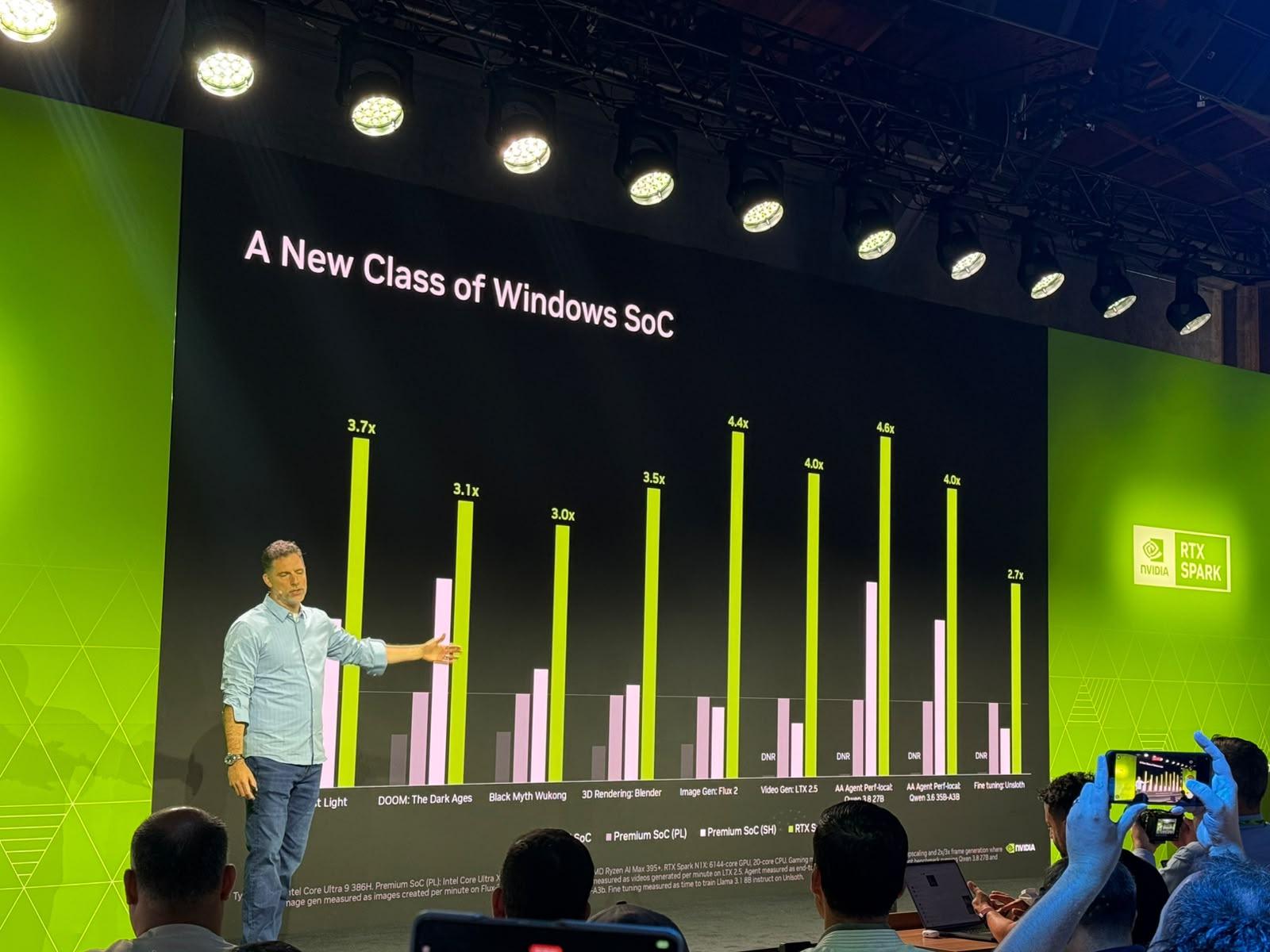
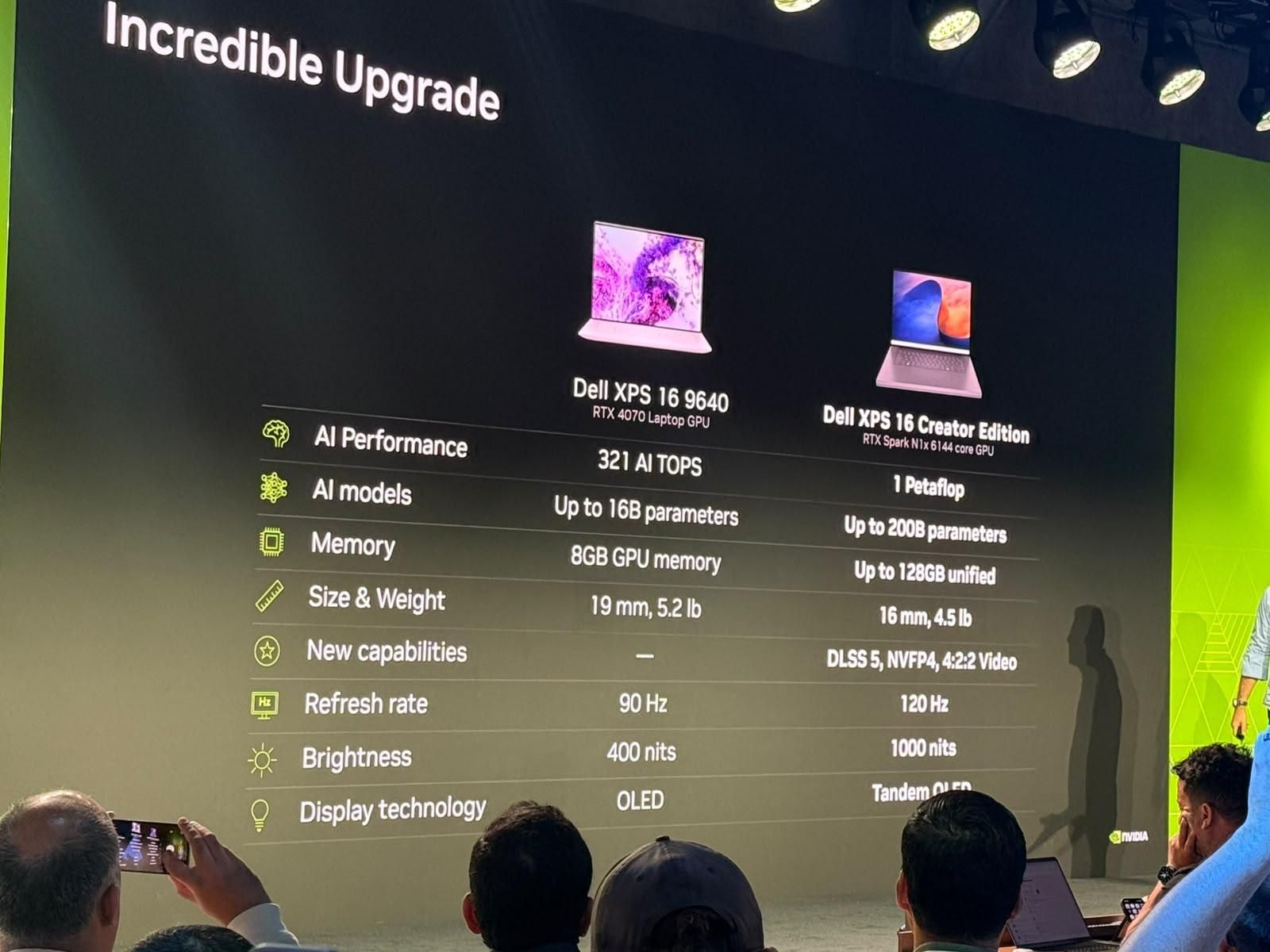
NVIDIA also compares Dell’s earlier XPS 16 9640 with the new XPS 16 Creator Edition.
| Dell XPS 16 9640 | Dell XPS 16 Creator Edition | |
|---|---|---|
| GPU | RTX 4070 Laptop GPU | RTX Spark N1X, 6,144-core GPU |
| AI performance | 321 AI TOPS | 1 petaflop |
| Largest AI models | Up to 16B parameters | Up to 200B parameters |
| Memory | 8GB GPU memory | Up to 128GB unified |
| Thickness / weight | 19 mm, 5.2 lb | 16 mm, 4.5 lb |
| New capabilities | — | DLSS 5, NVFP4, 4:2:2 video |
| Display | 90 Hz OLED, 400 nits | 120 Hz Tandem OLED, 1,000 nits |
The new machine is thinner and lighter, with far more memory available to GPU workloads. The 321 TOPS and one-petaflop figures use different AI-compute metrics, though, so they shouldn’t be read as the new XPS being three times faster across the board.
That is why I find the performance-per-watt argument more persuasive than any single multiplier. If a thin notebook can sustain useful GPU and AI throughput on battery without excessive heat or fan noise, it changes where demanding work can happen. NVIDIA has demonstrated the potential; independent reviews now need to show what the experience is like after an hour of use, not just during a benchmark run.
The Big Play: High Performance On-Device Local Agentic AI
Jason Paul, NVIDIA’s Vice President for Local AI and Gaming Platform, framed 2026 as the year of local agents. His evidence included OpenClaw reaching 391,000 GitHub stars by late September and Hugging Face downloads of local-sized models increasing about fivefold to 1.68 billion. Those figures show intense interest, not that autonomous agents are already reliable enough to replace conventional workflows. The more substantial change is model capability: NVIDIA’s slide places leading local models at 40 on the Artificial Analysis Intelligence Index, against 46 for open-source cloud models and 58 for proprietary cloud models at the upper end of its comparison.
NVIDIA’s agent design combines an LLM with a controlled cycle of reasoning, action, evaluation and tool use. Agents can access local applications, files, web search and connected services, giving them a practical route from a user’s instruction to a finished task. Local execution may keep sensitive work on the device, avoid network delays for some operations and reduce cloud API bills. But privacy is not automatic when an agent uses web tools or cloud connectors, and removing token charges does not remove hardware and electricity costs. The value depends on how reliably an agent completes work, not how many steps it can attempt.
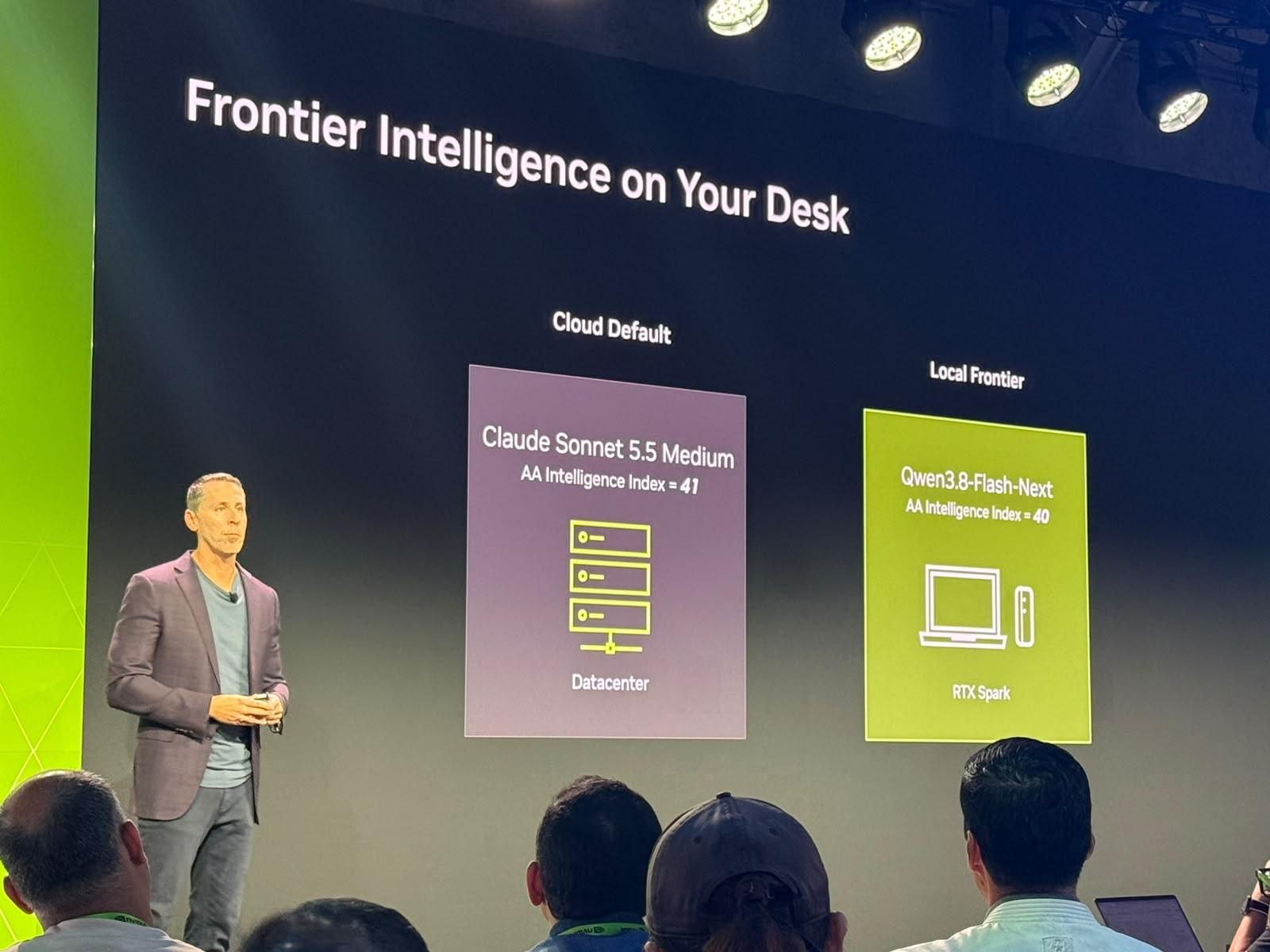
NVIDIA demonstrated Qwen 3.8 Flash-Next, a 125-billion-parameter mixture-of-experts model, running locally. It gives the model a score of 40 on the Artificial Analysis Intelligence Index, versus 41 for the selected Claude Opus 4.7 Max and Claude Sonnet 5.5 Medium comparisons. A one-point gap on one benchmark is not a declaration of general parity with cloud frontier models, but it is evidence that powerful inference no longer has to be exclusively remote.
NVIDIA’s cost example is provocative: a small-form-factor RTX Spark desktop, averaging an assumed 200W and running Qwen 3.8 Flash-Next through llama.cpp, could produce about 61 million output tokens per month for roughly $20 in electricity, compared with about $1,200 in Claude Sonnet 5.5 Medium API fees. The calculation assumes approximately 19.8 hours of daily processing, electricity at $0.18/kWh and excludes hardware costs; it is not a laptop battery or total-cost-of-ownership estimate. Even with those limitations, it shows why sustained local inference may appeal to developers and heavy agent users.
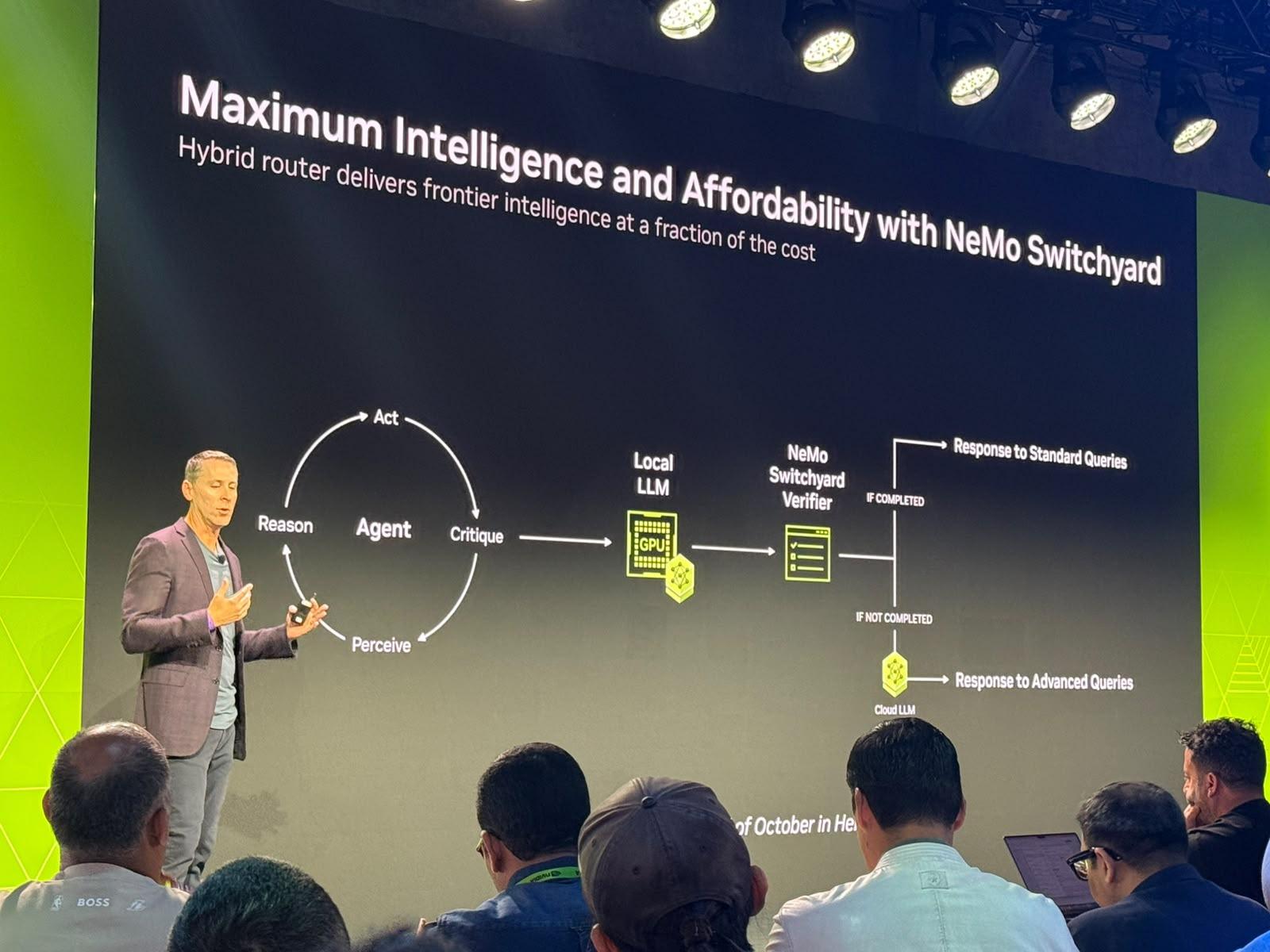
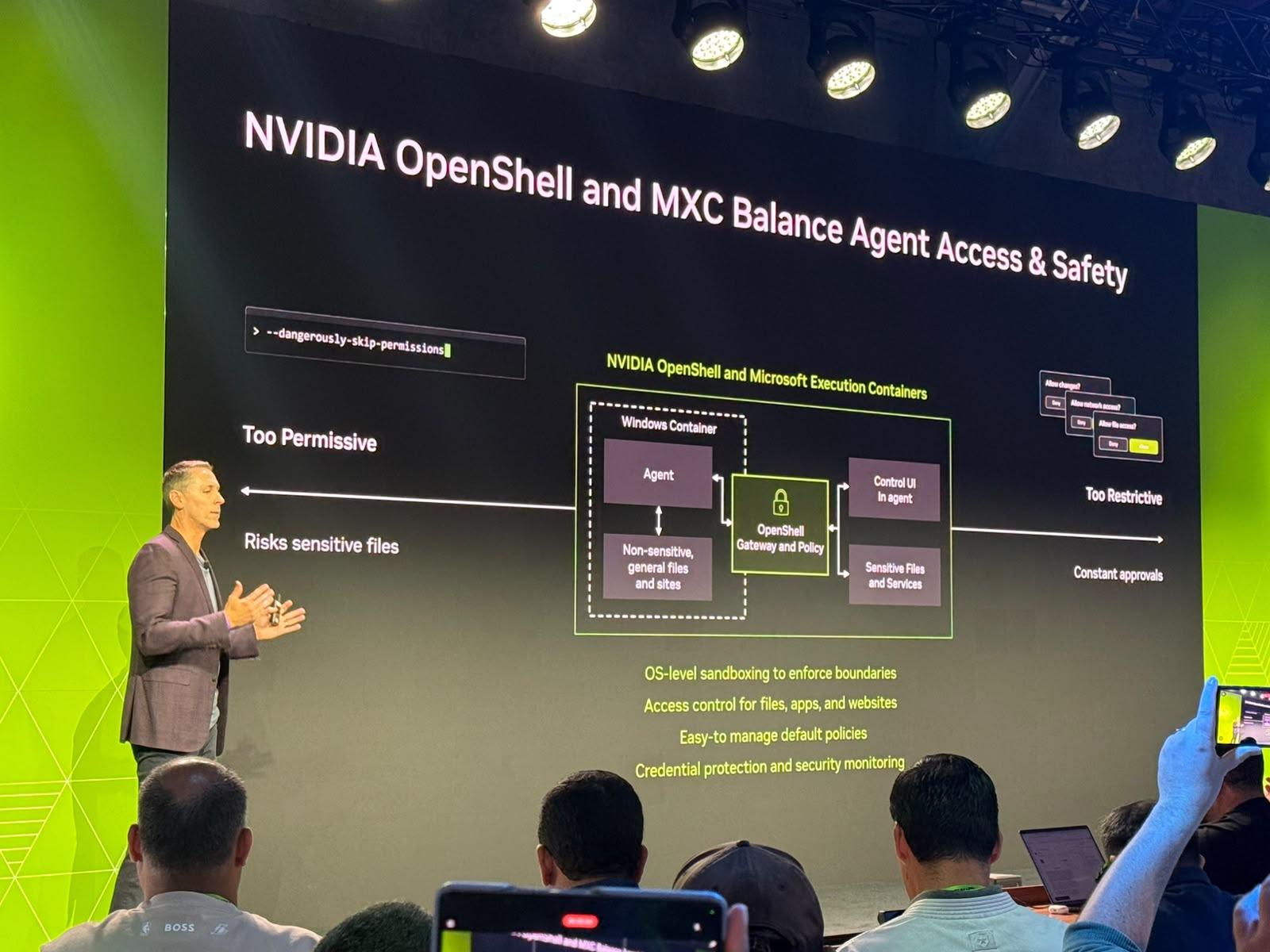
NVIDIA is also preparing a hybrid alternative. NeMo Switchyard is designed to attempt tasks locally, verify whether they were completed and route unresolved requests to a cloud model, with a Hermes beta expected at the end of October. More difficult is security. NVIDIA’s contrast between unrestricted agent access and endless approval prompts was one of the more useful parts of the briefing: neither is practical. OpenShell and Microsoft Execution Containers aim to place agents in sandboxes and apply policies to sensitive files, sites and credentials. Until those controls prove dependable, local agents will need supervision, however impressive their models become.
NVIDIA lists six agent platforms optimized for RTX Spark: GitHub Copilot, Hermes, OpenClaw, Perplexity, Pi and WorkBuddy, with varying support for local execution, app access, sandboxing and hybrid routing. Their tools and MCP integrations span Office, Gmail, Slack, VS Code, Docker, Blender, Premiere Pro, ComfyUI and system actions such as file operations and browser control. Windows offers a ‘Choose your AI agent’ setup flow, while NVIDIA provides playbooks. Breadth is encouraging, but support for a tool is only the first step; what matters is whether agents use it predictably and recover gracefully when they fail.
NVIDIA also sketched an always-on RTX Spark desktop as a home AI computer, handling automation, security, maintenance alerts from sensors such as leak detectors and the family calendar. NVIDIA PAIR, the Personal AI Router, connects these devices and reached general availability on October 13. PAIR discovers devices on the local network, configures models through Ollama, LM Studio and now llama.cpp, and distributes inference to whichever machine is free, whether that’s an RTX Spark laptop, a teenager’s RTX gaming PC or even a MacBook. It is open source under Apache 2.0 and drew more than 50 community contributions in its first month.
The Developer Capability
Gerardo Delgado, NVIDIA’s Senior Director of Product for Local AI, described a shift from writing code to directing coding agents. That does not make IDEs or compilers obsolete; it changes how developers divide their time between design, implementation, testing and review. NVIDIA argues that this could make software creation accessible to far more people than today’s estimated 50 million developers. Its practical observation is more immediate: an AI developer often works across a laptop, a cloud coding API and a rented virtual machine for testing. RTX Spark aims to bring more of that activity onto one device.
RTX Spark is proposed as one machine for coding, testing and deployment. Developers can work in Windows and in Linux through WSL, run coding agents locally, and target the installed base of more than 150 million RTX PCs as well as the cloud, though real portability will still depend on a project’s dependencies and native Arm support. Against Intel’s Core Ultra X9 388H, NVIDIA claims the N1X runs a local coding agent 4.6 times faster on the Artificial Analysis AgentPerf benchmark with Qwen 3.8 27B, fine-tunes Llama 3.1 8B with Unsloth LoRA 2.7 times faster, and compiles the Linux kernel 1.8 times faster in the Phoronix Test Suite. That last result is a CPU-only test, and a meaningful win for the Grace cores.
For Windows on Arm, I found the discussion of developer tools particularly encouraging. NVIDIA pointed to a first-day PyTorch-CUDA release, Python running natively by default, support for 97% of the top 15,000 Python packages and more than 2,000 Conda packages, with day-zero support across coding agents, models from Qwen and Nemotron to Mistral and GPT-OSS, and frameworks from PyTorch, vLLM, llama.cpp and Ollama to LangChain and Hugging Face, all on the CUDA-X library stack. NVIDIA has also made CUDA-X libraries available as agent skills at github.com/nvidia/skills, allowing coding agents to use these capabilities directly rather than depending entirely on model training. Real-world compatibility will still depend on specific packages and native extensions, so Microsoft’s work on native Arm apps, WSL, Windows ML and Prism matters as much here as NVIDIA’s silicon.
Local coding agents also change the economics of repeated attempts. In a cited September 2026 preprint involving 100 hard LiveCodeBench problems, Qwen 3.8 Flash-Next scored 84% zero-shot and 93% when allowed up to ten agent turns; the selected Claude Fable 5 cloud model scored 90% zero-shot with $61 in API charges. That is not an apples-to-apples model-quality comparison: the local model was allowed several rounds of work and the cloud model was not. It does, however, demonstrate the advantage of being able to test and revise repeatedly without paying for each local model call.
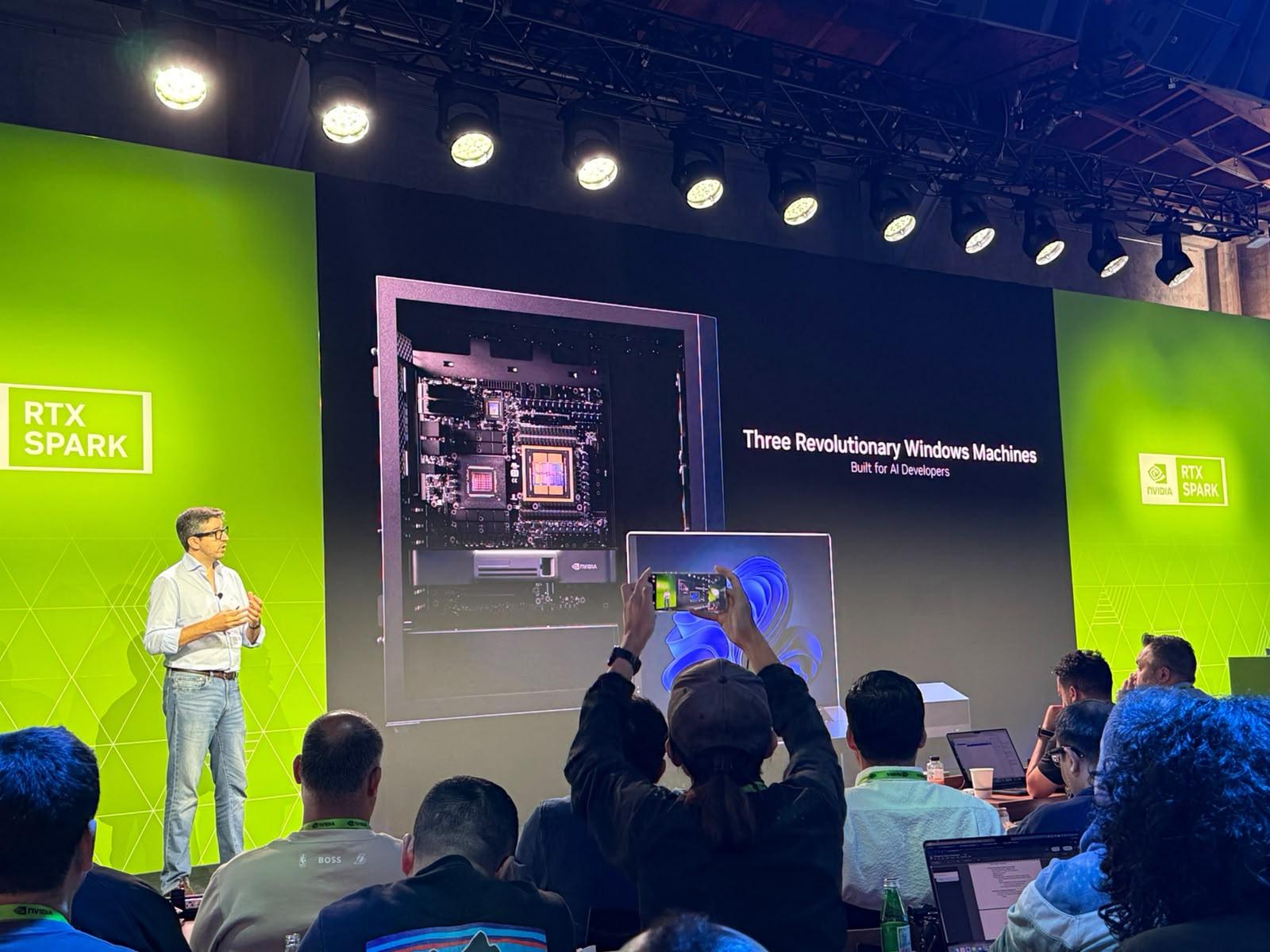
GitHub Copilot is a centrepiece of the push. On RTX Spark it runs local AI through Windows ML, routes prompts between local and cloud models, gains Microsoft’s 137-billion-parameter MAI Code 1.1 Flash model and is sandboxed with MXC. NVIDIA also showed a newer category it calls decision models, where a small model looks at the current state and directly outputs a classification, a route or a next step instead of running a full reasoning loop; its demo had the open-source Mica-v0.1-4B model making rapid moves in a falling-block puzzle game. For teams that need far more, DGX Station for Windows arrives in December with 20 petaflops of AI compute and 748GB of coherent memory, completing a family of Windows machines for AI developers that scales from a backpack to a deskside supercomputer.
The Creator Capability
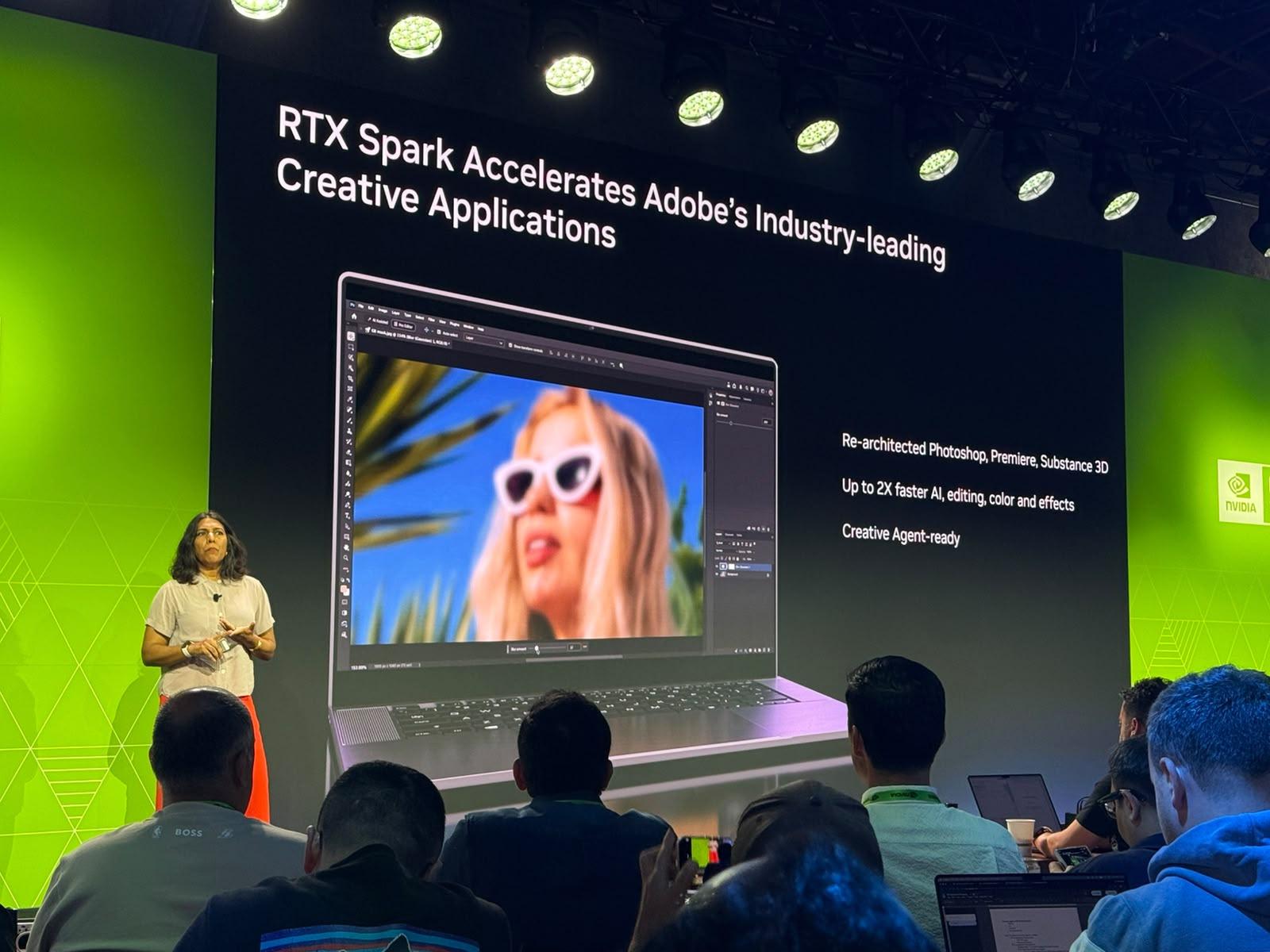
Joel Pennington, who leads product management for creative applications, placed RTX Spark at the end of a 16-year arc: GPU-accelerated media processing in the GeForce GTX era, Tensor Core AI post-processing on RTX 30-series hardware, NVFP4 generative video on RTX 50-series GPUs, and now creative agents supported by unified memory. More than 130 RTX-accelerated creative applications run on the platform, from Blender, Cinema 4D, Redshift, V-Ray and Octane to DaVinci Resolve, CapCut, OBS and Unreal Engine. The biggest partner news is Adobe, which has re-architected Photoshop, Premiere and Substance 3D for RTX Spark. NVIDIA claims up to twice the speed for AI features, editing, colour and effects, with GPU acceleration across Premiere’s audio and video workflows, Substance 3D Painter’s compute-heavy tasks and Photoshop’s compositing, all of it ready for creative agents.
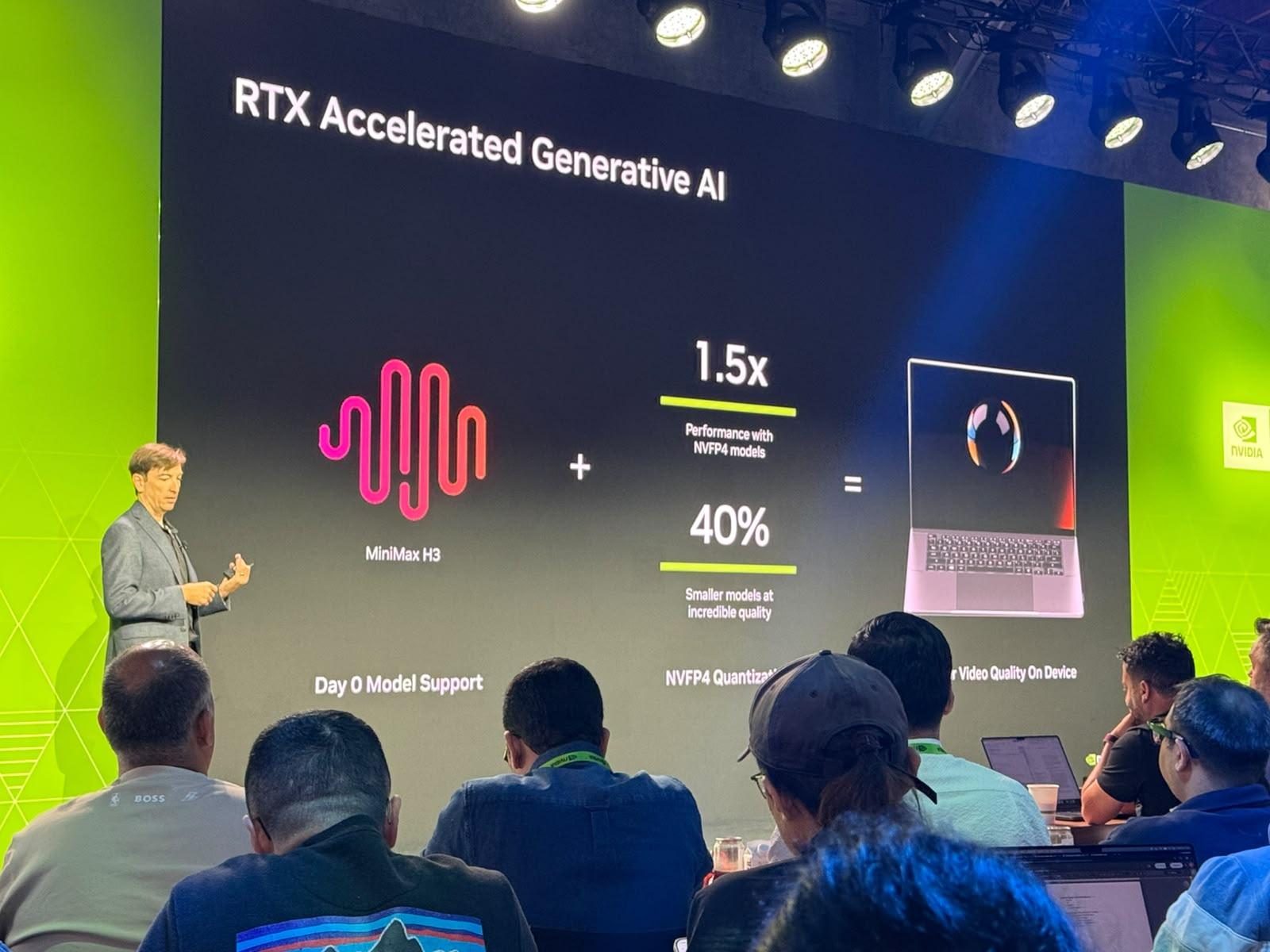
Local generative AI gets equal billing. NVIDIA promises day-zero support for new models such as MiniMax H3 and says NVFP4 quantisation delivers 1.5x the performance with models 40% smaller at comparable quality, with the goal of frontier-quality video generation on the device, including 4K 60fps video in minutes. RTX Video Frame Generation and HDR are coming to ComfyUI; in NVIDIA’s demo, a 1080p clip generated with LTX 2.5 at 30fps was shown at 60fps, with the HDR effect simulated for illustration. The new NVIDIA Broadcast, available from October 13, adds RTX Video Super Resolution, Frame Generation, Studio Voice profiles, an offline file processor and MCP support so agents can drive it, while Blender 5.3 gains DLSS 4.5 Ray Reconstruction in November. Underpinning all of it, NVIDIA says the unified memory lets RTX Spark handle native 4:2:2 video, 8K footage and massive 3D scenes that would overflow a conventional laptop GPU.
What interested me most in the creator session was the problem between applications, not the speed of an individual filter. Production routinely moves through concept work, sculpting, texturing, rigging, simulation, rendering, sound and editing. NVIDIA illustrated that full chain, then showed a narrower agent-assisted ‘turn my sketch into…’ workflow in which tools, scripts and generative AI produced a scene in under 30 minutes. It did not demonstrate an agent independently completing an entire production. The near-term opportunity is more credible: artists retain control inside familiar software while agents coordinate repetitive work across the tools.
The Gaming Capability: Blackwell Graphics, DLSS 5 and a New Arm Gaming Test
RTX Spark is also an important test of high-performance gaming on Windows on Arm. NVIDIA is bringing the full RTX stack to Spark, from ray tracing and DLSS to Reflex, G-SYNC, RTX Remix and Game Ready drivers, and says hundreds of major games are supported at launch, among them Gears of War: E-Day, AION 2, NBA 2K27, CONTROL Resonant and Aniimo, with World of Warcraft: Forever following on November 4. The catch is esports. PUBG: Battlegrounds, EA’s Javelin anti-cheat, Call of Duty, League of Legends and Valorant are all listed as coming to RTX Spark rather than available today. Announced support is not day-one compatibility, especially for titles with kernel-level anti-cheat, and gamers should check their own favourites rather than assume the Windows catalogue carries across without friction.
NVIDIA’s target is 1440p at more than 100 frames per second, and its own numbers for the full N1X clear that bar.
| Game | NVIDIA-quoted fps at 1440p |
|---|---|
| DOOM: The Dark Ages | 142 |
| Pragmata | 142 |
| 007 First Light | 137 |
| Cyberpunk 2077 | 135 |
| Gears of War: E-Day | 135 |
| Naraka: Bladepoint | 135 |
These were measured on the medium preset with ray tracing, DLSS 4.5 Balanced Super Resolution and 3x Frame Generation. For an integrated laptop platform they are notable, but they include AI-generated frames and say nothing yet about input latency, frame pacing or how the experience compares with a conventional RTX 5070 gaming laptop. That will have to be established game by game.
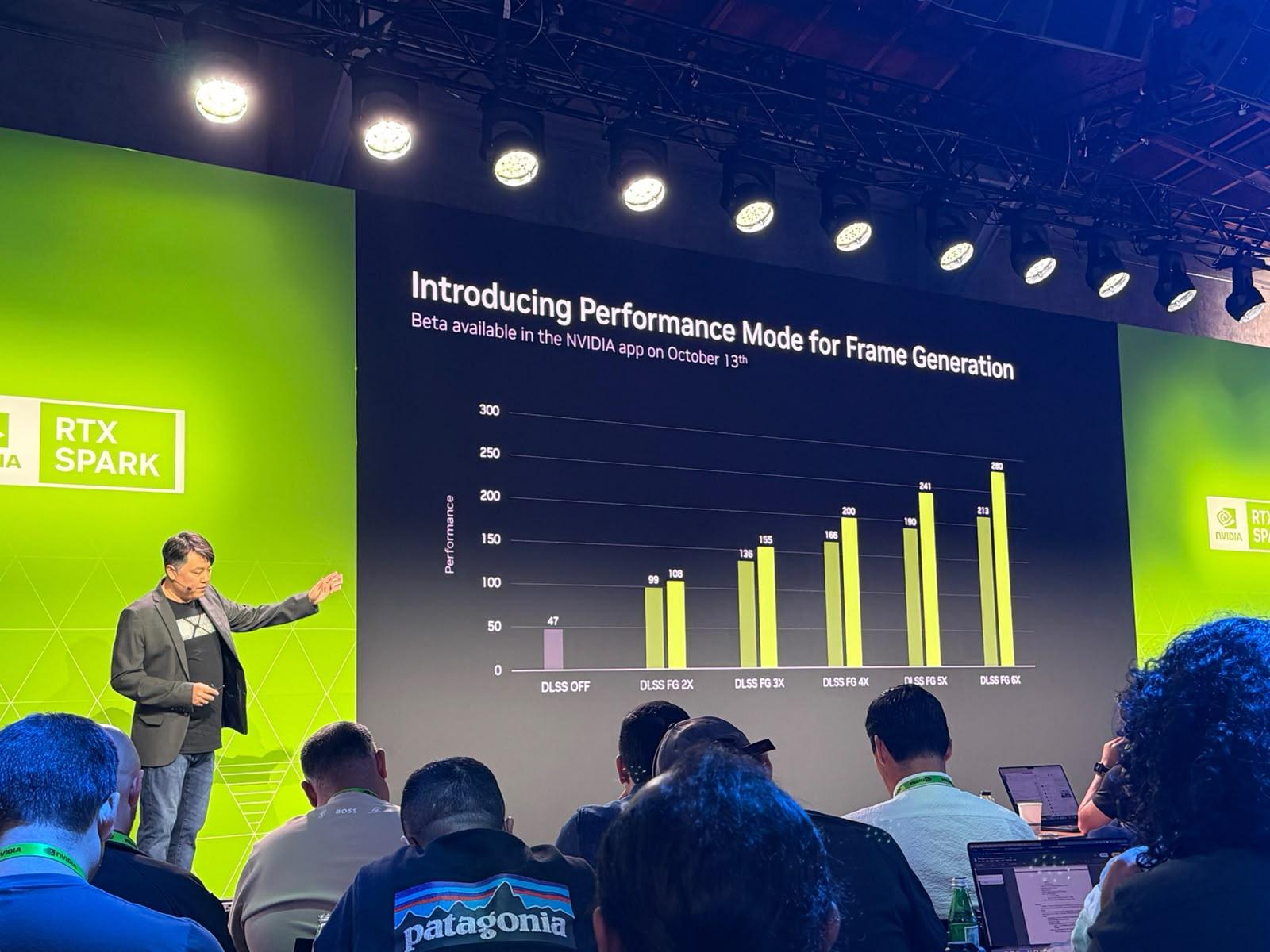
DLSS plays a major role in RTX Spark’s gaming performance. After a year that brought transformer Super Resolution, 6x Dynamic Frame Generation and second-generation Ray Reconstruction, September delivered DLSS 5, which NVIDIA calls 3D-guided neural rendering for more lifelike lighting and materials. NVIDIA is introducing two additional updates in October. From October 16, a DLSS 5 model that runs twice as fast arrives for RTX Spark and RTX 50 Series; in NBA 2K27 on an ASUS ProArt P16, NVIDIA’s slide shows 65fps with September’s model rising to 90fps with October’s. From October 13, a Performance Mode for Frame Generation is in beta in the NVIDIA app; in NVIDIA’s Cyberpunk 2077 test at 1440p with ray tracing, it lifts the 6x frame-generation result from 213fps to 280fps, on a base of 47fps with DLSS off. DLSS 5 also comes to Hogwarts Legacy on November 5 and Where Winds Meet in late November. Generated frames shouldn’t be mistaken for an equivalent gain in responsiveness, but they make games look smoother and more detailed without the same increase in rendering work.
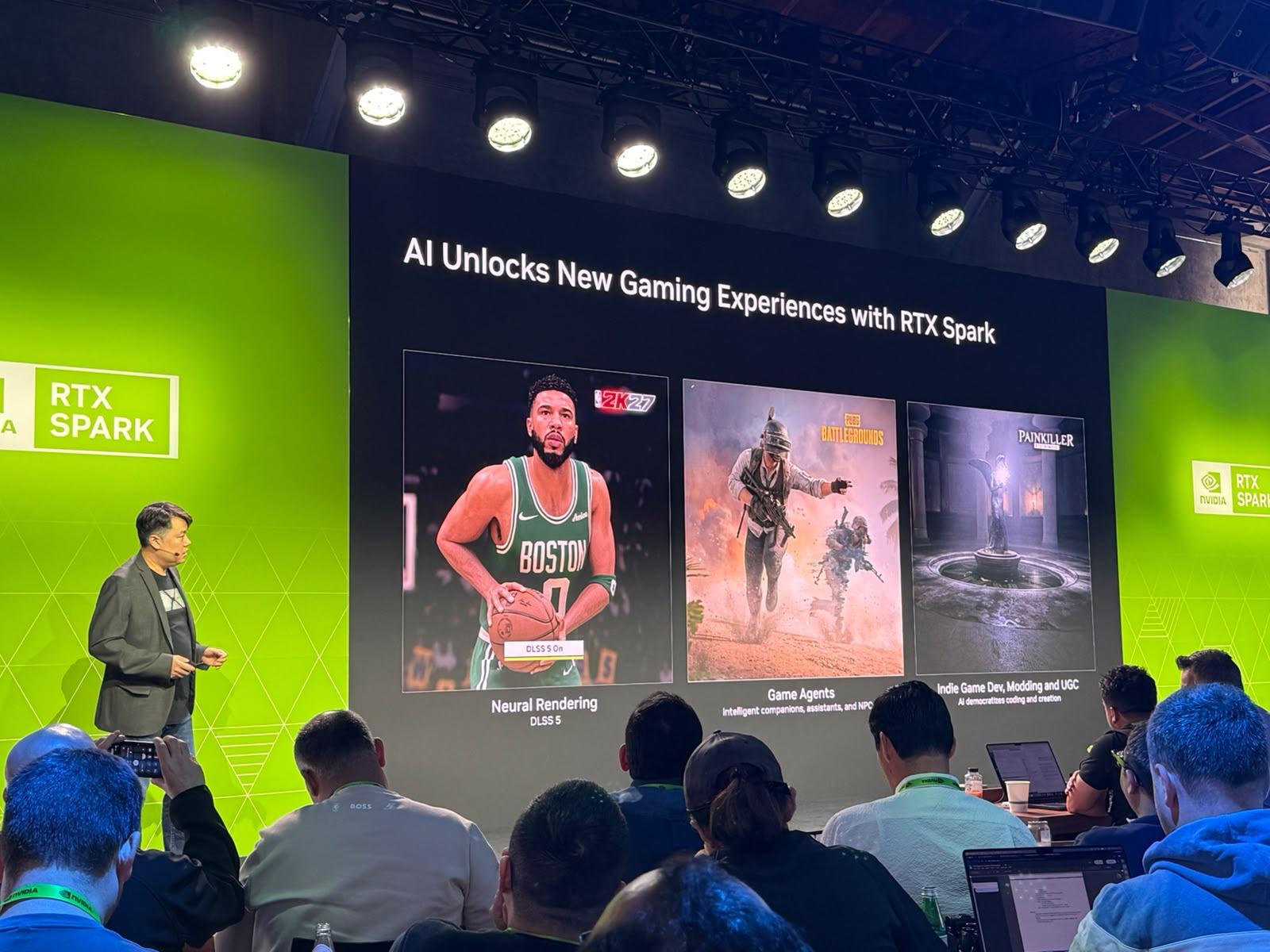
AI is changing what happens inside games too. NVIDIA ACE powers PUBG Ally, a co-playable AI teammate in PUBG: Battlegrounds, and natural conversations with your creatures in Aniimo. On October 23, NVIDIA releases Nemotron 3.5 Bolt E4B, a compact model that lets game characters hear a player, read the game context and respond with dialogue and actions. The same day brings DLSS 5 for RTX Remix and a beta Remix mod kit that adds path tracing and DLSS to existing Minecraft Java maps, joining community mods that already use local AI to power NPCs in Mount & Blade II, RimWorld and Skyrim.
My concern is compatibility rather than whether Blackwell can render attractive frames under NVIDIA’s chosen settings. Native Arm games, Prism-translated x86 titles, launchers, drivers and anti-cheat systems must function together. A professional may find a workaround for an awkward plugin; a competitive game that refuses to launch has no workaround worth discussing. NVIDIA’s benchmark charts make a credible performance case. A reliable Windows gaming library is still something the shipping laptops must prove.
RTX Spark Laptops You Can Actually Buy
RTX Spark is a platform rather than a single reference notebook. Six launch partners, ASUS, Dell, Microsoft, HP, Lenovo and MSI, have laptops from $2,599 with the first shipments on October 16, and specifications vary widely in display size, memory, cooling and form factor, from conventional creator notebooks to convertibles. The headline 6,144-core GPU, 128GB memory and thin-and-light weight figures should never be assumed to apply to every model on sale.
ASUS targets creators with the ProArt P14 and P16. The P14 is a 14-inch machine weighing about 1.48kg and measuring 15.9mm thick, with a 3K Lumina Pro OLED display and a starting price of $2,599.99. The 16-inch P16 has a 4K panel, weighs approximately 1.77kg and starts at $2,799.99; it was also used for NVIDIA’s gaming demonstrations. Both can be configured with up to 128GB of unified memory, although the highest-spec models cost considerably more, at around $6,500 for the P14 and $7,000 for the P16. Dell’s XPS 16 Creator Edition starts at $3,799 with a 120Hz Tandem OLED and up to 128GB. Microsoft’s Surface Laptop Ultra is especially significant as a first-party Windows implementation: a 15-inch machine with a mini-LED PixelSense Ultra display, starting at $2,599.99 and reaching approximately $5,900 in its highest configurations.
HP has the OmniBook Ultra 16, with a 16-inch 3K OLED display starting at $3,199.99, and the more portable OmniBook X 14, with model-specific shipping schedules extending into November. Lenovo offers two distinct RTX Spark machines. The Yoga Pro 9n is a 15.3-inch creator and developer laptop with a PureSight Pro OLED display, up to 128GB of unified memory and a starting weight of approximately 1.65kg. The Yoga 9n 2-in-1 takes a different approach, with a 16-inch 360-degree convertible design, pen input and up to 64GB of unified memory. MSI’s Prestige N16 Flip AI+ is another 16-inch convertible, available with a UHD+ Tandem OLED touchscreen and configurations reaching the full 20-core, 6,144-CUDA-core N1X and up to 128GB of unified memory. Compact RTX Spark desktops are planned for November, while DGX Station for Windows is scheduled for December.
The right configuration depends on the workload. A 24GB model should not be bought with the expectation of running the 100-billion-plus-parameter models shown at Editors Day, while a developer who genuinely needs 64GB or 128GB may have a stronger reason to pay the premium. At these prices, I would check native Arm compatibility for essential software before choosing a machine, then look at the exact CPU/GPU configuration, thermal limits, unplugged performance and game support. The manufacturer’s implementation will matter almost as much as NVIDIA’s chip.
A Different Kind of Personal Computer, If the Software Delivers
What I missed in Taipei became clear in San Francisco: RTX Spark’s computing capability makes more sense when the PC is expected to run applications and the agents using them. NVIDIA has brought technologies from the Blackwell generation of AI infrastructure into a portable Windows machine. It cannot match a data centre, but it can attempt substantial local inference workloads while remaining a useful creator, developer and gaming laptop. To me, the important measure isn’t its petaflop rating or a frame-rate chart. It’s how much real work a person can complete without relying on a second workstation, a rented GPU or constant manual intervention.
There is a condition attached to that promise. Windows on Arm must become ordinary in the best possible way: applications must run properly, drivers must work and users should rarely need to ask which processor architecture their software supports. Agents also need dependable permissions and enough accuracy to be trusted with meaningful tasks. Independent testing still has to establish sustained performance, heat, noise and battery life. These are not minor details to be addressed after launch. At this price, they will decide whether the experience matches the hardware’s promise.
I don’t expect people to stop opening applications or writing code. I do expect more of the routine work between decisions to be delegated to agents, leaving us to direct, evaluate and refine the results. If NVIDIA and Microsoft deliver on that experience, RTX Spark could be an important step in the PC’s evolution. If they don’t, it risks becoming an expensive example of what powerful silicon can promise but software cannot quite fulfil. That is the question I brought home from San Francisco, and it interests me far more than the CUDA-core count alone.