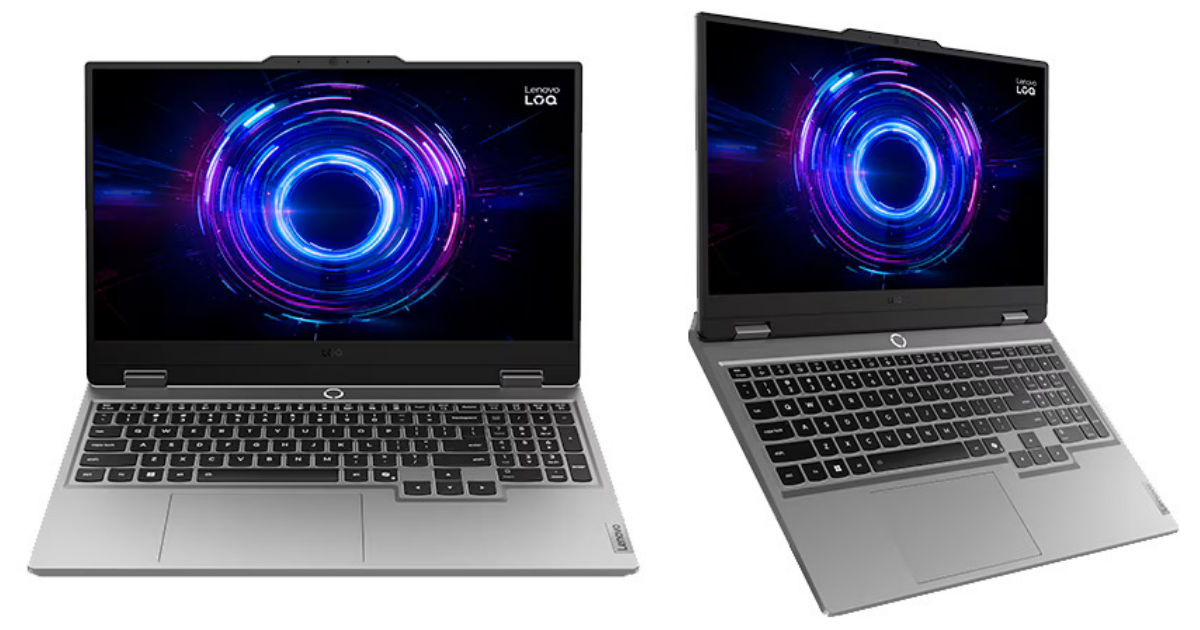
For years, the gaming laptop segment has been all about compromises: performance over battery, design over thermals, or price over longevity. But as competition heats up and gaming goes mainstream, Lenovo has stepped up to reshape the segment with its latest LOQ gaming laptops.
In recent times, we are seeing more OEMs chasing AI capabilities. Lenovo has stood by gamers and brought the power of the latest Nvidia RTX 50 Series GPU at an affordable price. You also get to choose between AMD and Intel CPUs, depending on your preference towards Team Red or Team Blue. Here’s a closer look at the new Lenovo LOQ gaming laptops.
What do the new Lenovo LOQ laptops bring to the table?
Instead of forcing you to choose between preset configurations, the new Lenovo LOQ gaming laptops are available on a Custom-to-Order basis. You can choose your own CPU, GPU, and add extra RAM and storage as per your requirements.
Intel CPUs are available up to the Intel Core i7-14700HX, while AMD options can be picked up to the Ryzen 7 250. However, it’s important to note that the Intel configuration lacks a dedicated NPU, which is present on the AMD chips. While the AI prowess of the Ryzen CPUs is not enough to qualify as a CoPilot PC at 16 TOPS, it’s enough to make a difference if your workload involves using image or video editing software that benefits from an NPU.
Graphic options are available up to the Nvidia RTX 5060 8GB. By using this GPU, you can play demanding games like Cyberpunk 2077, Alan Wake 2, and other big titles at 1080p with up to 90fps using DLSS 4. For shooter games like Valorant and Counter-Strike 2, you can expect up to 180fps. You can truly enjoy the high-frame gaming as the Lenovo LOQ laptops offer up to 165Hz screens.
In both configurations, you get the Lenovo LA1 AI chip, which balances both power consumption and performance to achieve the best of both worlds. Instead of switching modes manually, your laptop does it automatically for you.
The laptops are also certified with MIL-STD-810H for military grade durability. For the gaming DNA, they also have a 4-zone RGB lighting keyboard with a 1.5mm key travel.
Lenovo’s Stiff Competition
The gaming laptop segment is a crowded place, with several key players like the ASUS TUF and ROG Series, MSI, HP, and many others. However, not many options are available with the RTX 50 graphics, as these Nvidia GPUs are still fairly new in the market for laptops.
Lenovo’s LOQ laptops with i7-14700HX and Nvidia RTX 5060 start at approximately Rs 1,23,000 in India. The price goes up further as you add extra RAM and storage under the Custom-to-Order configuration.
For what’s currently present, we have the ASUS Gaming V16 starting at Rs 1,19,000, with the same GPU, but the Intel Core i7 240H chip. ASUS has a weaker chip, but it’s more power-efficient compared to the HX-Series CPU on Lenovo. The difference in raw performance won’t take a hit on gaming FPS, and can only be noticed in CPU-related tasks. So if you want better battery life with similar gaming performance, then you can consider the ASUS V16 over the Lenovo LOQ.
MSI has the Katana 15 with RTX 5060, and the i7-14650HX, almost on par with the latest Lenovo LOQ models. The pricing is also similar at Rs 1,27,000. The company also has the Crosshair 16 with the Ultra 7 255HX chip, which comes with powerful AI capabilities, more performance, and improved power efficiency, but the prices go up to Rs 1,40,000. The Katana also offers a 240Hz display, instead of the 165Hz present on Lenovo and ASUS.
Considering that laptops with the RTX 4060 are available in the market at a starting price of Rs 65,000, it does not make sense to spend almost double just to get the new RTX 5060 laptops at Rs 1.2 lakhs. Instead, you can also look at RTX 4070 laptops at around Rs 90,000.
If you specifically want an RTX 50 Series gaming laptop, then now is not a good time to buy, as the prices appear to be steep. We may witness some discounts in the upcoming Amazon Great Indian Festival or the Flipkart Big Billion Days sale, which can make the new Nvidia laptops more lucrative.
Are RTX 50 Series Laptops Worth It?
Gaming laptops are evolving faster than ever, especially with the rise of AI integration in GPUs and technologies like DLSS. However, many enthusiasts have criticized that the performance gains between the two generations are not worth the price hike, especially after considering that a majority of the FPS gains come from DLSS and artificial frame generation, instead of an actual increase in raw power.
We are also witnessing a major transformation in laptop chips with the emergence of ARM-based Qualcomm Snapdragon X processors, which offer more performance at groundbreaking battery efficiency levels. Intel and AMD have tried to catch up with their AI-ready chips, but their x86 architecture is no match for ARM.
However, such a disruption is missing in the GPU segment, with Nvidia being the monopoly in laptop graphics. The new Lenovo LOQ laptops try to solve this problem by offering a CTO-based configuration to help customers get the perfect laptop as per their fit.