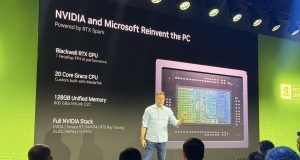
The Intel Arc G3 family makes a strong first statement. Built on the Panther Lake platform and fabricated on Intel’s 18A process node, the Arc G3 is purpose-designed for handheld gaming devices.
We sat down with Tom Peterson, one of Intel’s most visible technical fellows, for a conversation on Intel’s approach to handheld gaming, what comes next for the platform, and a lot more. Peterson walked us through the full Arc G3 deck and then stayed on well past the slides, fielding questions that ranged from silicon architecture to cloud gaming to AI compute on a handheld. What emerged was a clear picture of a company that has thought deeply about what handheld gaming demands from silicon and is now working on building the ecosystem discipline needed to support it.
The Numbers: 44% Gen-on-Gen, 42% vs AMD
Let’s start with the headline claims, because Intel came prepared with a thick benchmark stack to defend them. Against its own previous generation, the Core Ultra 7 258V, the Arc G3 Extreme delivers 44% faster average frame rates at 1080p with 2x upscaling enabled across a broad game suite, tested at 35W sustained. That is the generational leap number. Against the competition, specifically the ASUS ROG Xbox Ally X running the AMD Z2 Extreme at the same 35W sustained setting, the MSI Claw 8 EX AI+ with Arc G3 Extreme is 42% faster on average.
But the efficiency claim is the sharper one. At 17W, the Arc G3 Extreme reportedly delivers equivalent performance to what the AMD Z2 Extreme produces at 35W. Intel frames this as 2x performance per watt, and for a handheld device, that ratio matters far more than peak throughput. If you want pure performance, Intel claims 42% more than AMD. If you want battery life and thermal headroom, Intel claims you get the same output at literally half the power draw.
How Intel Did It: Fine-Tuning the Hardware and Software to Deliver More in Less
The engineering story behind the performance gains centers on a rethinking of how power is managed inside a gaming-specific SoC. Peterson described this as deciding re-prioritizing the SoC for a hand-held platform. Where you re-arrange the stack to deliver more gaming performance and efficiency. And then layer it up with intelligent software and tools that deliver handsomely to achieve the intended outcome.
The core logic is straightforward: in handheld gaming, the GPU is the critical resource, not the CPU. Standard SoC power management divides the power budget using general-purpose heuristics designed for mixed workloads. Intelligent Bias Control v3.5 explicitly prioritizes GPU frequency as the first objective, then works to stabilize the balance between GPU and CPU power share dynamically, using Dynamic Platform Tuning at the firmware level to push real-time decisions down to the SoC.
The combined result is a tighter, more stable power envelope that keeps GPU clocks high without the spike-and-throttle behavior that characterizes competitor platforms under sustained load.
Hands-On: Two Devices, Two Design Languages
After the briefing wrapped, Intel set up a hands-on area with devices propped on stands against a floor-to-ceiling city view. We got some playtime with two machines, and they told slightly different stories about where the Arc G3 ecosystem is heading.
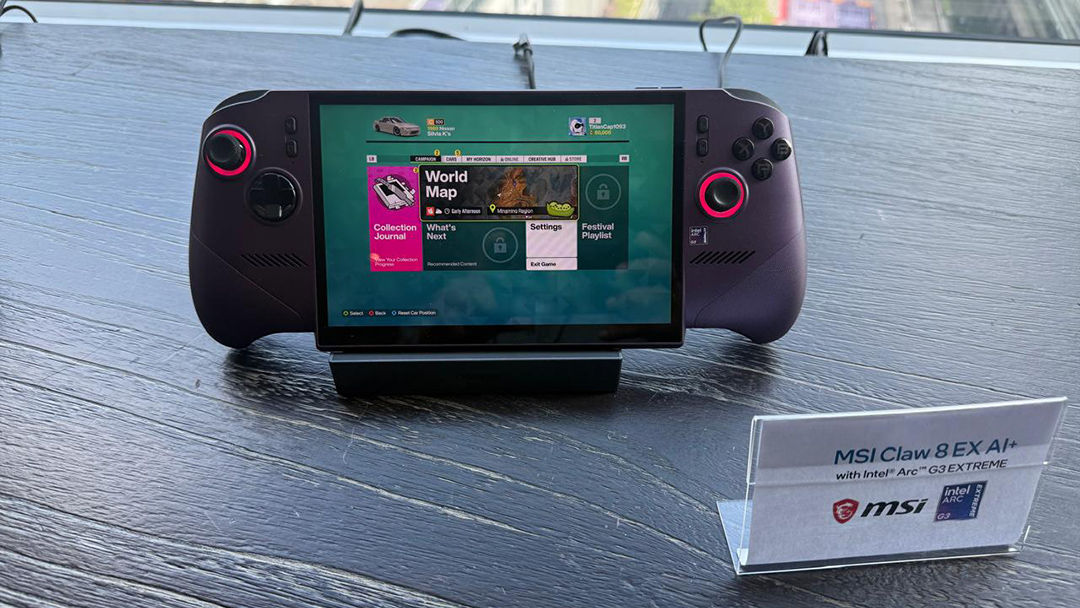
The MSI Claw 8 EX AI+ was the almost a given, expected presence, having served as the primary reference device through the entire benchmark deck. Up close, it has a no-nonsense aesthetic, a dark purple-gray body with pink-red accents on the thumbstick rings and face buttons. The display is large and punchy for a handheld, and the unit in hand felt substantial without tipping into unwieldy. The demo had Forza Horizon loaded to the world map, and navigation through the menus was immediate with no perceptible lag or stutter. The screen held up well even with the ambient daylight coming through the windows behind it.
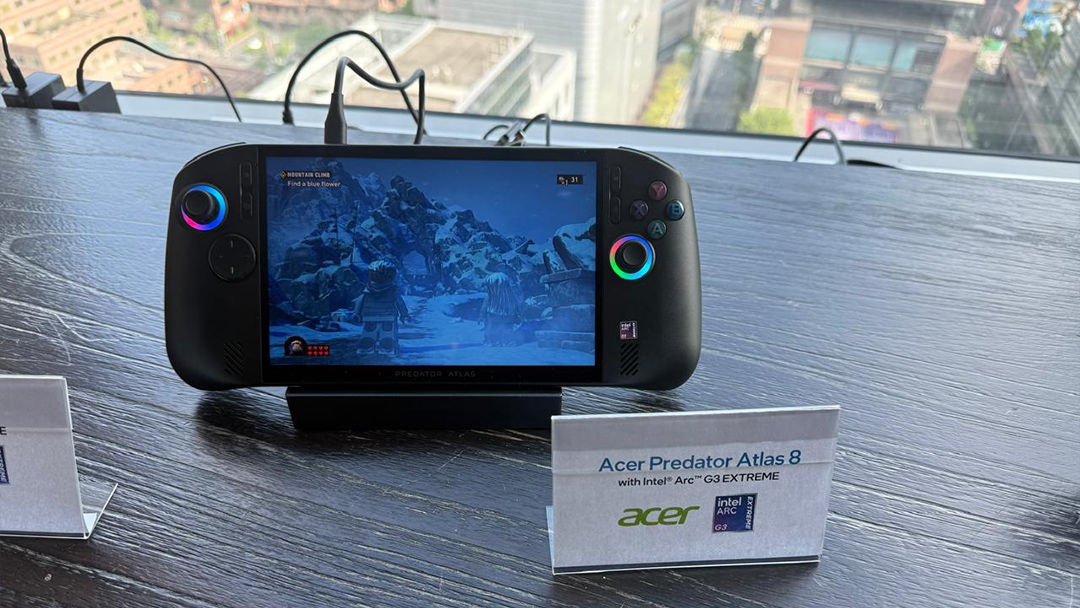
The more interesting device on the table was one that Intel had not foregrounded in the slide deck: the Acer Predator Atlas 8, also running Arc G3 Extreme. This is a new OEM entry into the Arc G3 ecosystem, and its design takes a different direction from the MSI. The Predator Atlas 8 goes bolder, with RGB rings on both thumbsticks, an all-black chassis, and a form factor that feels slightly more compact in the grip. Our playtime with the devices was brief, and a controlled demo environment is not a substitute for extended review testing. That said, both devices ran cool to the touch, the displays were bright enough to make a strong case for this generation of handheld gaming, and the overall responsiveness left no obvious red flags.
Thermal Behavior in Practice
Peterson was direct about the thermal reality of the current shipping hardware. The MSI Claw 8 EX AI+, the reference device for the launch, is specced and thermally designed to handle 35W sustained. In practice, Peterson said he had not observed thermal throttling at that power level during his testing. The thermal solution on the device is comfortably ahead of the chip’s sustained power envelope at 35W.
The more interesting behavior happens at the battery level. Intel implements battery-aware power management that steps down the power envelope as the battery drains toward empty. This is a deliberate choice: at higher charge levels, the system runs at its rated performance envelope, and as the battery gets low, Intel pulls back the power draw to extend remaining playtime rather than maintain full performance until the device cuts off abruptly.
On whether plugged-in performance differs from battery performance, Peterson’s answer was essentially no, with one qualifier. As long as the battery is not low, plugged-in and on-battery performance should be equivalent. The mode selection, manual or auto, gives users control over the power envelope. Auto mode selects dynamically based on conditions; manual mode lets the user lock a specific power target.
XeSS3 and the Upscaling Story
XeSS3 combines AI-based spatial upscaling with Multi-Frame Generation, Intel’s answer to AMD’s Fluid Motion Frames and Nvidia’s DLSS 3 Frame Generation technology. For handheld gaming, where native 1080p performance at 35W is genuinely difficult for any platform, AI-based frame generation is not optional polish but a core part of the performance equation.
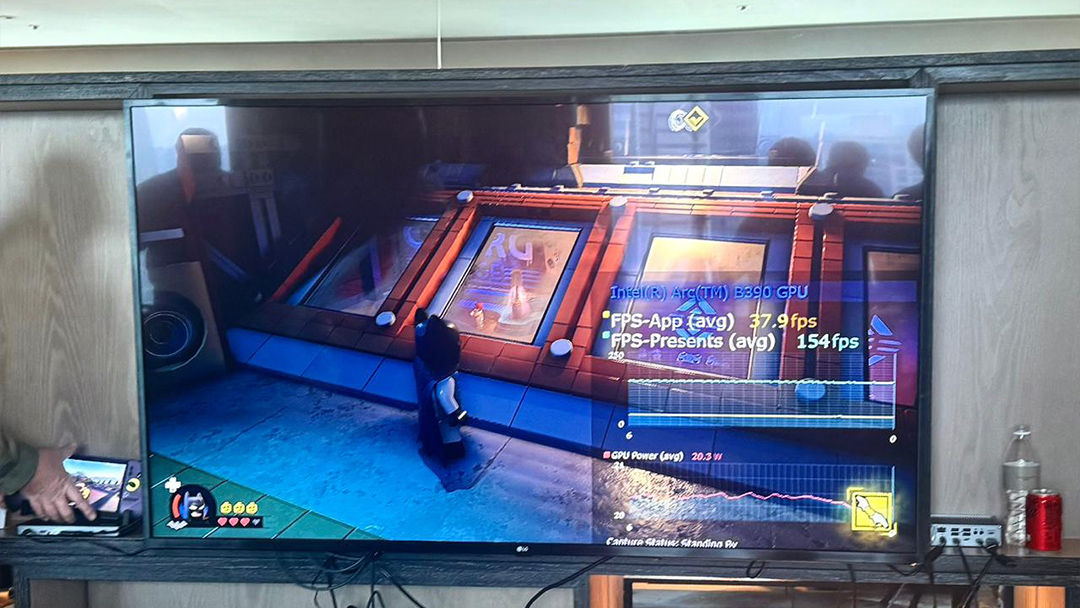
Intel’s 42% and 44% gain figures are explicitly measured with 2x upscaling enabled in supported titles. XeSS is doing meaningful work inside those numbers, and Intel is making no attempt to obscure that. The argument Intel is making is that XeSS3 is itself a hardware and software advantage: better upscaling and frame generation technology applied to a more efficient GPU produces better output at lower power than the competition’s approach. The more than 3x faster precompiled shaders claim adds to this, reducing the cold-start stutter penalty that has historically made Arc GPU gaming feel rough in the first minutes of a new title.
The OEM Ecosystem: Where Does It Go Next?
At launch, Intel’s handheld push is no longer just about proving the silicon. The next challenge is building enough OEM confidence to turn Arc G3 into a broader platform. MSI is leading the first wave with the Claw 8 EX AI+, while Acer has also entered the ecosystem with the Predator Atlas 8 running Arc G3 Extreme. ASUS already has a strong presence in the handheld category with its ROG Xbox Ally lineup, and Lenovo remains another important name to watch as the segment expands. For Intel, the goal now is not just delivering a faster chip but convincing more manufacturers that Arc G3 can support a full generation of handheld gaming devices.
Peterson’s comments on OEM expansion were grounded in how Intel thinks about market development. The data on handheld gaming growth is, in his words, irrefutable. The segment is expanding. Intel is interested in enabling it and continuing to invest in it. But Intel’s role at this stage is to build the technology and the experience layer that makes the market worth servicing, not to push OEMs into it before the market signals justify the investment.
On how deeply Intel works with OEMs on the actual hardware design today, Peterson was candid. Right now, the design decisions are OEM-driven. Intel is not specifying chassis design, thermal solution architecture, or fan curves. But he indicated that would change as the market matures. Intel has historically set minimum performance bars for thermal and acoustic performance in its platform programs, and as the handheld segment becomes more serious, those minimum standards will follow.
Cloud Gaming and the Local vs. Streaming Question
The conversation moved to GeForce Now, which launched in India recently and represents a different model for delivering high-end gaming to small devices. Peterson’s answer was thoughtful rather than dismissive.
He acknowledged that cloud gaming is genuinely competitive with local rendering for certain use cases. There are AAA titles that simply cannot be rendered locally at the resolution and frame rate a player might want, and for those titles, a cloud service with enough bandwidth between server and client can bridge the gap. The question is always what that infrastructure looks like in practice, and whether the experience holds up under real network conditions.
Where Peterson sees local hardware maintaining a durable advantage is in the raw experience quality when conditions are right. Local generation, he said, is almost always going to produce a better experience than streaming when you have a capable device, because there is no latency in the rendering loop and no dependency on network quality. The ownership versus consumption framing was how Peterson ultimately characterized the choice: whether a user wants to own what they play on, or is comfortable with a subscription model, is a personal and financial decision.
AI on a Handheld: The Next Use Case
The final thread in the conversation was perhaps the most forward-looking. Asked whether these small handheld devices could also serve as AI compute platforms, Peterson did not hesitate.
He pointed to a small form factor device visible at the briefing, running Panther Lake silicon, that was being demonstrated specifically for AI workloads rather than gaming. The Panther Lake platform carries a substantial GPU, NPU and the full XMX AI Engine array, all of which are relevant to local AI inference. Peterson noted that the market is moving quickly enough that the idea of a handheld gaming device doubling as a serious AI inference platform is not a stretch. The same silicon efficiency that makes Arc G3 attractive for gaming makes it relevant for AI tasks that would historically have required cloud compute or a discrete GPU.
The point was not that every handheld gamer is about to become an AI power user. It was that the platform Intel has built is not limited to gaming, and the category itself may evolve in directions that are not yet fully defined.