We are on the ground in Taipei for Computex 2026, where Intel held a dedicated launch event on the sidelines of the show to unveil the Arc G-Series, its first family of processors designed from the ground up for Windows gaming handhelds. Built on a modified version of the Panther Lake (Core Ultra Series 3) platform and manufactured on Intel’s 18A process node, the new chips launch in two configurations: Arc G3 and Arc G3 Extreme. This is what Intel announced, and why it matters.
The Chips
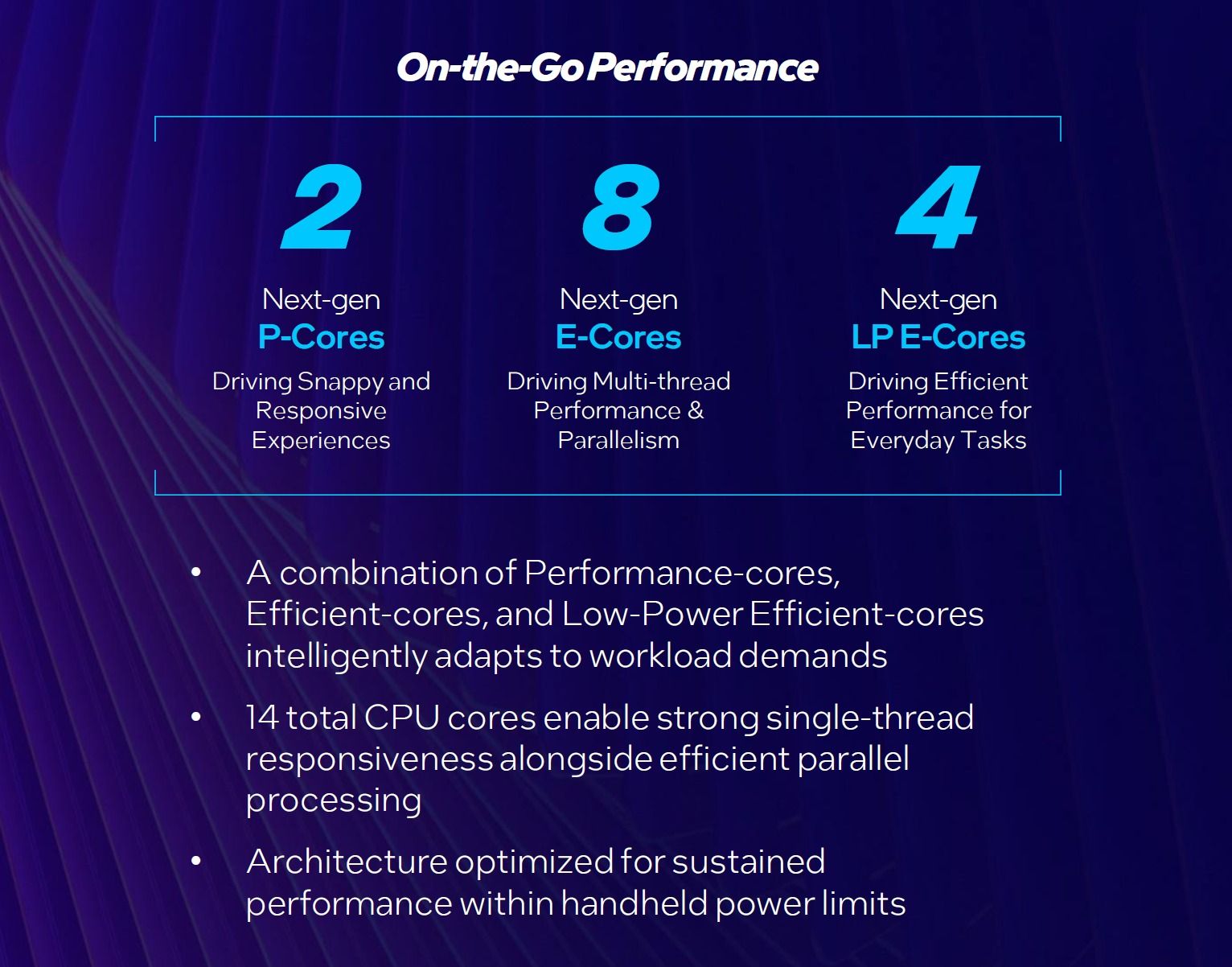
Both SKUs share a 14-core CPU configuration (2 Performance-cores, 8 Efficient-cores, 4 Low-Power Efficient-cores), a 46 TOPS NPU, 12 MB Smart Cache, and LP5/X memory support at 8533 MT/s with up to 96 GB capacity. The GPU is where they diverge: the G3 Extreme carries an Intel Arc B390 with 12 Xe3 cores at 2.3 GHz and 113 GPU PTOPS, while the G3 uses an Arc B370 with 10 Xe3 cores at 2.2 GHz and 90 GPU PTOPS. Both chips run a configurable TDP range from 8W, with the G3 capping at 30W and the G3 Extreme at 35W.
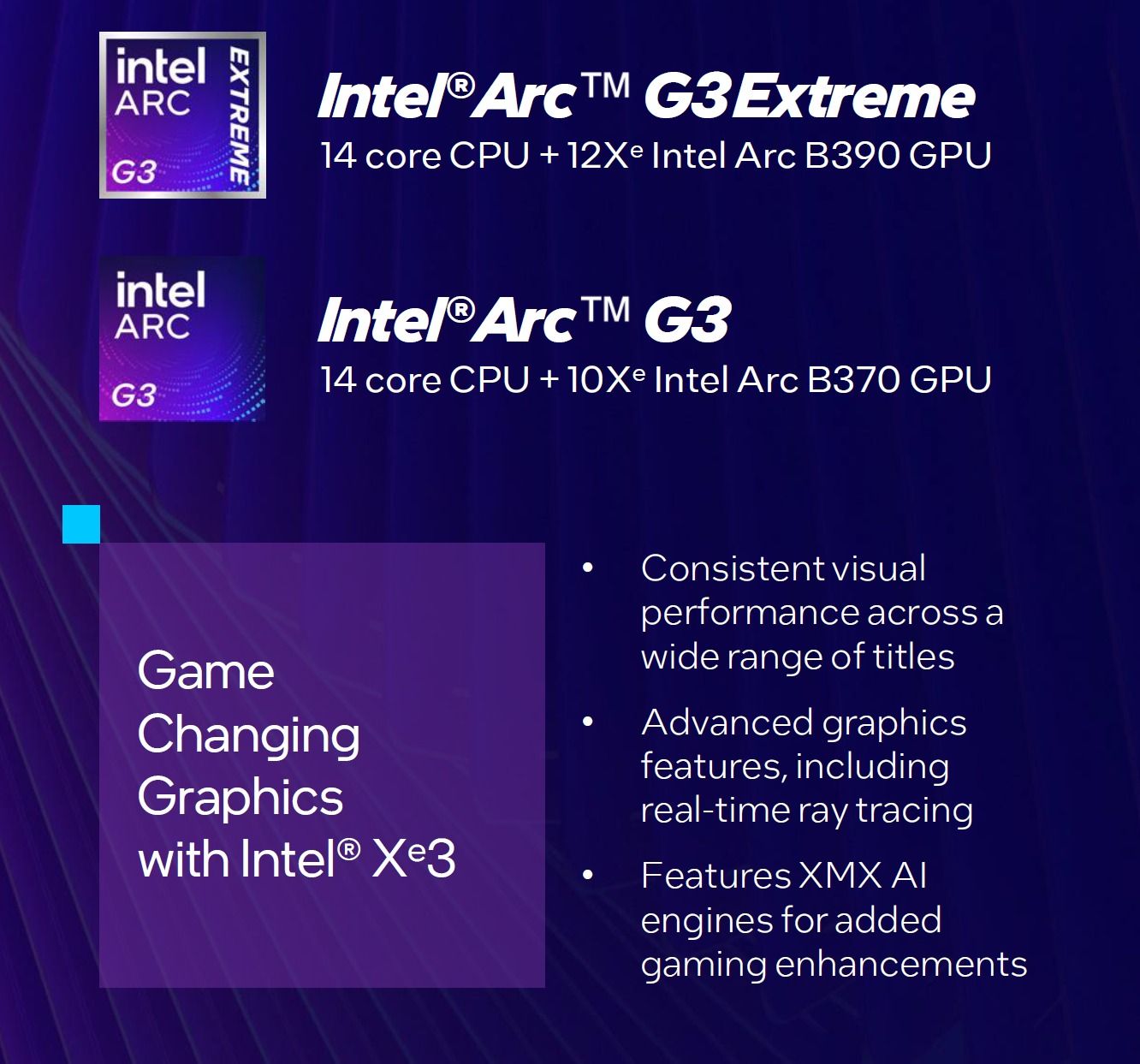
| Specification | Arc G3 Extreme | Arc G3 |
|---|---|---|
| GPU | Intel Arc B390 (Xe3) | Intel Arc B370 (Xe3) |
| Xe Cores | 12Xe @ 2.3 GHz | 10Xe @ 2.2 GHz |
| GPU PTOPS | 113 PTOPS | 90 PTOPS |
| CPU Cores | 14 (2P + 8E + 4LP E) | 14 (2P + 8E + 4LP E) |
| P-Core Max Turbo | 4.7 GHz | 4.6 GHz |
| NPU | 46 TOPS | 46 TOPS |
| Smart Cache LLC | 12 MB | 12 MB |
| Memory | LP5/X 8533 MT/s, 96 GB max | LP5/X 8533 MT/s, 96 GB max |
| Connectivity | Wi-Fi 7 R2 / Dual BT 6.0 / 2x TBT4 | Wi-Fi 7 R2 / Dual BT 6.0 / 2x TBT4 |
| TDP Range | 8W to 35W | 8W to 30W |
| Process Node | Intel 18A | Intel 18A |
How Intel Tweaked Panther Lake for Handhelds
The most significant architectural decision Intel made for the G-Series was reducing the P-core count to just 2. A standard Panther Lake laptop configuration carries a higher P-core count, but P-cores are the most power-hungry core type in the lineup. In a gaming handheld constrained to a sub-35W thermal envelope, every watt given to the CPU is a watt withheld from the GPU.
Intel calls this “right-sized compute”: 2 P-cores handle responsiveness and single-threaded tasks, 8 E-cores cover parallel gaming workloads, and 4 LP E-cores manage background efficiency tasks at the lightest possible power draw. The freed power budget is redirected to the Xe3 GPU, allowing it to operate at a level otherwise impossible inside a handheld TDP.
Intel’s Endurance Gaming system manages the full power range across three user-selectable modes: Performance, Balance, and Battery, giving OEMs and users control over how the power budget is distributed across a session.
XESS 3, Software, And Connectivity
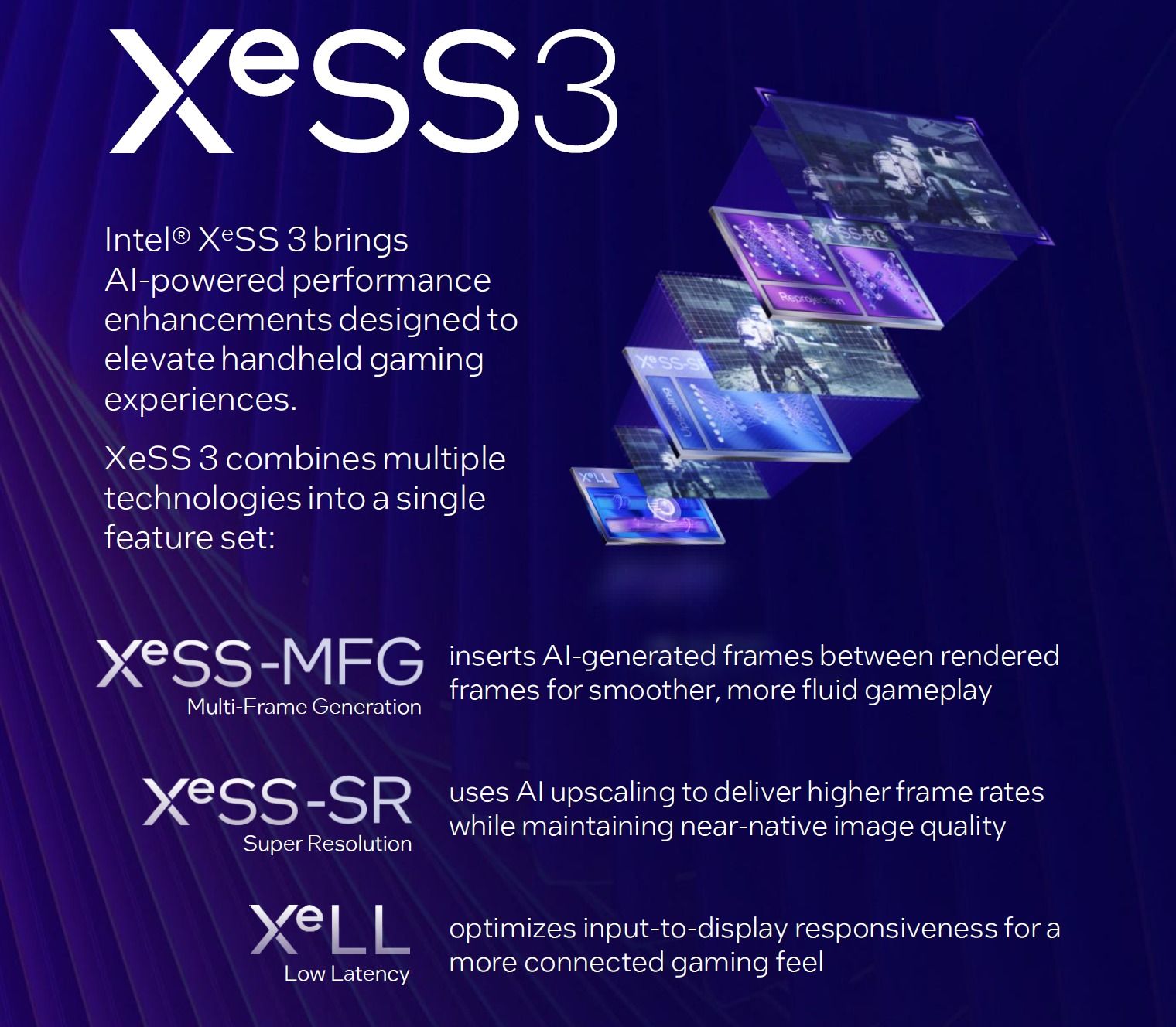
Both SKUs support XeSS 3, Intel’s AI gaming stack built on XMX engines embedded in every Xe3 core. It comprises three components:
- XeSS Super Resolution: AI upscaling for higher frame rates at near-native image quality.
- XeSS Multi-Frame Generation: AI-generated frames inserted between natively rendered frames, multiplying perceived frame rate without proportional GPU power cost.
- Xe Low Latency: Input-to-display latency reduction integrated directly with game engines.
On the platform software side, Intel ships Day-0 Game On drivers for broad game compatibility at launch, Precompiled Shader Distribution that pulls prebuilt shader files from the Intel cloud to eliminate DirectX 12 stutter, and Xbox Mode, a controller-optimised full-screen gaming interface for Windows 11.
Connectivity includes Intel Wi-Fi 7 R2, Dual Bluetooth 6.0, and 2x Thunderbolt 4 with Thunderbolt Share for 40 Gbps high-speed docking and game library transfers between devices.
Performance Claims: Intel vs. Prior Gen and AMD
Intel came to Taipei with a thick benchmark stack to back its numbers. Against its own previous generation, the Arc G3 Extreme is 44% faster on average than the Core Ultra 7 258V at 1080p High with 2x upscaling enabled, tested at 35W sustained. Against AMD, the MSI Claw 8 EX AI+ with Arc G3 Extreme clocks 42% faster on average than the ASUS ROG Xbox Ally X running the AMD Z2 Extreme at the same 35W sustained setting.
The efficiency claim is the sharper one. At just 17W, the G3 Extreme delivers equivalent average performance to the AMD Z2 Extreme running at 35W. Intel frames this as 2x performance per watt, and for a handheld where battery life and thermal headroom matter as much as peak numbers, that ratio counts for more than any single frame rate figure.
All performance figures are measured with 2x XeSS upscaling enabled and are Intel-claimed. We will be testing these numbers independently in our full review. Stay tuned.