MediaTek is preparing to take another major step in the flagship smartphone chipset segment with the Dimensity 9600 Pro. Based on the DX6 engineering sample, the upcoming platform brings together a 2nm process, a new CPU architecture, next-generation memory and storage standards, improved ray tracing and a stronger focus on on-device AI.
Dimensity 9600 Pro Specifications
The Dimensity 9600 Pro is built on TSMC's N2P 2nm process, making it MediaTek's first 2nm silicon. The smaller process node is central to the company's effort to increase sustained performance while maintaining efficiency. The chipset uses a 2+3+3 CPU configuration, with one additional prime core compared to the Dimensity 9500. MediaTek's focus here is not simply on achieving higher peak benchmark scores, but on maintaining performance over longer workloads while benefiting from the efficiency gains offered by the 2nm node. The platform also introduces LPDDR6 RAM and UFS 5.0 storage to the Dimensity family for the first time with total cache going up to 34.5MB, providing the chipset with a larger pool of fast-access data for demanding workloads.
Graphics performance gets a significant overhaul with the 12-core Mali G2 Ultra NX GPU along with third-generation ray tracing and a new Neural Graphics Architecture which allows AI-based techniques such as super-resolution upscaling to become part of the graphics pipeline. This fits into a broader approach with the Dimensity 9600 Pro, where AI is not treated as something that runs exclusively on a standalone NPU.
Dimensity 9600 Pro Gaming And AI Performance
MediaTek's engineering sample was tested across CPU, GPU and AI workloads. The company claims that the DX6 is a pre-production engineering sample, and says there should be no difference in benchmark scores between this sample and commercial devices at launch. Also, the test unit had no active cooling, meaning there was no fan, vapor chamber or other active cooling system assisting the chipset during testing. The benchmark figures should be viewed as a comparison against the same Dimensity 9500 engineering sample rather than directly against retail smartphones, according to the provided testing notes.
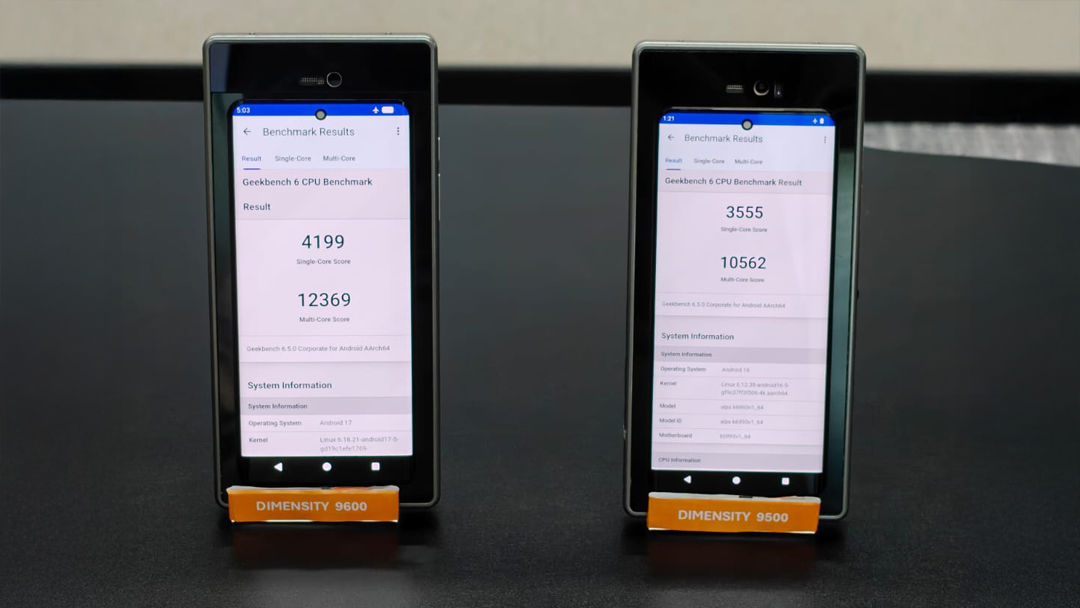
The more interesting demonstration comes from actual gameplay, testing several demanding titles on the DX6 engineering sample without active cooling.
Mediatek claims Genshin Impact ran at a locked 60fps for 30 minutes, while Wuthering Waves also maintained a locked 60fps during a 30-minute session. The most notable result came from BGMI, which ran at 120fps for one hour.
AI is another major focus of the Dimensity 9600 Pro. MediaTek has moved to a dual-NPU architecture, combining a dedicated, power-efficient eNPU with the primary NPU. The idea is to divide workloads according to their complexity. Lightweight and always-on inference can run on the more efficient eNPU, while heavier generative AI workloads can use the primary NPU. This should reduce the need to activate the full AI processing pipeline for simpler tasks.
The chipset also delivers a 2x improvement in INT4 compute compared to the previous generation. MediaTek's engineering sample scored 31,232 in the ETH Zurich AI Benchmark, an independent academic benchmark for AI inference. INT4 is particularly important for running larger AI models locally. Quantisation allows AI models to operate using lower numerical precision. While mobile AI has traditionally relied on formats such as INT8 and FP16, INT4 reduces the bit width further, allowing models to use less memory and require less compute for individual operations.
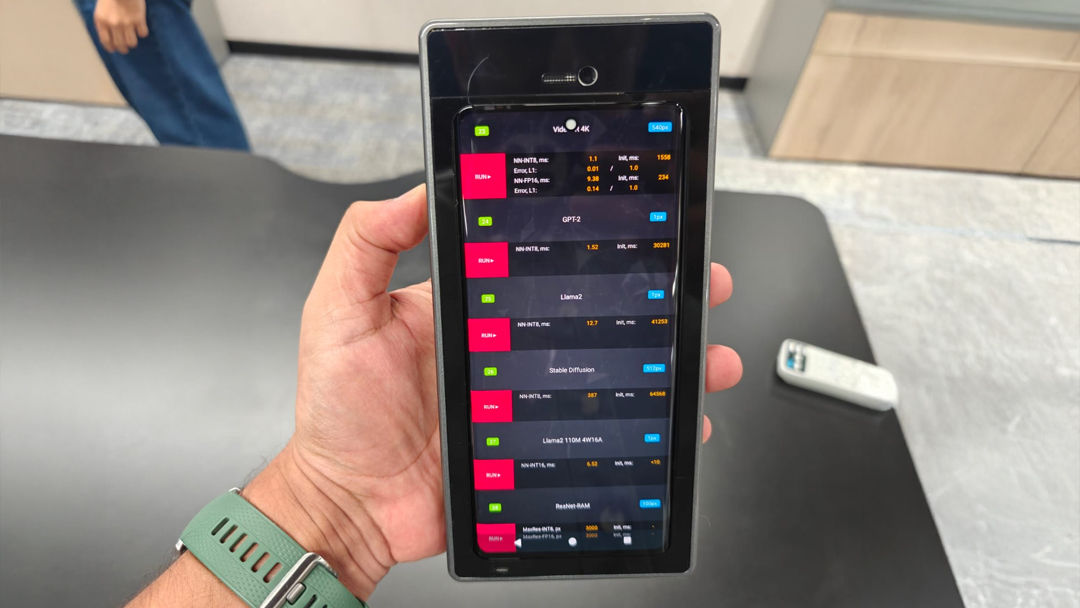
In practical terms, better INT4 performance can allow larger AI models to run directly on the smartphone while reducing inference latency and power consumption. This is particularly relevant to on-device Agentic AI, where AI systems need to perform multi-step and proactive tasks without constantly relying on a cloud connection. It can also benefit generative AI features such as image generation and real-time text or voice processing.
Is Dimensity 9600 Pro Is More Than a Generational Upgrade?
The Dimensity 9600 Pro represents a broader change in MediaTek's flagship strategy. The company is combining 2nm manufacturing, native AI acceleration, next-generation memory, sustained gaming performance and improved AI efficiency rather than focusing on a single headline specification.
The DX6 engineering sample's gaming results are particularly interesting because the performance was sustained without active cooling. At the same time, the introduction of LPDDR6 and UFS 5.0 gives the platform a faster foundation for future smartphones, while the dual-NPU design and INT4 acceleration target the next generation of on-device AI. The most interesting thing about the Dimensity 9600 Pro is that MediaTek isn't treating AI as just another block on the chipset diagram. The architecture is designed around AI-aware processing across the CPU, GPU and memory subsystem, while the dual-NPU setup and INT4 acceleration are aimed at making increasingly capable AI models practical on the device itself.
The gaming results also deserve attention. Maintaining 60fps in demanding games for 30 minutes and 120fps in BGMI for an hour on an engineering sample with zero active cooling is arguably more meaningful than a single peak benchmark score. If these characteristics translate cleanly to commercial smartphones, the Dimensity 9600 Pro could give MediaTek a strong flagship platform for the next generation of premium Android devices.