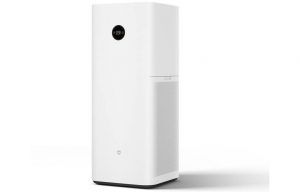
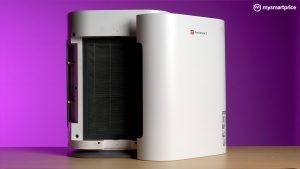
Dreame has introduced the PM Neo Air Purifier in China, marking its entry into advanced purification solutions with long-term formaldehyde control and smart sensing features. The new model aims to cover large indoor areas and deliver continuous air quality management for modern homes.
Smart purification with formaldehyde decomposition
The Dreame PM Neo features proprietary FCO (Formaldehyde Catalytic Oxidation) decomposition technology, which breaks down formaldehyde into water vapour and carbon dioxide rather than simply capturing it in filters. Dreame claims this process can remove up to 99.24 percent of formaldehyde, and the system is designed to remain effective for 10 to 15 years without frequent filter changes.
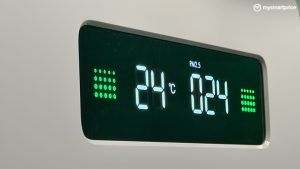
A six-stage purification process includes a dust and hair mesh, an H13 HEPA filter capable of capturing particles as small as 0.1 microns, an activated carbon layer, a formaldehyde decomposition filter, and dual sterilisation via UVC light and plasma. Real-time air quality is tracked by a 7-in-1 sensor array that monitors PM1, PM2.5, PM10, TVOC, formaldehyde, temperature and humidity, with readings displayed on a built-in LCD.
Coverage, Airflow and Pricing
Dreame positions the PM Neo as a whole-home solution. The purifier delivers a clean air output of up to 300 cubic metres per hour, allowing it to refresh air in a 100 square metre space in around 20 minutes, with maximum effective coverage reaching up to 157 square metres. A dual-air-duct system can switch between jet and diffusion airflow depending on indoor air quality conditions.
Smart features include millimetre-wave radar that detects user movement up to five metres away and automatically adjusts airflow direction over a 120-degree arc. Control options include a mobile app, remote control, voice commands, and on-device interface. In comfort mode, the purifier operates at noise levels as low as 32 dB(A).
The Dreame PM Neo has launched in China with a price tag of 3,199 yuan (about $455 / ~₹41,000). There is no official confirmation of a global rollout or India availability at this stage.
Promising Product For Local Market
India has one of the most critical air quality challenges globally, with poor AQI levels recorded across urban centres and many tier-2 cities throughout the year. Despite this, Dreame has yet to enter the Indian air purifier category, even as it expands into intelligent home appliances abroad. The PM Neo's advanced formaldehyde decomposition and broad coverage make it well-suited to Indian homes, especially newly built or renovated spaces where VOCs are a persistent concern.
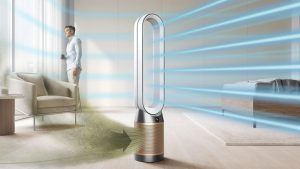
Global air purifier brands that have entered India, such as Dyson and Coway, focus on sealed HEPA systems and mainstream particulate removal, but large-room, high-performance purifiers remain relatively niche. For example, Dyson's Purifier Cool PC1 – TP11 was recently launched in India at around ₹39,900, targeting premium buyers.
Dreame's absence may stem from broader business decisions around local certification, service and parts infrastructure. Indian consumers often face challenges when brands launch products without a strong after-sales network; this has been visible in other home appliance categories where support and spare parts availability lag behind initial sales, affecting long-term ownership confidence.
If Dreame were to bring the PM Neo to India, it could fill an important gap between entry-level purifiers under ₹10,000 and premium imports above ₹30,000, especially for households seeking living-room and whole-home coverage. Many Indian brands, such as AGARO, Eureka Forbes and Qubo, are active in the lower price segments, yet few offer advanced formaldehyde control or high CADR for large areas. Given India's year-round air quality concerns, products like the PM Neo are well aligned with evolving consumer needs, and their absence is increasingly conspicuous.
For Indian consumers interested in high-end purification, options today include premium sealed HEPA solutions from global brands and smaller mid-range purifiers from local players. The Dreame PM Neo, with its long-term formaldehyde strategy and broad coverage, would be a welcome addition if and when it enters India. Until then, buyers should weigh coverage area, CADR ratings and after-sales support when choosing alternatives suitable for large homes.