Lumio launches tend to have a recognizable rhythm: objective comparisons, category data, and pointed observations about where existing products leave room for improvement. This is followed by the company’s case for offering better quality and value without pushing the price out of reach. The Lumio Aura 5 launch followed much the same playbook. However, this time Lumio stepped into a category where specifications tell only part of the story.
On the sidelines of the launch, we sat down with Raghu Reddy, CEO and Co-Founder of Lumio, and Sudeep Sahu, Head of Product, to move past the presentation and understand what went into the company’s first home-audio product, why it chose powered bookshelf speakers rather than the far more familiar soundbar, and what kind of research went into the making of the Aura 5.
The conversation went well beyond the launch-day spiel. We spoke about the listening sessions that influenced the tuning and the compromises imposed by cabinet size and driver choice. We also covered the thinking behind the price point and why Lumio believes this combination of stereo separation, built-in amplification, and broad connectivity naturally fits the living room.
Lumio is comfortable calling the Aura 5 a Hi-Fi speaker. Anyone familiar with traditional Hi-Fi audio setups knows how quickly a system expands from a pair of speakers into separate amplification, source equipment, and DACs. These upgrades can easily run into lakhs of rupees. At this stage, it is more useful to think of the Aura 5 as Lumio’s attempt at an affordable, simplified Hi-Fi setup for the living room. Whether it truly earns the Hi-Fi badge is something we will decide after our review unit arrives. We plan to give it a long, hard, and appropriately loud listen across genres, films, television, and everyday use.
Why Speakers, and Why Now?
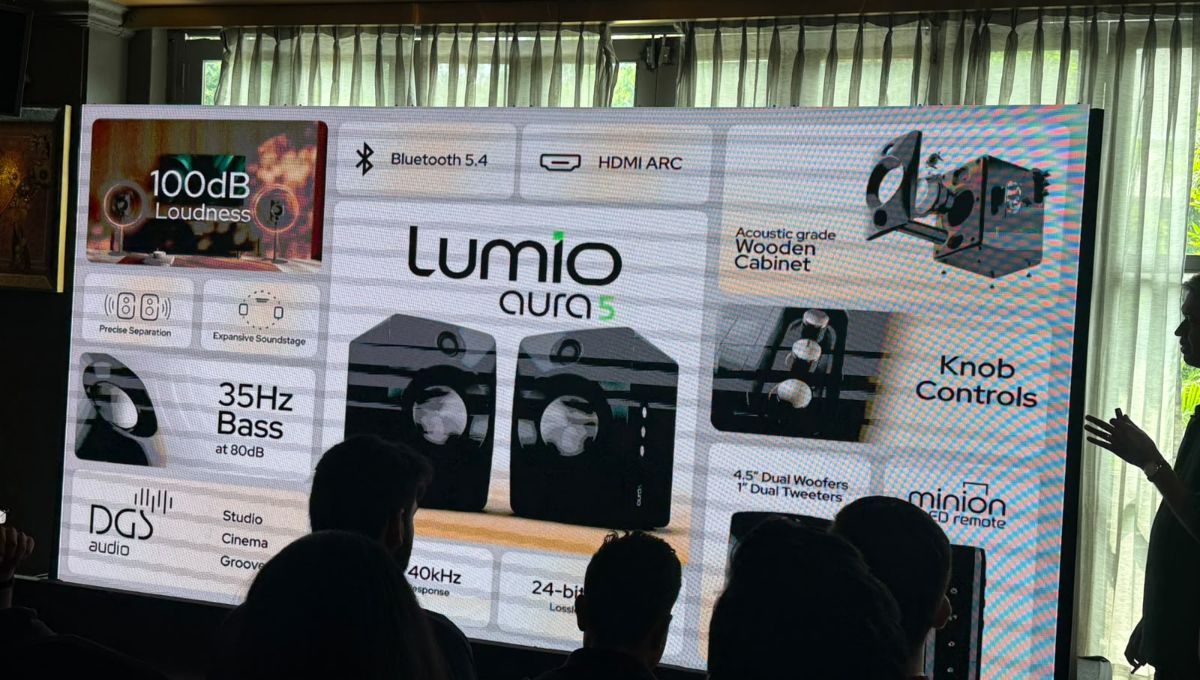
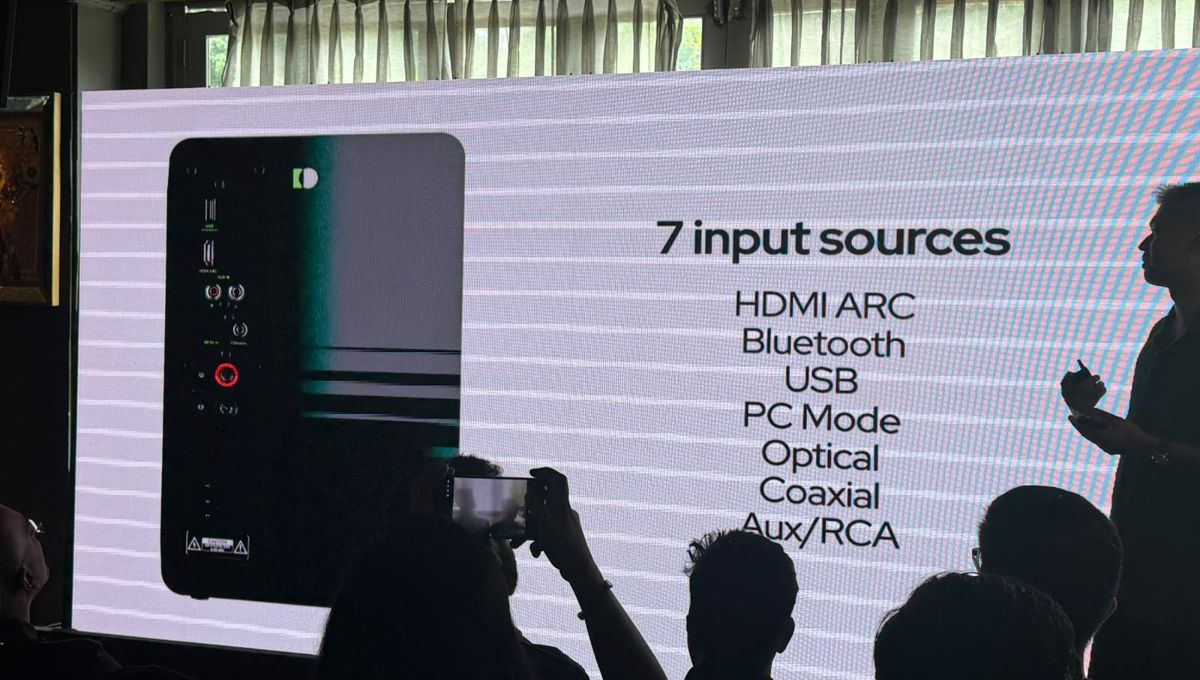
Audio was an obvious gap in Lumio’s home-entertainment portfolio. The company has spent its early years building around the screen with televisions and projectors, leaving sound as the missing part of the setup. The less obvious decision was what kind of audio product should come first. A soundbar would have been the conventional extension of a TV business, easy to explain and familiar to anyone looking for an upgrade from built-in television speakers. Instead, Lumio chose a pair of powered bookshelf speakers, betting that some buyers will trade the compactness of a single cabinet for proper left-right separation and a system that can do more than just sit beneath a television. The Aura 5 offers HDMI ARC, optical, coaxial, and analogue inputs, along with Bluetooth 5.4 and USB (covering both PC use and direct playback). Because amplification is built in, there is no need to choose a receiver or external amplifier. That is central to Lumio’s proposition: retain the physical separation of a conventional stereo pair while removing the complex setup that makes traditional Hi-Fi intimidating to first-time buyers.
Soundbar vs Bookshelf Setup
Choosing bookshelf speakers is one thing; persuading a soundbar buyer to choose them is another. The first difficult question is dialogue. A soundbar can place a physical center channel directly beneath a television, which gives speech an obvious preference. A stereo pair has no speaker in the middle, and anyone who has used conventional bookshelves with a TV will know the irritation of riding the volume control through a film: dialogue seems too quiet, the action sequence is too loud if the volume is adjusted for clear dialogues, and the cycle starts again. We have seen this too often to not relate.
Lumio knew it had to address that. The Aura 5 solves for it using a phantom-center presentation, with the left and right speakers creating the impression that voices originate between them rather than from either cabinet. According to Sudeep, dialogue intelligibility was treated as a specific part of the tuning because it was one of the recurring complaints the company encountered while looking through customer feedback in the category. Cinema mode adds further emphasis around speech, while the stereo image is expected to do the job that a physical center speaker would otherwise handle.
Sudeep also questions whether a physical center channel automatically produces a more convincing result. He argues that a center speaker can concentrate dialogue into a single point directly beneath the display. In contrast, a properly tuned phantom center can place voices more naturally across the space between two cabinets. It is an intriguing argument that deserves to be tested in practice. The success of a phantom center depends on speaker placement, listening position, room acoustics, and stereo image consistency—all of which are best judged in an actual living room.
Lumio Did Not Tune the Aura 5 in Isolation
That leads into one of the more interesting parts of the development story. Lumio says the Aura 5 took roughly a year from the initial idea, with around six months spent testing samples and working through different versions. The company did its own listening internally, but it also brought regular listeners into the process rather than treating the preferences of its product team as a substitute for the people who would eventually buy the speaker.
The blind listening sessions lasted more than 45 minutes and included both movies and music. Participants compared the Aura 5 against a soundbar setup with a dedicated center channel and subwoofer, and Lumio says the product was only greenlit after those sessions produced results the team was comfortable with. That makes for a more useful development story than simply saying the speaker was community tuned.
The reasoning behind them is sound, though. Audio becomes subjective very quickly. One listener’s detailed speaker is another’s bright one; extra bass can make a demonstration impressive and an hour-long listening session exhausting. The job is not simply to produce a response curve and declare the work finished. Lumio had to decide what kind of sound it wanted the Aura 5 to have while accepting that there would be no single tuning that suited every listener, room and piece of content.
Three Modes Rather Than One Sound for Everything
Lumio’s answer is a three-mode system it calls DGS tuning. Studio is intended as the balanced, everyday profile; Cinema adjusts the presentation for films and gives dialogue and atmospheric detail more emphasis; Groove raises the bass response for music that benefits from a more energetic presentation. Sudeep expects Studio to do most of the work for most owners, which is telling in itself: the modes are not being pitched as three radically different personalities that require constant switching. The baseline tuning still has to stand on its own, with Cinema and Groove providing more targeted adjustments rather than repairing weaknesses in the default sound.
Underneath those presets, Sudeep described a relatively restrained tuning philosophy. The team avoided aggressive parametric correction to force drivers toward a predetermined response. Instead, they worked with the natural behavior of the selected drivers, adjusting the crossover and EQ while preserving the hardware’s innate characteristics. The drivers were chosen after evaluating alternatives at different price tiers, settling on the balance that best served the product.
Why Lumio Stopped at 4.5-inches
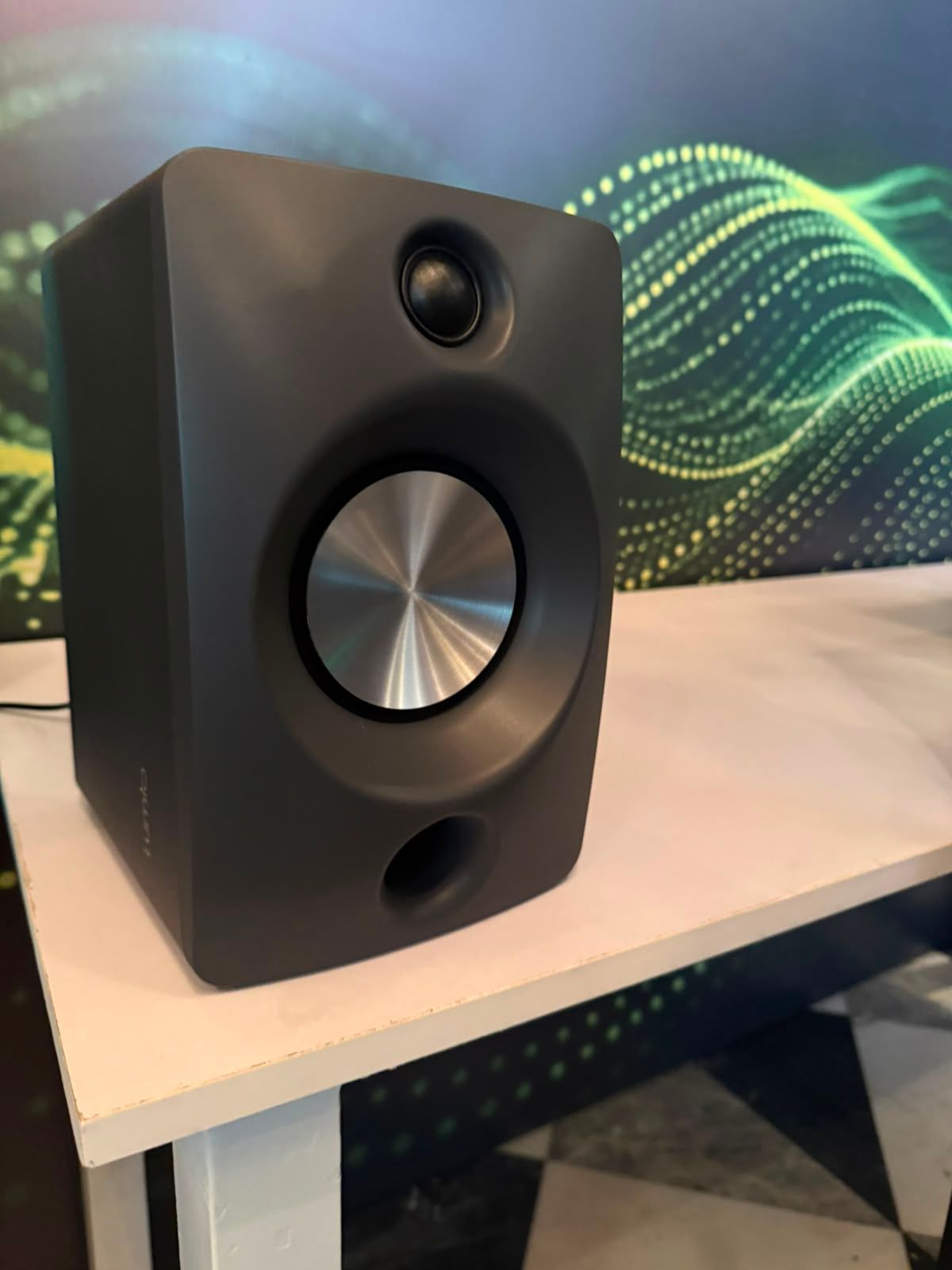
For someone accustomed to traditional bookshelf speakers, a 4.5-inch woofer may sound modest. Five inches is typically where many consider a bookshelf speaker to be a full-range proposition. Sudeep did not pretend driver diameter is irrelevant. Instead, he framed the choice as a compromise between physical cabinet size and the output Lumio wanted to achieve.
Moving to a larger woofer would have required more cabinet volume, and the team did not want to produce a pair of speakers that became awkward beside a television or overwhelming on a desk. The 4.5-inch driver gave Lumio the dimensions it wanted, while enclosure design and port tuning were used to extend the low end.
Lumio specifies bass extension down to 35Hz at 80dB and says the pair can reach 105dB SPL at one meter, with 100W continuous and 200W peak output. Digital playback is supported up to 24-bit/48kHz. The integrated amplifiers are class-D, although we were not able to confirm whether the drivers are bi-amped or driven by a single amplifier. The amplifier chip is also yet to be officially confirmed.
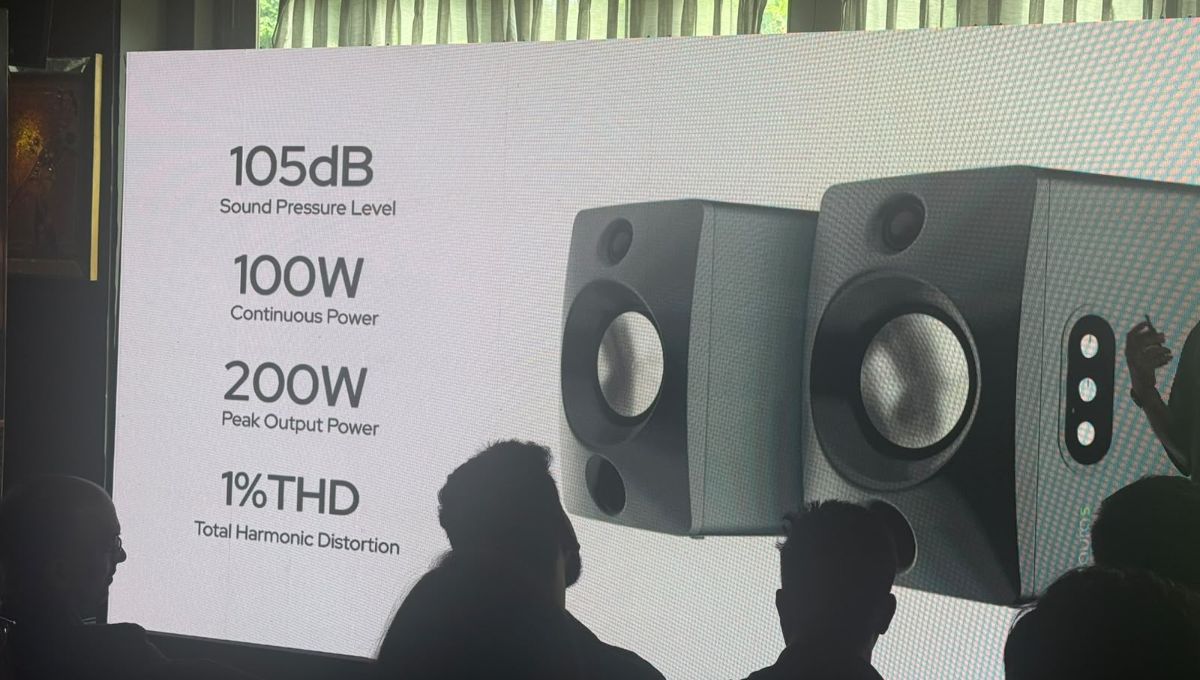
The specifications suggest Lumio intends the Aura 5 to work convincingly without a separate subwoofer, but figures alone cannot tell us how much authority it retains at the bottom of its range or how it behaves at higher volumes in a real room. Those are questions we will answer in the review.
Building Something for the Living Room, Not the Listening Room
That distinction gets to the heart of the Aura 5. Lumio is not trying to build a purist two-channel system and then persuade a mainstream buyer to adapt to it. It is approaching the problem from the other direction: start with how people actually use audio in a living room, then remove as much of the friction associated with a traditional stereo setup as possible.
HDMI ARC is central to that. So is the Bluetooth remote with its OLED display, which Lumio calls Minion, and the planned Android and iOS apps. These may not be the details that excite someone shopping for separates, but they matter to somebody moving from a soundbar. Convenience is a significant part of the proposition.
The physical separation between the speakers remains the Aura 5’s main advantage over a single-box design. Lumio makes a stronger claim in its launch material, arguing that a soundbar can only simulate the soundstage created by two speakers. We would phrase that more carefully: a stereo pair begins with genuine physical separation, while the quality of the resulting soundstage still depends on the speakers, their positioning, and the room.
The Price Point Changes the Comparison
At Rs 24,999, with an early-bird price of Rs 19,999, the Aura 5 sits in a part of the market where it will be compared not only with soundbars but also with powered monitors and active bookshelf speakers.
The price also explains some of the product decisions. Had Lumio built a passive pair requiring a separate amplifier, it would have targeted a very different buyer. Here, amplification, DAC, connectivity, remote, and speakers are all part of one package.
That makes the Aura 5 less about replicating a traditional component system and more about bringing some of its advantages into a simpler living-room product. Whether the sound quality justifies that positioning is something we will determine once we have spent more time with it.
Selling Two Boxes in a One-Box Market
The engineering challenge may only be half the job. A soundbar explains itself instantly: place it under the television, connect a cable, and the TV sounds better. Bookshelf speakers require the buyer to make room for two cabinets, and their biggest advantages are difficult to communicate through a product page.
Raghu expects hands-on listening opportunities to help bridge that gap. The company plans to offer demonstrations in physical retail stores, host community listening events, and share content across Lumio’s channels alongside media reviews. That approach makes sense because qualities such as imaging, dialogue placement, and tonal balance are difficult to convey through product photos or wattage figures.
It also means the Aura 5 enters a broader competitive set than a typical soundbar, spanning powered monitors, established active bookshelf speakers, and entry-level stereo systems. Lumio will have to convince buyers that its mix of TV-friendly convenience and two-channel presentation is worth choosing over those alternatives.
Aura 5 Is Also a Test of Lumio’s Larger Strategy
Raghu’s broader view is that a young consumer-electronics company earns the right to expand by doing a few things well rather than rushing into every adjacent category. Home entertainment remains the immediate focus, which makes audio a fairly natural extension of televisions and projectors.
There are broader ambitions in the background, including ideas around further audio products and, eventually, a wider range of consumer electronics, but neither was presented as a near-term roadmap.
Now We Need to Hear It
The thinking behind the Aura 5 is clearer after speaking to the people who built it. Lumio has made a series of deliberate compromises around cabinet size, dialogue presentation, tuning, connectivity, and ease of use in an attempt to make a stereo pair feel at home in a mainstream living room. Now comes the more important part: hearing whether those decisions work together.
Our review unit is awaited. When it arrives, we will be listening for how convincingly the phantom center handles dialogue, whether Studio remains comfortable over long sessions, how useful Cinema and Groove are in practice, and how much those 4.5-inch woofers can deliver when pushed.