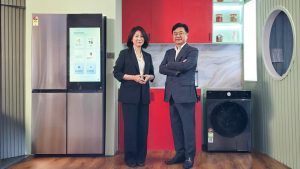
Xiaomi has formally introduced its Mijia home and lifestyle sub-brand in India, setting the stage for an expansion into large appliances. The move comes just ahead of the festive buying season, at a time when Indian consumers are moving towards larger, smarter and more premium appliances, while established Korean players continue to command a formidable position in the market.
Xiaomi is preparing for a much bigger play inside Indian homes. The company has announced the introduction of Mijia by Xiaomi in India, its dedicated home and lifestyle sub-brand, and has confirmed that upcoming large appliances will sit under the new branding.
Mijia, which translates to "Mi Home", will become the umbrella for Xiaomi’s home and lifestyle products in India. More importantly, Xiaomi says it plans to deepen its presence in existing categories such as air purifiers while strategically moving into large appliances, bringing the Home part of its global Human × Car × Home strategy into sharper focus in India.
No refrigerator, washing machine or air-conditioner has been announced for India yet, nor has Xiaomi provided a launch timeline. Still, the announcement is considerably more significant than a branding exercise. Xiaomi already has a substantial large-appliance business in China and has been expanding Mijia refrigerators, washers and air conditioners into global markets. India now appears to be getting the foundation on which a similar portfolio can be built.
Xiaomi Had Already Hinted at a Bigger Home Play to MySmartPrice
Xiaomi’s recent India moves, the direction should not come entirely as a surprise. Earlier this year, in an exclusive interaction with MySmartPrice, Xiaomi India had already indicated that its ambitions around the home would stretch beyond its existing portfolio.
Mijia now gives that earlier strategy a much clearer commercial identity. Instead of trying to stretch the Xiaomi name across an increasingly diverse collection of products, the company can use Mijia to establish a dedicated home-appliance proposition, much as its smartphone business has distinct positioning across Xiaomi, Redmi and POCO.
Premiumisation Makes the Timing Particularly Interesting
India’s appliance market is also changing in Xiaomi’s favour. Consumers are increasingly using replacement cycles to move towards larger capacities, better energy efficiency, connected features and more premium designs instead of simply replacing an old appliance with an equivalent model. Premium products accounted for around 17% of India’s home-appliance market in FY25, and industry commentary has consistently pointed towards that share increasing as buyers upgrade.
Refrigerators offer a particularly clear example. Buyers are gradually moving from basic single-door models towards frost-free, side-by-side and larger-capacity formats, pushing average selling prices higher. Similar behaviour can be seen in washing machines, where higher-capacity front-load models and washer-dryers are gaining greater attention.
All this comes at a time when Mijia’s global positioning is no longer built only around affordability.
Xiaomi describes its latest smart-appliance portfolio around premium design, intelligent technology and connected experiences. Its current international range includes products such as the Mijia Refrigerator Cross Door 502L, Mijia Front Load Washer Dryer Pro 9kg and Mijia Air Conditioner Pro Eco, all designed to connect through the Xiaomi Home ecosystem.
China goes considerably further. Xiaomi has already pushed into the ultra-premium large-appliance segment there with products such as the Mijia Central Air Conditioner Pro, while its broader Chinese portfolio has included sophisticated built-in refrigerators and dual-drum washer-dryers. Xiaomi’s smart large home-appliance revenue grew 56.4% in 2024, with shipments of ACs, refrigerators and washing machines all reaching record levels during the year.
India therefore does not require Xiaomi to create a large-appliance business from scratch. The bigger decisions will be around which products it localises, how aggressively it prices them, and how quickly it can build the distribution, installation and after-sales network required for white goods.
Strong Competition Awaits
Those last points will arguably be harder than designing the products themselves. Unlike smartphones and several smart-home categories where Xiaomi entered India while the market was still changing rapidly, refrigerators and washing machines are categories where consumer trust has been built over decades.
LG and Samsung remain particularly formidable. LG had roughly 30% value share in refrigerators and 33% in washing machines around September 2025, while Samsung was its closest major Korean rival with around 25% share in refrigerators and 16-17% in washing machines, according to industry estimates cited by JM Financial. LG was even stronger in premium categories, holding around 43% of side-by-side refrigerators.
Samsung, meanwhile, has increasingly been using connected features and AI as a premiumisation lever through its Bespoke portfolio, covering refrigerators, washing machines and other appliances. Its own India business has said premium AI-enabled appliances have been growing faster than their respective overall categories.
For Xiaomi, competing with these brands will therefore involve more than offering an impressive specification sheet or undercutting them on price. Refrigerators, ACs and washing machines are long-term purchases where installation, servicing, spare parts, warranties and reliability can carry as much weight as the product itself.
Interestingly, Xiaomi will not be the only relatively newer electronics brand looking for a larger slice of this market.
Hisense has also accelerated its large-appliance journey in India. After building its presence through televisions and air conditioners, the company entered India’s washing-machine category in July 2026 with top-load and semi-automatic models.
Two Chinese consumer-electronics companies broadening their Indian appliance portfolios at around the same time suggests the category is becoming strategically important, especially as connected-home ecosystems become a bigger part of brand roadmaps.
Mijia’s Global Portfolio Gives India Plenty to Look Forward To
Timing is another reason today’s announcement stands out. August marks the beginning of the build-up towards India’s crucial festive shopping period, when consumer-electronics brands traditionally introduce new products, expand retail offers and compete particularly aggressively for upgrade buyers.
Xiaomi has not said whether its first Mijia large appliances will arrive during the 2026 festive season. However, establishing the sub-brand now puts the company in position to begin talking about the Home ecosystem before one of the biggest purchasing periods of the year.
There is certainly no shortage of products to choose from. Globally, Xiaomi’s current appliance catalogue already spans side-by-side and cross-door refrigerators, front-load washers, washer-dryers, top-load washing machines and multiple capacities of Mijia air conditioners. Markets such as Malaysia are already seeing large-capacity refrigerators, 13kg top-load washing machines, front-load washer-dryers and inverter ACs under Mijia.
Not all of those products will necessarily make sense for India, and Xiaomi has not confirmed that any particular global model is coming here. What they do show, however, is just how broad the company’s options are.
Mijia’s arrival could consequently become one of Xiaomi India’s more important strategic moves in recent years. Smartphones may have introduced the brand to Indian consumers, while televisions and AIoT products expanded its place inside the home. Refrigerators, washing machines and ACs would take that relationship into categories with significantly longer replacement cycles and very different expectations around ownership.
For now, Xiaomi has announced the brand rather than the appliances.
What comes next will be far more interesting. If the company can bring some of the scale, connected features and product diversity already visible in China and global markets while getting localisation, pricing and after-sales support right, Mijia could give India’s large-appliance market a fresh challenger just as premiumisation is gathering momentum.