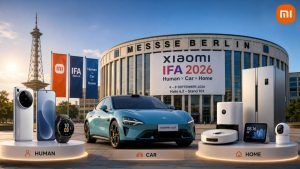
Xiaomi has made its debut at IFA 2026 in Berlin, and it is using the show to make a much broader statement than simply showcasing new consumer electronics. The company has set up a 3,300-square-metre exhibition, its largest standalone overseas booth yet, bringing together more than 380 products spanning smartphones, appliances, smart home devices, AI, robotics and electric vehicles.
At the centre of Xiaomi's IFA push is what it calls its "Human × Car × Home" ecosystem, essentially its attempt to connect personal devices, smart appliances and vehicles through Xiaomi HyperOS and AI. More interestingly, IFA also gives us a look at where Xiaomi intends to take this strategy next, including the Xiaomi 18 Fold powered by its next-generation XRING O3 chip, a wider Mijia expansion in Europe, and Xiaomi Auto's planned European entry in 2027.
Xiaomi 18 Fold and XRING O3 Make an Appearance
One of the more interesting products mentioned in Xiaomi's IFA showcase is the Xiaomi 18 Fold, which the company describes as its first flagship smartphone powered by the next-generation XRING O3 chip.
Xiaomi hasn't provided detailed specifications for either the phone or chipset in the announcement. However, the company is positioning the device as a demonstration of its work across mobile computing, foldable hardware and on-device intelligence.
The presence of the XRING O3 is particularly noteworthy because Xiaomi is continuing to invest in developing more of the technology underlying its devices in-house. The company says its semiconductor work currently includes computing architectures and NPUs, with the aim of improving areas such as on-device AI, performance and power efficiency.
For Xiaomi, therefore, the Fold is arguably as much a showcase for its silicon ambitions as it is a new smartphone.
Xiaomi Wants AI to Move Beyond Individual Devices
A large portion of Xiaomi's IFA exhibit is built around demonstrating AI across devices rather than AI features running independently on a smartphone or appliance.
The company has divided the exhibition into three areas: AI Tomorrow, AI Today and the Human × Car × Home Product Portfolio. The latter covers more than 380 products across categories including cooking, refrigeration, home cleaning, air management, entertainment, security, personal devices and mobility.
Xiaomi's demonstrations show, for example, a system using information such as a user's location, time and weather conditions to prepare lighting and air conditioning before they reach home. Another demonstration allows a user to ask the ecosystem to print a photograph they have just taken, requiring different connected devices to work together to complete the request.
The distinction Xiaomi is trying to make is important. Smart-home ecosystems have traditionally relied heavily on users setting routines or issuing explicit commands. Xiaomi's longer-term ambition appears to be an ecosystem that can use context to decide which connected devices should respond to a request.
Whether these experiences work as seamlessly outside controlled demonstrations will, of course, be the more important test.
Mijia Is Getting a Bigger European Push
IFA is also becoming a launchpad for Xiaomi's appliance ambitions.
The company announced a large-scale European expansion for Mijia, its smart-home brand. Compatible products can be controlled through the Xiaomi Home app and can interact with other devices within the ecosystem.
Mijia already spans more than 2,000 products across over 130 product categories globally, according to Xiaomi.
That expansion is worth watching because Xiaomi has increasingly moved beyond smaller connected products such as security cameras, air purifiers and robot vacuum cleaners into mainstream home-appliance categories. A broader European Mijia portfolio also gives the company another way to build an ecosystem around its smartphone users rather than competing only on individual products.
Xiaomi Auto Is Coming to Europe in 2027
Cars form the third major piece of Xiaomi's ecosystem strategy.
Xiaomi is showing three vehicles at IFA, including the Xiaomi Vision Gran Turismo concept, the new-generation Xiaomi SU7 and the performance-focused Xiaomi SU7 Ultra.
The SU7 is also being used to demonstrate the interaction between Xiaomi HyperOS, personal devices and connected homes. Xiaomi says it intends to bring its automotive business to European markets, including Germany, in 2027.
That timeline makes the IFA appearance more than a concept-car showcase. Europe is one of the first regions where Xiaomi could eventually sell all three parts of its Human × Car × Home proposition: smartphones and wearables, Mijia home products and Xiaomi vehicles.
CyberOne Is Back, This Time With a Factory Connection
Xiaomi has also brought its CyberOne humanoid robot to IFA. On the exhibition floor, the robot can respond to visitors using gestures such as finger hearts and thumbs-ups.
There is a slightly more practical side to the demonstration as well. Xiaomi says CyberOne is being trialled at its automotive factory as it evaluates the robot's perception, control and ability to execute manufacturing tasks. Xiaomi is separately experimenting with humanoid robots for production tasks such as tightening nuts on vehicles.
Xiaomi's IFA Debut Is Really About What Comes After the Smartphone
The scale of Xiaomi's first IFA appearance is notable, but the more interesting development is how deliberately the company is tying together businesses that would once have looked unrelated.
Phones remain central to Xiaomi, but the company is increasingly building around a much wider stack encompassing its own silicon, HyperOS, AI models, appliances, robotics and automobiles. Xiaomi says it expects to invest more than EUR 24 billion globally in R&D between 2026 and 2030, covering areas including AI, operating systems, semiconductors, vehicles, robotics and smart manufacturing.
IFA 2026 therefore looks less like Xiaomi simply showing hundreds of gadgets and more like an attempt to establish what the company wants its next phase to look like. The products may sit in very different categories, but Xiaomi increasingly wants the software, AI and ecosystem connecting them to be the thing that keeps users inside its world.