After spending time with Intel’s Core Ultra 200S Plus line-up, one thing becomes clear very quickly. This isn’t Intel trying to reclaim the top spot in gaming. It’s Intel trying to stay relevant where most people actually buy.
Instead of chasing AMD’s X3D chips at the very top, Intel is pushing more cores and better tuning into the mid-range. The Core Ultra 7 270K Plus and Core Ultra 5 250K Plus sit right at the centre of that shift. They don’t introduce a new architecture, but they do change how Arrow Lake behaves in real-world usage.
Test Bench and Configuration
The test setup is built to remove GPU bottlenecks and expose CPU behaviour clearly:
- CPU: Core Ultra 7 270K Plus, Core Ultra 5 250K Plus
- GPU: ASUS ROG Astral GeForce RTX 5080
- Motherboard: ASUS ROG Maximus Z890 Hero
- RAM: 32GB DDR5-7200 (G.Skill Trident Z5 RGB)
- Storage: PCIe Gen 4 SSD
- PSU: Corsair 1000W Gold
All tests were run on a clean Windows 11 install with latest drivers.
Pricing and positioning: where Intel is playing now
Intel’s strategy is immediately visible in pricing.
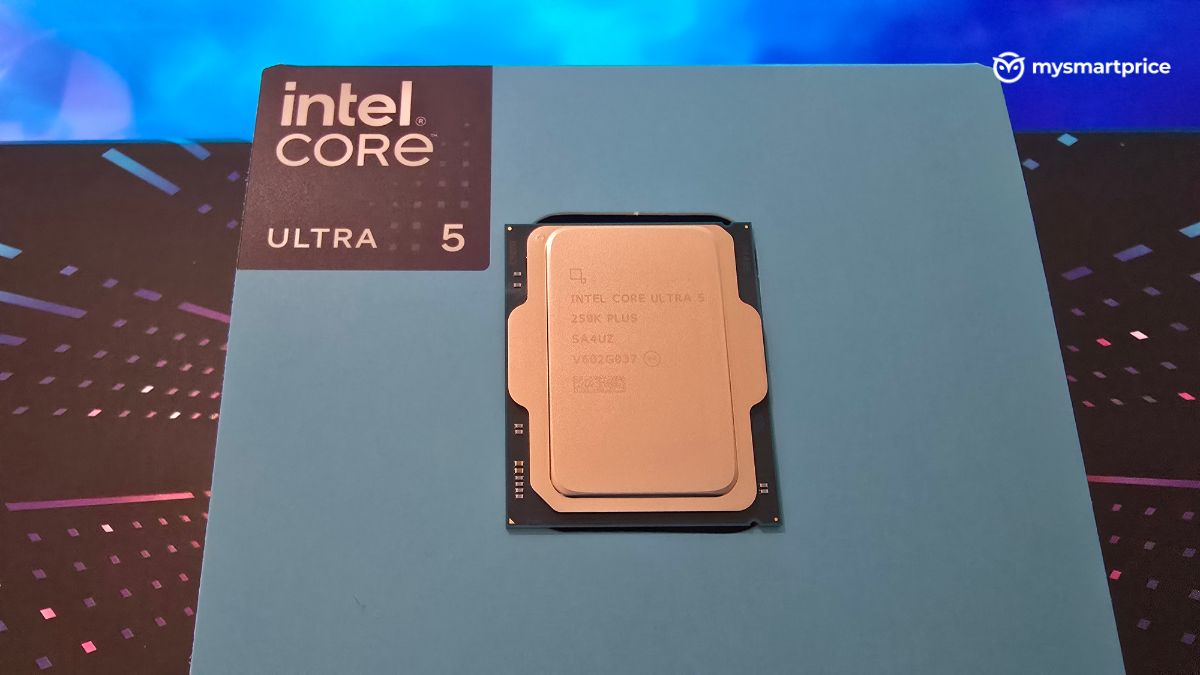
The Core Ultra 7 270K Plus sits at $299 (around ₹28,042), while the Core Ultra 5 250K Plus comes in at $199 (roughly ₹18,663). What stands out is not just the price, but the core configurations attached to it.
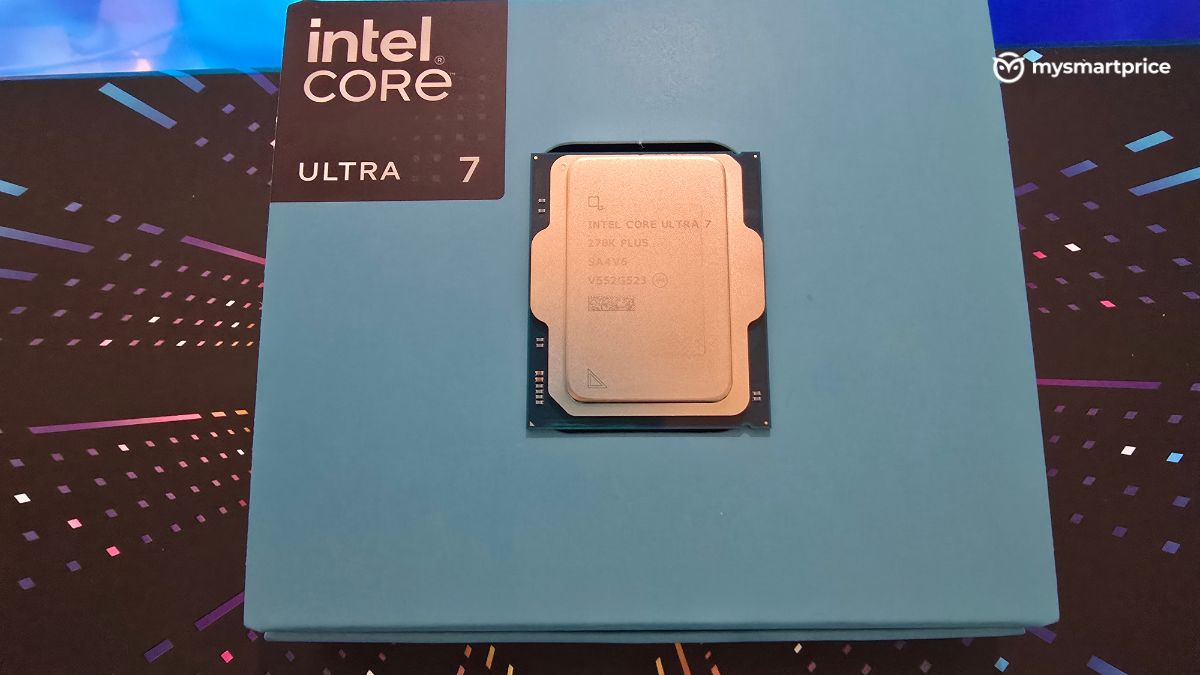
The 270K Plus delivers 24 cores with an 8P + 16E layout. The 250K Plus follows with 18 cores in a 6P + 12E configuration. A year ago, this kind of core count lived much higher up the stack.
This effectively pushes Intel’s older flagship positioning out of relevance. Instead of scaling upwards, Intel is bringing high-end core counts into more accessible segments.
Gaming performance: better, but not decisive
At 1080p, where CPU performance matters the most, both chips show clear gains.
| Processor | Cyberpunk 2077(1080p / 1440p) | Space Marine 2(1080p / 1440p) | Counter-Strike 2(1080p / 1440p) | Baldur’s Gate 3(1080p / 1440p) |
| Ultra 7 270K Plus | 196 / 140 | 130 / 95 | 766 / 682 | 156 / 127 |
| Core i7-14700K | 190 / 140 | 126 / 94 | 743 / 650 | 151 / 125 |
| Ultra 5 250K Plus | 188 / 138 | 125 / 91 | 675 / 594 | 146 / 121 |
| Core i5-14600K | 182 / 137 | 121 / 89 | 654 / 575 | 141 / 119 |
The Core Ultra 7 270K Plus consistently leads. In Cyberpunk 2077, it delivers around 196 FPS with 1% lows near 134 FPS, slightly ahead of the Core i7-14700K. The 250K Plus follows closely at around 188 FPS, maintaining a small but consistent lead over the i5-14600K.
The pattern repeats across titles like Space Marine 2 and Baldur’s Gate 3, where both chips improve average FPS and frame consistency.
In CPU-heavy games like Counter-Strike 2, the gains become more obvious. The 270K Plus pushes beyond 760 FPS with strong 1% lows, while the 250K Plus comfortably outpaces its predecessor. This is where Intel’s latency improvements start to show up.
At 1440p, the differences shrink. The GPU becomes the limiting factor, and performance between processors begins to converge. Even then, the 270K Plus holds a slight edge.
The bigger picture is simple. Peak performance hasn’t changed dramatically, but consistency has improved.
What actually changed: behaviour, not brute force
What’s interesting is where the gains are coming from.
Core clocks haven’t moved much, and there’s no major cache redesign. Instead, Intel has focused on fixing how the architecture behaves.
Interconnect speeds have been pushed from around 2.1 GHz to roughly 3.0 GHz, reducing latency between tiles. That alone addresses one of Arrow Lake’s biggest weaknesses.
On the software side, Intel is doing even more. The Intel Platform Performance Package improves thread scheduling, keeping game workloads on Performance cores and pushing background tasks to Efficiency cores. Tools like iBOT also reorganise instructions in real time to improve execution efficiency.
Put together, this is less about raw power and more about better utilisation of what’s already there.
Multi-threaded performance: where Intel wins
This is where the new chips stand out the most.
| Processor | Cinebench 2024(Multi / Single) | Geekbench 6.3(Multi / Single) |
| Ultra 7 270K Plus | 2,515 / 140 | 23,966 / 3,325 |
| Core i7-14700K | 1,900 / 125 | 18,800 / 2,900 |
| Ultra 5 250K Plus | 1,872 / 134 | 20,643 / 3,220 |
| Core i5-14600K | 1,390 / 115 | 16,000 / 2,700 |
The Core Ultra 7 270K Plus delivers a Cinebench 2024 multi-core score of 2,515 and around 23,966 in Geekbench 6. That’s a clear jump over the i7-14700K.
The Core Ultra 5 250K Plus also shows strong scaling, moving from roughly 1,390 to 1,872 in Cinebench and crossing 20,000 in Geekbench multi-core.
Single-core gains are modest across both chips. The real story is multi-threaded throughput.
For creators, developers, and anyone running parallel workloads, these chips offer a noticeable improvement at their price point.
Power and thermals: the cost of more cores
There is a trade-off. Both CPUs carry a base TDP of 125W, but under load, power draw increases sharply. The 270K Plus can reach up to 250W, while the 250K Plus peaks around 159W.
| Processor | Temperature (°C) | Power Consumption (W) |
| Ultra 7 270K Plus | 78 | 142 |
| Core i7-14700K | 73 | 135 |
| Ultra 5 250K Plus | 66 | 96 |
| Core i5-14600K | 65 | 90 |
This results in higher temperatures, especially on the Ultra 7. It runs noticeably hotter and requires strong cooling to maintain performance.
The 250K Plus is easier to manage, but it still consumes more power than its predecessor.
Final verdict: a correction that works
The Core Ultra 7 270K Plus and Core Ultra 5 250K Plus are solid CPUs.
They improve gaming consistency, deliver strong multi-threaded performance, and bring high core counts into more affordable price segments. That alone makes them relevant.
At the same time, this doesn’t feel like a breakthrough. It feels like Intel fixing what should have worked the first time.
Arrow Lake is now more competitive, but the overall landscape hasn’t shifted dramatically. What has changed is the value equation.
This generation sets a new baseline for what mid-range CPUs should look like. The real question is whether Intel can build on this with its next architecture.
For now, this is a step in the right direction.