Although both chipsets are based on a 4nm process node, their CPU configurations set them apart, leading to different priorities. While the Snapdragon 7s Gen 4 focuses more on power efficiency, the Snapdragon 7 Gen 4 favours performance gains.
This brings us to the key question: which processor delivers a better everyday experience on these smartphones? To answer it, we compared the Snapdragon 7s Gen 4 in the Redmi Note 15 Pro Plus with the Snapdragon 7 Gen 4 in the Realme 16 Pro Plus, focusing on CPU and GPU performance. Our testing included CPU and GPU benchmarks, as well as gaming sessions featuring BGMI and Wuthering Waves. Here’s what we found.
Understanding the CPU Specs and Our Testing Process
Before heading into the showdown, let’s take a closer look at the differences between the Snapdragon 7s Gen 4 and the Snapdragon 7 Gen 4:
|
Qualcomm Snapdragon 7 Gen 4 |
Qualcomm Snapdragon 7s Gen 4 |
| Process Node |
4nm |
4nm |
| CPU Configuration |
1x Cortex-A720 @ 2.8 GHz (Prime Core)
4x Cortex-A720 @ 2.4 GHz (Performance Core)
3x Cortex-A520 @ 1.8 GHz (Efficiency Core) |
1x Cortex-A720 @ 2.7 GHz (Prime Core)
3x Cortex-A720 @ 2.4 GHz (Performance Core)
4x Cortex-A520 @ 1.8 GHz (Efficiency Core) |
| GPU |
Adreno 722 |
Adreno 810 |
The prime core inside the Snapdragon 7 Gen 4 SoC runs at a higher frequency than the one in the Snapdragon 7s Gen 4 SoC. In theory, the Snapdragon 7 Gen 4 SoC has an advantage over the latter in tasks that demand immediate, maximum power for short durations, such as launching an app, rendering a heavy webpage, or processing the main logic of a game.
Additionally, the Snapdragon 7 Gen 4 features an additional performance core at the expense of an efficiency core, whereas the Snapdragon 7s Gen 4 prioritises efficiency cores. This suggests that the Snapdragon 7 Gen 4 can maintain high frame rates after the game has loaded more effectively than the latter.
That said, this is what we expect based solely on specifications. To see how their architectural differences translate into real-world performance, we put them through these CPU and GPU benchmarks:
- Antutu V11
- Geekbench CPU and GPU
- CPU Throttling (15 Minutes and 20 Threads)
- 3DMark
Since smartphone brands have been reported to optimise benchmark results through software tweaks, we also relied on these games alongside benchmarks for a fairer evaluation:
- BGMI
- Wuthering Waves
It’s worth noting that we ran these games for 20 minutes each on the Realme 16 Pro Plus and the Redmi Note 15 Pro Plus.
What the Tests Revealed
With the CPU architecture and benchmark methodology covered, it’s time to examine how the Snapdragon 7s Gen 4 and the Snapdragon 7 Gen 4 hold up in our performance test:
|
Qualcomm Snapdragon 7 Gen 4 (Realme 16 Pro Plus) |
Qualcomm Snapdragon 7s Gen 4 (Redmi Note 15 Pro Plus) |
| Antutu |
1480753 |
1047274 |
| Antutu CPU |
582883 |
399687 |
| Geekbench Single-Core |
1287 |
1266 |
| Geekbench Multi-Core |
4011 |
3154 |
| CPU Throttling |
81% |
94% |
Since Antutu is a comprehensive benchmarking tool, multiple factors contribute to a smartphone’s overall score. Its parameters include CPU, GPU, Memory, and UX. Faster storage and better software optimisation push the Realme 16 Pro Plus ahead of the Redmi Note 15 Pro Plus in the overall Antutu score.
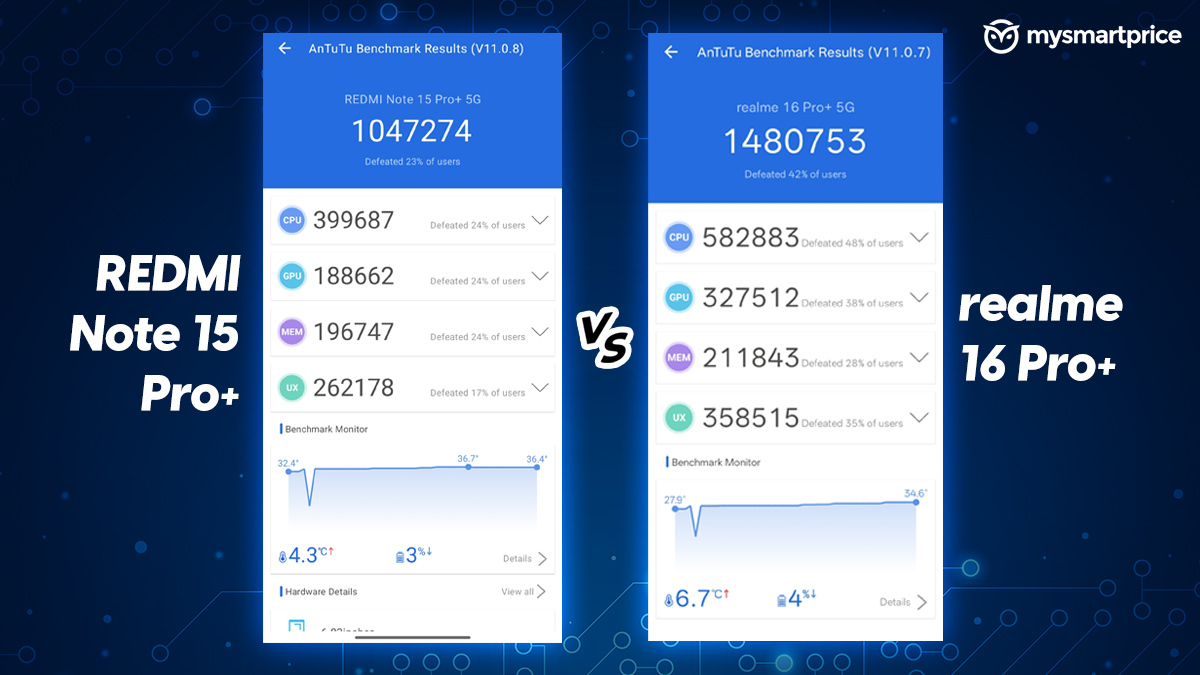
That’s why it’s essential to focus on the Antutu CPU score, as no other parameter influences its result. Even when isolating the CPU score, the Snapdragon 7 Gen 4 in the Realme 16 Pro Plus still outperforms the Snapdragon 7s Gen 4 used in the Redmi Note 15 Pro Plus.
According to Geekbench, the similar single-core scores indicate that both processors can open apps at the same speed and maintain a responsive UI during scrolling. That said, the higher multi-core score highlights that the Snapdragon 7 Gen 4 SoC excels in multi-threaded tasks, such as 4K video export or multitasking.
The CPU throttling results indicate that the Snapdragon 7s Gen 4 chipset can sustain performance better than the Snapdragon 7 Gen 4 SoC under heavy workloads.
|
Qualcomm Snapdragon 7 Gen 4 (Realme 16 Pro Plus) |
Qualcomm Snapdragon 7s Gen 4 (Redmi Note 15 Pro Plus) |
| Antutu GPU |
327512 |
188662 |
| Geekbench GPU |
4773 |
3569 |
| 3DMark Wild Life Extreme |
2107 |
1113 |
| 3DMark Wild Life Extreme Stress Test |
95.5% |
99.4% |
Antutu simulates console-grade gaming on smartphones and measures the number of frames per second they can output to assess GPU performance. As the Snapdragon 7 Gen 4 scores nearly twice as high as the Snapdragon 7s Gen 4 here, it shows a clear advantage in handling visually demanding games. Its real-world performance in titles such as Wuthering Waves is discussed later in the article.
Geekbench GPU measures the smartphone’s GPU potential in terms of productivity, including image processing, face detection, and physics simulation. The higher score indicates that the 7 Gen 4 SoC can render videos and apply filters to a 4K photo more quickly than the Snapdragon 7s Gen 4 processor.
The 3DMark Wild Life Extreme mirrors mobile games, with a resolution of 3840×2160 pixels, and measures the peak performance of a smartphone over a short period. The Snapdragon 7 Gen 4 SoC maintains its lead here as well, indicating that it can handle graphically demanding games better.
However, the Snapdragon 7s Gen 4 gains an upper hand in the 3DMark Wild Life Extreme Stress test, which evaluates the device’s performance stability under heavy workload. This reinforces that the Snapdragon 7s Gen 4 is designed to deliver consistent performance over an extended period.
|
Qualcomm Snapdragon 7 Gen 4 (Realme 16 Pro Plus) |
Qualcomm Snapdragon 7s Gen 4 (Redmi Note 15 Pro Plus) |
| BGMI Average Frame Rate |
58.9fps |
59.6fps |
| BGMI 5% Low Frame Rate |
54.5fps |
56.3fps |
On the Realme 16 Pro Plus and the Redmi Note 15 Pro Plus, BGMI is set to run at the lowest graphics settings.

Interestingly, the Redmi Note 15 Pro Plus supports only a 60fps frame rate at the lowest settings, while the Realme 16 Pro Plus can push the frame rate up to 90fps. In the spirit of fairness, the frame rate on the Realme 16 Pro Plus is lowered.
Both smartphones maintain a frame rate of 60fps throughout the 20-minute round, as indicated by the average frame rate. However, the Redmi Note 15 Pro Plus exhibits slightly better frame stability, given the least variance between the average frame rate and the 5% low-frame-rate threshold.
|
Qualcomm Snapdragon 7 Gen 4 (Realme 16 Pro Plus) |
Qualcomm Snapdragon 7s Gen 4 (Redmi Note 15 Pro Plus) |
| Wuthering Waves Average Frame rate |
29.9fps |
32.3fps |
| Wuthering Waves 5% Low Frame Rate |
15.3fps |
14.8fps |
Wuthering Waves is configured to run at high settings and a frame rate of 60fps on both devices.

The Realme 16 Pro Plus and the Redmi Note 15 Pro Plus fall short of reaching the desired result throughout the run. Having said that, the Redmi Note 15 Pro Plus keeps the frame rate comparatively steadier, as indicated by the average frame rate.
On the contrary, the Realme 16 Pro Plus delivers a steadier gameplay experience, considering the marginal difference between its average frame rate and 5% low-frame-rate threshold.
Takeaway:
On closer inspection, benchmarks and real-world testing reveal a clear split in how these two chipsets approach performance. The Snapdragon 7s Gen 4 chipset inside the Redmi Note 15 Pro Plus prioritises efficiency and proves to be a highly dependable performer, excelling at maintaining stable output over extended periods. This consistency translates into a smooth everyday experience, although it falls behind in peak benchmarks such as AnTuTu and Geekbench multi-core tests.
The Snapdragon 7 Gen 4, on the other hand, offers superior raw power. Its higher scores across both CPU and GPU benchmarks give it a noticeable advantage, particularly for high-end gaming and demanding workloads such as 4K video editing. For users seeking the highest possible performance for intensive use, the Snapdragon 7 Gen 4 in the Realme 16 Pro Plus is the more capable chipset.