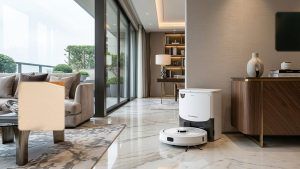
As Indian homes slowly warm up to robot vacuums, a parallel shift is underway in commercial spaces where the scale of cleaning is far more demanding. Malls, airports, hospitals, and large office campuses are dealing with rising manpower costs, inconsistent workforce availability, and the need to maintain hygiene across longer operating hours. This is pushing facility management toward automation, particularly in floor care.
Milagrow is now looking to tap into that opportunity with the launch of the Spaze, an autonomous floor-cleaning robot designed specifically for large, high-traffic indoor environments.
Built for Continuous Cleaning in High-Footfall Spaces
Unlike residential robot vacuums that focus on convenience, Spaze is built around continuous operation and large-area coverage. The system combines sweeping, scrubbing, vacuuming, and mopping into a single unit, allowing it to handle both dry debris and liquid spills commonly found in commercial environments.
The robot can also detect carpets and automatically adjust its cleaning approach by increasing suction while disabling mopping functions to avoid moisture damage. Milagrow says the system delivers up to 15,000Pa suction and can cover areas of up to 40,000 square feet, making it suitable for large-format spaces such as malls, hospitals, and corporate campuses.
A 24V, 40,000mAh battery supports up to 12 hours of operation, enabling extended cleaning cycles with minimal downtime. Operating noise is kept under 70dB, allowing it to function during business hours without causing disruption.
Navigation and Autonomy Designed for Dynamic Environments
Spaze is built to operate in environments where movement is constant and layouts are often complex. It uses a combination of LiDAR-based mapping, cameras, and sensor systems to navigate safely while adapting to people, carts, and temporary obstacles in real time.
The robot is designed to clean close to walls and corners while also manoeuvring through tight areas such as corridors, elevators, and access points. This becomes particularly important in commercial settings where layout constraints are far more demanding than residential spaces.
Automation extends beyond navigation. The robot can return to its workstation to clean its pads, refill water, and discharge wastewater with minimal human intervention. It also recharges automatically and resumes cleaning from where it stopped. Milagrow has also integrated patrol-based cleaning, allowing the robot to identify and respond to stains during routine operation.
A Shift Toward Managed, IoT-Led Facility Cleaning
For facility teams, Spaze integrates with cloud-based systems that enable real-time monitoring, scheduling, and reporting. Operators can manage cleaning tasks remotely, track performance, and coordinate multiple robots across large spaces.
This kind of connected system is increasingly becoming relevant as commercial cleaning moves toward predictable, data-driven workflows rather than manual supervision. Features such as remote task allocation and fleet coordination suggest that robots like Spaze are being positioned not just as machines, but as part of a larger facility management ecosystem.
Where Commercial Robotics Fits in India's Cleaning Landscape
The launch of Spaze highlights how robotics adoption in India is beginning to diverge across segments. While residential robot vacuums are still evolving around affordability and user behaviour, commercial deployments are driven by efficiency, consistency, and operational scale.
In high-footfall environments, where cleaning needs to be continuous and standardised, automation offers clearer returns. Systems like Spaze are less about convenience and more about reducing manpower dependency, improving uptime, and maintaining hygiene benchmarks without variability.
Milagrow has priced the Spaze at Rs 36,84,990, placing it firmly in the enterprise segment. The robot is available through the company's website and Vijay Sales, with adoption expected to be led by institutional buyers rather than retail consumers.