Rising memory costs have changed what buyers can expect from the Rs 40,000 smartphone segment in India. Counterpoint Research says smartphone memory prices rose by more than 80% quarter on quarter in Q2 2026, pushing bill of materials costs for mid-range models up 52% year on year. Its India launch tracker also found that the average launch price of new smartphones climbed 11% year on year to Rs 37,200 in Q1 2026 as brands adjusted pricing and specifications to absorb higher component costs.
That matters in a price band that was once an easy place to find a strong all-rounder. In the current market, getting a phone below Rs 40,000 that combines consistently good cameras, strong performance, dependable battery life, a good display and solid build quality without an obvious compromise is much harder. For this comparison, we picked four recent launches that are among the most relevant options in this segment: the Motorola Edge 70 Pro, Nothing Phone 4a, vivo V70 FE and the OnePlus Nord CE6. Each takes a different approach and each has clear strengths and weaknesses.
Our objective is to identify the best camera-centric all-rounder among these four, not simply the phone with the highest single camera score, biggest battery or fastest chipset. We are looking for the recommendation with the fewest meaningful compromises and the strongest overall experience, with camera performance as the key focus. To arrive at that recommendation, we put our camera tests, full reviews and benchmark data ahead of the specification sheet.
Camera Phone Report Card: Our Picks at a Glance
The table below gives you the answer before the deep dive. We have also placed our original performance test reports and available full reviews inside the table, so you can jump directly to the underlying test data or camera samples.
| Phone | Approx. Price | MSP Camera Score* | What the Tests Say | Main Compromise | Our Pick |
|---|---|---|---|---|---|
| Motorola Edge 70 Pro | Rs 37,999 | 8.2/10 | 8.7 main; 8.8 selfie; 8.8 rear video; strongest performance here | No dedicated telephoto; battery endurance trails vivo and OnePlus | Best Camera Centric All Rounder |
| Nothing Phone 4a | Rs 36,250 | 7.9/10 | 3.5x OIS periscope; 8.0 scores across ultrawide, telephoto, portrait, selfie and video | 7.5 main camera score; much lower peak performance than Motorola | Best for Zoom / Camera Value |
| vivo V70 FE | Rs 40,000 | 7.6/10 | 8.5 main + 8.5 portrait; 28h 13m PCMark battery result | 6.5 ultrawide and 6.5 front video; no dedicated optical telephoto | Best Battery Life With a Strong Main Camera |
| OnePlus Nord CE6 | Rs 37,999 | 7.0/10 | 8.5 main + 8.5 rear video; 24h 36m PCMark battery result | No ultrawide and no dedicated telephoto | Battery / Durability Alternative |
Score note: The camera scores are calibrated to each phone’s price segment.
Price note: prices were checked as on August 28, 2026, for the relevant base variants.
Our Recommendation At a Glance
The Motorola Edge 70 Pro is our best camera centric all rounder among these four phones under Rs 40,000. It posts the highest overall camera score among these four and is especially strong for the main camera, selfies and video. It also has a huge performance advantage over the other three.
Choose the Nothing Phone 4a if zoom matters more than outright speed. Its 3.5x OIS periscope is the one piece of camera hardware Motorola cannot match, and Nothing is remarkably consistent across its secondary camera tests.
The vivo V70 FE makes most sense for buyers who mainly shoot at 1x and want long battery life. Its 200MP main camera and portrait results are strong, but the ultrawide and front video scores pull down the complete camera experience.
The OnePlus Nord CE6 is the least camera centric choice here. Its primary camera and rear video test well, but the absence of both an ultrawide and a dedicated telephoto leaves it with far less framing flexibility than the others.
How the Four Compare in Our Camera Tests
We are putting the lab results before the spec sheet because this is the part of the comparison that is original to our lab tests and reports. The scores show not only which phone has the strongest primary camera, but also where quality drops when you switch to another lens, the selfie camera or video.
| Phone | Overall | Main | Ultra Wide | Telephoto | Portrait | Front | Rear Video | Front Video |
|---|---|---|---|---|---|---|---|---|
| Motorola Edge 70 Pro | 8.2/10 | 8.7 | 7.9 | N/A | 8.2 | 8.8 | 8.8 | 8.6 |
| Nothing Phone 4a | 7.9/10 | 7.5 | 8.0 | 8.0 | 8.0 | 8.0 | 8.0 | 8.0 |
| vivo V70 FE | 7.6/10 | 8.5 | 6.5 | N/A* | 8.5 | 7.0 | 7.5 | 6.5 |
| OnePlus Nord CE6 | 7.0/10 | 8.5 | N/A | N/A* | 8.0 | 7.5 | 8.5 | 7.5 |
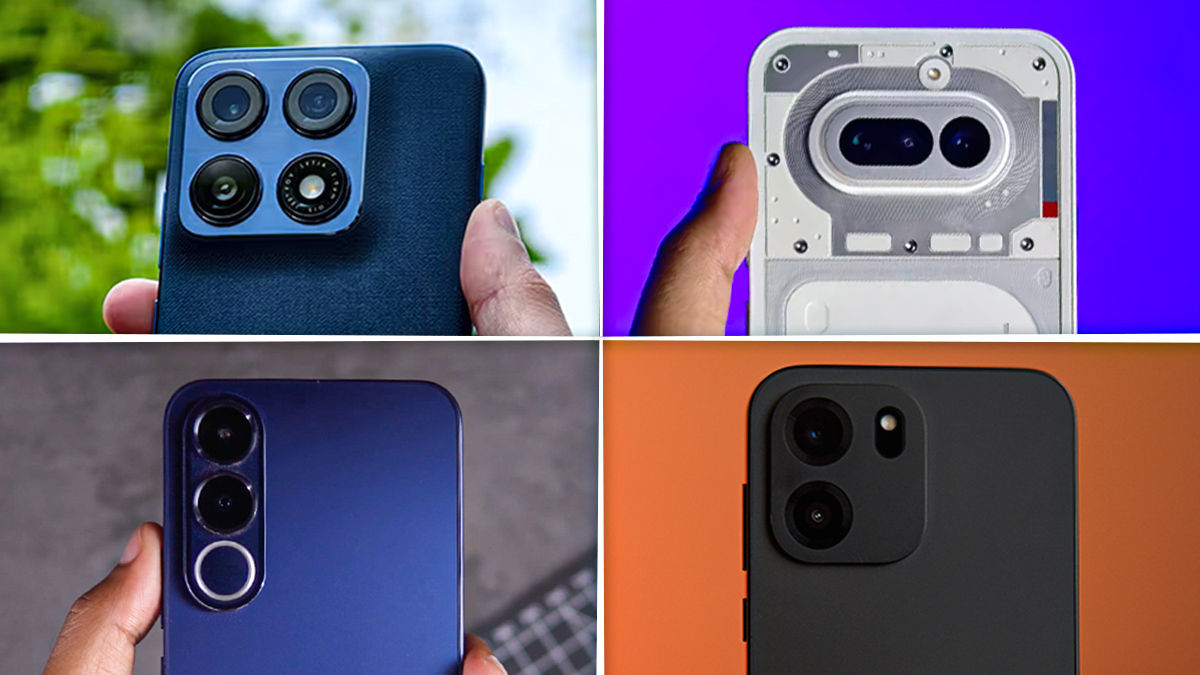
Motorola has the highest overall score, but the more useful story is where that advantage comes from. It scores 8.7 for the main camera, 8.8 for selfies, 8.8 for rear video and 8.6 for front video. Its 7.9 ultrawide result is also competitive, so there is no large quality collapse when you move away from the primary camera, except that there is no optical telephoto to move to.
Nothing is almost the inverse. Its 7.5 main camera score is the lowest primary camera result among the four, but its supporting cameras are consistent: the ultrawide, telephoto, portrait, selfie, rear video and front video categories all score 8.0. If you switch lenses often, that consistency is valuable.
vivo looks very capable if you judge it only on its main camera. The 200MP main camera and portrait mode both score 8.5. The weakness appears when you switch cameras: the ultrawide drops to 6.5, the front camera to 7.0 and front video to 6.5.
OnePlus makes the same point in a different way. Its main camera and rear video both score 8.5, but the camera system itself is limited. With no ultrawide and no optical telephoto, a good primary sensor has to cover far more shooting situations than it should on a camera focused phone.
How to Read These Scores
The linked lab test report pages in the above table clarify that the ratings are calibrated to each phone’s price segment. The segments overlap but are not identical: Motorola is scored in roughly the mid Rs 30,000 to low Rs 40,000 band, Nothing in the low Rs 30,000 to high Rs 30,000 band, vivo in the upper Rs 30,000 to mid Rs 40,000 band, and OnePlus in the low Rs 30,000 to high Rs 30,000 band. That makes the scores most useful as test based directional evidence rather than perfectly price neutral laboratory measurements.
For that reason, this comparison does not simply sort the phones by the overall number. We also look at the individual mode scores, the physical camera hardware, focal length coverage and the rest of the phone. A telephoto lens, for example, can change what you are able to frame even when the main camera score is lower.
Camera Hardware: Specifications Compared
| Phone | Main Camera | Ultra Wide | Telephoto / Zoom | Front Camera | Video |
|---|---|---|---|---|---|
| Motorola Edge 70 Pro | 50MP Sony LYTIA 710; OIS | 50MP Samsung JN5; autofocus; macro capable | No dedicated telephoto | 50MP Samsung JN5; autofocus | 4K60 across all cameras in our review testing |
| Nothing Phone 4a | 50MP; OIS; f/1.88 | 8MP; 120° FOV | 50MP 3.5x periscope; OIS | 32MP | Up to 4K30 rear; 1080p60 front in detailed review |
| vivo V70 FE | 200MP; 1/1.56 inch; f/1.88; OIS; AF | 8MP; 120°; fixed focus | No dedicated optical telephoto; AI/crop zoom from main | 50MP; autofocus; 92° | 4K rear and front |
| OnePlus Nord CE6 | 50MP; dual axis OIS; PDAF | None; 2MP assistance camera | No dedicated optical telephoto | 32MP; autofocus; 90° | 4K video front and rear |
This table explains why the Motorola versus Nothing decision is not as simple as the overall score. Motorola puts more emphasis on the cameras most people use every day: main, ultrawide, selfie and video. Nothing spends part of its camera budget on something Motorola simply does not offer, a real 3.5x optical periscope.
The Indian Motorola Edge 70 Pro in this comparison has a 50MP main camera and 50MP ultrawide at the rear. It does not have a dedicated telephoto camera. That point is worth stating explicitly because the Edge 70 family has multiple similarly named models and specifications can be easy to mix up.
vivo takes a high resolution approach with a 200MP main sensor and then relies on crop and AI assisted zoom rather than a physical telephoto. The OnePlus Nord CE6 goes even further toward a primary camera first setup: its second rear sensor is only an assistance camera, so there is no ultrawide or optical zoom lens.
Where Each Phone Gains and Gives Something Up
Motorola Edge 70 Pro: Best Across the Cameras You Will Use Most
Motorola’s advantage is consistency across everyday camera use. In our lab test it scores 8.7 for the main camera, 8.8 for the front camera, 8.8 for rear video and 8.6 for front video. The detailed review reinforces that result: the Sony LYTIA 710 main sensor produces detailed, balanced daylight images, and low light photography is a particular strength thanks to good noise control and OIS. It is not flawless. Our review also found that HDR can occasionally become aggressive and flatten contrast, while the lab report notes some inconsistency in skin tone reproduction.
The ultrawide also contributes rather than merely filling a spec sheet slot. It has autofocus, works for macro shots and maintains respectable colour consistency with the main camera. The autofocus selfie camera is another practical advantage for group selfies and video, and the review found 4K60 recording available across all cameras.
The trade off is not image quality at 1x; it is framing flexibility at longer focal lengths. There is no dedicated telephoto, so buyers who regularly shoot wedding stages, school events, concerts or compressed telephoto portraits have a clear reason to prefer Nothing.
Read: Motorola Edge 70 Pro 5G Performance Test and Benchmarks Based Review
Read: Motorola Edge 70 Pro Review: Pros, Cons and Verdict
Nothing Phone 4a: The Only One Here With Proper Optical Zoom
Nothing is the most versatile camera system in the conventional sense because it covers main, ultrawide and a real 3.5x telephoto. Its lab scores reinforce the appeal of that setup: the telephoto, ultrawide, portrait, selfie and both video categories all score 8.0.
The detailed review found the periscope especially useful for portraits and close up work because it gives more natural subject separation than digital crop zoom. It also keeps distant subjects clearer without forcing you to move closer, useful at a cricket match, concert, school function or wedding stage.
The cost of that versatility is the primary camera result. At 7.5, Nothing’s main camera score is below Motorola, vivo and OnePlus. So this is not the phone to choose simply because you want the best 1x result. It is the phone to choose when you value focal length flexibility enough to accept a lower primary camera score and lower overall performance.
Read: Nothing Phone 4a Performance Test and Benchmarks Based Review
Read: Nothing Phone 4a Review: Pros, Cons, and Verdict
vivo V70 FE: Strong at 1x, Less Convincing When You Switch Cameras
The V70 FE is the easiest phone here to overrate from the spec sheet. The 200MP badge is impressive, and the 8.5 main camera score gives that headline some substance. Portrait mode also scores 8.5, making vivo a strong choice when most of your photography happens on the primary camera.
The weaknesses appear as soon as you move beyond that. The ultrawide scores 6.5, the selfie camera 7.0 and front video 6.5. Our test lab report also calls out inconsistent camera output, including softer detail, less natural colour and grain in indoor 4K front video.
vivo promotes 200MP cropping and AI assisted zoom, but the published camera hardware lists only the 200MP main and 8MP wide angle cameras on the rear. That is useful digital flexibility, not a substitute for Nothing’s optical periscope when the subject is genuinely far away.
Read: vivo V70 FE Performance Test and Benchmarks Based Review
OnePlus Nord CE6: Good Main Camera, Not Enough Camera Hardware
The Nord CE6 is a good example of why one strong camera does not automatically make a camera phone. Its main camera scores 8.5 and rear video also scores 8.5, which is competitive with the best individual results here.
The problem is what happens when you want a wider or longer view. OnePlus does not give you an ultrawide, and there is no dedicated telephoto. The second rear sensor is a 2MP assistance camera, so the 50MP main sensor has to cover landscapes, normal shots, portraits and digital zoom.
That is acceptable for a buyer whose priorities are battery life, performance and durability with occasional photography. It is much harder to justify for someone explicitly shopping for a camera centric all rounder near Rs 40,000.
Read: OnePlus Nord CE 6 5G Performance Test and Benchmarks Based Review
How the Four Compare in Performance and Battery Tests
If the camera comparison between Motorola and Nothing looks relatively close, the rest of the lab data strengthens Motorola’s case as the better all rounder. Processing headroom matters for HDR, portrait segmentation, high resolution capture, video encoding, editing and simply keeping the phone fast over several years.
| Phone | AnTuTu | Geekbench 6 Single / Multi | 3DMark Wild Life Extreme | PCMark Work 3.0 | 3DMark Stability | PCMark Battery |
|---|---|---|---|---|---|---|
| Motorola Edge 70 Pro | 2,136,881 | 1,720 / 6,705 | 4,397 | 15,745 | 47.5% | 16h 17m |
| Nothing Phone 4a | 1,181,112 | 1,261 / 3,319 | 1,116 | 11,510 | 99.4% | 16h 10m |
| vivo V70 FE | 964,946 | 994 / 3,052 | 868 | 10,836 | 99.5% | 28h 13m |
| OnePlus Nord CE6 | 1,153,170 | 1,095 / 3,133 | 1,119 | 10,618 | 99.7% | 24h 36m |
Motorola is in a different performance class. Its AnTuTu score is about 2.14 million, versus roughly 1.18 million for Nothing, 1.15 million for OnePlus and 0.96 million for vivo. The gap is even clearer in 3DMark and Geekbench multi core, and Motorola’s UFS 4.1 storage also records much higher sequential speeds than the UFS 3.1 phones.
That does not mean Motorola wins every performance metric. Its 47.5% 3DMark stability result is much lower than the 99%+ results of the other three, so the phone gives up considerably more peak GPU performance during a long graphics stress loop. For photography and normal daily use, however, it still has far more processing headroom.
Battery life reverses the order. vivo leads at 28 hours 13 minutes in PCMark, while OnePlus reaches 24 hours 36 minutes. Motorola and Nothing are both around 16 hours. For long travel days, weddings or extended video capture away from a charger, vivo and OnePlus have a real endurance advantage.
Beyond Camera: Display, Build and Charging Specifications Compared
| Phone | Processor / Storage | Display | Build / Protection | Battery / Charging |
|---|---|---|---|---|
| Motorola Edge 70 Pro | Dimensity 8500 Extreme; UFS 4.1 | 6.8 inch 1.5K Extreme AMOLED; 144Hz | 183g review unit; Gorilla Glass 7i; IP68/IP69; MIL STD 810H | 6,500mAh; 90W wired; no wireless charging |
| Nothing Phone 4a | Snapdragon 7s Gen 4; UFS 3.1 | 6.78 inch 1.5K flexible AMOLED; 120Hz; 2,160 nit tested peak | 205g; Gorilla Glass 7i; IP64 | 5,400mAh; 50W wired |
| vivo V70 FE | Dimensity 7360 Turbo; UFS 3.1 | 6.83 inch 2800 x 1260 AMOLED; 120Hz | 200 202g; IP68/IP69 | 7,000mAh; 90W wired |
| OnePlus Nord CE6 | Snapdragon 7s Gen 4; UFS 3.1 | 6.78 inch 1.5K AMOLED; 144Hz | 215g; IP66/IP68/IP69/IP69K | 8,000mAh; 80W wired; 27W reverse charging |
Motorola’s broader advantage is that it combines the best camera result with the fastest chipset and storage while remaining the lightest phone here in the reviewed 183g finish. That matters if you want one device to handle photography, editing, gaming and daily use rather than a specialist camera phone.
Nothing counters with the strongest display score in its own lab report, distinctive design and a clean software experience, but it gives up a lot of peak performance. vivo and OnePlus are much heavier but make up for it with large batteries and stronger water/dust protection. Those trade offs matter if the phone will spend long days outdoors or away from a charger.
Which One Should You Buy?
Best Camera Centric All Rounder: Motorola Edge 70 Pro
Pick Motorola if you want the strongest blend of tested camera quality and overall phone performance. It has the highest camera score here, excellent main/selfie/video results, a useful autofocus ultrawide and much more processing headroom than the other three. The one question to ask yourself is whether you can live without optical telephoto zoom.
Best for Zoom and Focal Length Flexibility: Nothing Phone 4a
Pick Nothing if you regularly shoot distant subjects or prefer telephoto portraits. The 3.5x OIS periscope is a capability the other three cannot match optically, while its supporting camera scores are consistently solid. You sacrifice primary camera score and peak performance, but gain the most flexible lens set.
Best Battery Life With a Strong Main Camera: vivo V70 FE
Pick vivo if most of your photos are taken on the main camera and you also want exceptional battery life. The 200MP primary and portrait results are strong, but this is not the best option if ultrawide quality, selfies, front video or optical zoom matter equally.
Best Battery / Durability Alternative: OnePlus Nord CE6
Pick OnePlus if battery capacity, ruggedness and a capable 1x camera matter more than camera flexibility. It is a strong all day phone, but we would not choose it specifically for photography at this price because the missing ultrawide and telephoto are significant compromises.
Verdict
For the best camera centric all rounder under Rs 40,000 among these four, the Motorola Edge 70 Pro is our recommendation. It wins because the cameras most buyers use most often, main, selfie and video, test strongly, the ultrawide is useful, and the rest of the phone has substantially more performance headroom than its rivals.
The Nothing Phone 4a is the more interesting alternative for a specific kind of camera buyer. Its overall score is a little lower, but its 3.5x OIS periscope changes what you can shoot. If zoomed portraits, school events, concerts, cricket or travel details are a regular part of your camera use, that lens may matter more to you than Motorola’s performance lead.
vivo is the 1x and battery specialist, while OnePlus is the battery and durability option with a good main camera. Neither gives us as complete a camera-first recommendation as Motorola or Nothing.
Frequently Asked Questions
- Which is the best camera phone under Rs 40,000 among these four?
The Motorola Edge 70 Pro is our pick for the best camera-centric all-rounder. It scores 8.2/10 overall in our camera testing and is particularly strong for the main camera, selfies, and video. If optical zoom is a priority, choose the Nothing Phone 4a instead.
- Does the Motorola Edge 70 Pro have optical zoom?
No. The Indian Motorola Edge 70 Pro compared here does not have a dedicated telephoto camera. Its rear setup uses a 50MP main camera and 50MP ultrawide. That is its biggest camera hardware limitation.
- Which phone is best for Zoom photography?
The Nothing Phone 4a. Its 50MP periscope provides 3.5x optical zoom with OIS, and the telephoto mode scores 8.0 in our testing. It is the clear choice here for distant subjects and telephoto portraits.
- Which phone is best for selfies and front camera video?
The Motorola Edge 70 Pro has the strongest tested front camera result in this group: 8.8 for selfies and 8.6 for front video. Its 50MP front camera also has autofocus.
- Does the vivo V70 FE have a telephoto camera?
No dedicated optical telephoto is listed in vivo’s camera specifications. The rear hardware is a 200MP OIS main camera plus an 8MP wide-angle camera. Vivo uses high-resolution cropping and AI-assisted zoom from the main sensor.
- Does the OnePlus Nord CE6 have an ultrawide camera?
No. Its rear system is a 50MP OIS primary camera plus a 2MP assistance camera. That is the main reason we do not recommend it as the camera first choice despite good primary camera and rear video scores.
- Which phone has the best battery life in our tests?
The vivo V70 FE leads the PCMark battery test at 28 hours 13 minutes. The OnePlus Nord CE6 is second at 24 hours 36 minutes. Motorola and Nothing are both a little over 16 hours.
- Which is the best overall phone under Rs 40,000 in this comparison?
The Motorola Edge 70 Pro. It combines the strongest overall camera result with by far the highest CPU, GPU and storage performance here. Nothing remains the better fit if optical telephoto zoom is non-negotiable.