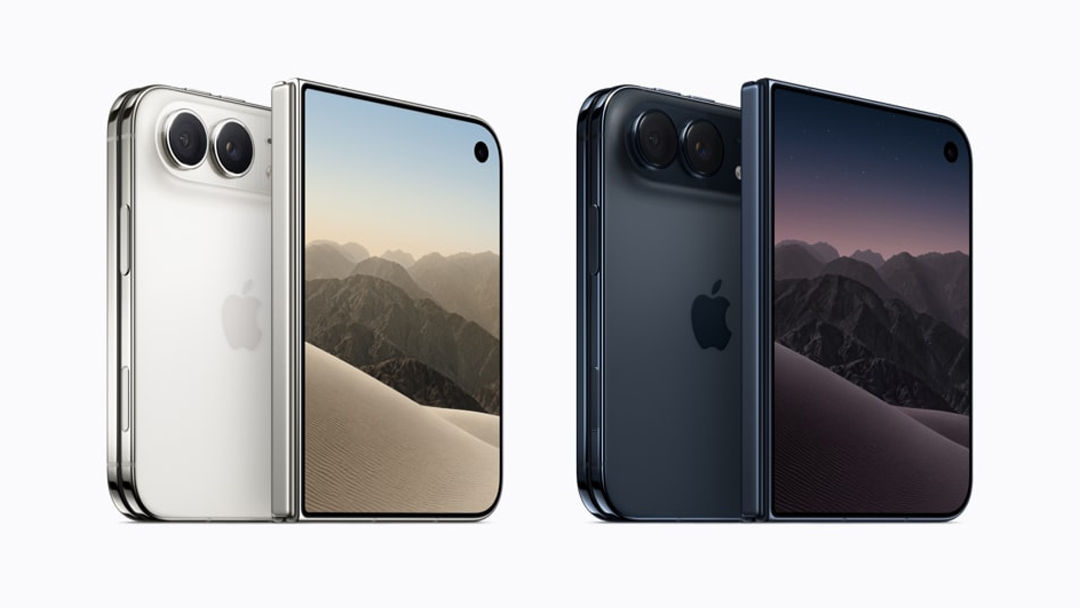
Apple has officially entered the foldable smartphone segment with the iPhone Duo. Apple arrives in a category that has already been explored by Samsung, Google, vivo, OPPO, OnePlus, Xiaomi, Honor, Huawei and Motorola. The company's first foldable uses a book-style design, combining a compact 5.4-inch outer display with a larger 7.6-inch folding screen on the inside.
Unlike most first-generation foldables, Apple is not treating the larger display simply as an extended version of the regular iPhone interface. iOS 27 has been adapted for two-app multitasking, app pairs and interactions that use both displays simultaneously. The company has also attempted to address familiar foldable concerns such as the visible crease, inner-screen durability and sustained performance.
iPhone Duo India Price, Storage Options and Availability
The iPhone Duo starts at Rs 2,99,900 in India for the 256GB storage variant. It will also be available with 512GB, 1TB and 2TB storage options.
Pre-orders in India will begin on October 16, while sales start on October 23. Buyers can choose between Star White and Night Sky colour options.
Apple has also launched the iPhone 18 Pro and iPhone 18 Pro Max alongside the Duo. The iPhone 18 Pro starts at Rs 1,64,900, while the iPhone 18 Pro Max starts at Rs 1,79,900. Pre-orders for the Pro models begin on September 12, followed by availability from September 18.
| Model | Starting Price |
|---|---|
| iPhone Duo | Rs 2,99,900 |
| iPhone 18 Pro | Rs 1,64,900 |
| iPhone 18 Pro Max | Rs 1,79,900 |
iPhone Duo Design, 5.4-inch Cover Screen and 7.6-inch Foldable Display
The iPhone Duo has a 5.4-inch Super Retina XDR display on the outside. Apple says it provides around 90 per cent of the usable screen area of the iPhone 18 Pro, despite the Duo's more compact folded form.
Opening the phone reveals a 7.6-inch Super Retina XDR display, which is 50 per cent larger than the screen on the iPhone 18 Pro Max. Both screens support ProMotion, Always-On Display and up to 3,000 nits of peak outdoor brightness.
Apple has kept the same aspect ratio across the two displays. Apps and content should, therefore, scale more naturally when users move between the cover and inner screens instead of abruptly changing shape.
A nano-texture finish on the inner display is designed to reduce reflections while making the crease less noticeable. Apple has also placed the FaceTime camera underneath the folding screen, leaving the main display free of a conventional cutout. Support for the USB-C Apple Pencil will be added later this year.
Touch ID is integrated into the side-mounted power button instead of using Face ID. The phone also retains Apple's Camera Control button and can be unlocked using a paired Apple Watch.
Apple Says the iPhone Duo Has a Less Visible Crease and a More Durable Inner Screen
The foldable display uses a nano-texture finish designed to reduce glare, reflections and the visibility of the crease. Apple is careful not to claim that the crease has disappeared completely, so this remains something that will need to be examined on a retail unit and after extended use.
Durability has received similar attention. The iPhone Duo uses a Grade 5 titanium frame, while its hinge consists of more than 100 components. The hinge supports the centre of the display when fully opened, and an integrated magnet system keeps the two halves securely closed.
Ceramic Shield protects the rear panel, while Ceramic Shield 2 is used on the cover display. The folding screen gets a scratch-resistant coating, high-strength glass layers and a custom polymer cover that Apple claims is up to 40 per cent stiffer than comparable materials used in the industry.
Support ribs and a titanium plate have been added to reinforce the internal structure. The phone also carries an IP68 rating for dust and water resistance. IP68 is particularly notable here because moving parts and an exposed hinge have traditionally made full dust protection difficult for foldable phones.
iOS 27 Gives the iPhone Duo Split View, App Pairs and Dual-Screen Features
The larger display is useful only if the software can do more with it, and iOS 27 is arguably the most important part of the iPhone Duo. Split View allows two apps to run side by side, while users can also open two windows of the same app. Regularly used combinations can be saved as app pairs.
Apple has repositioned the Dock, navigation controls and Dynamic Island to leave more vertical space for content. Apps can respond to the angle of the fold, move between the inner and outer displays and reorganise their interfaces when the phone is rotated.
Apple's own apps have been optimised for the Duo, while Netflix, Zoom and Slack are among the third-party apps already adapted for the folding screen. StandBy also works on either display without requiring the phone to remain connected to a charger.
None of these multitasking ideas will be unfamiliar to existing Android foldable users. Their arrival on the iPhone is still significant because Apple is building them into the operating system rather than presenting the larger display as an accessory to the regular iPhone experience. Long-term app support will determine whether that advantage extends beyond Apple's own software.
iPhone Duo Has Two 48MP Rear Cameras but No Dedicated Telephoto Camera
The iPhone Duo has a 48MP Fusion Main camera with sensor-shift optical image stabilisation and an optical-quality 2x zoom option. A 48MP Fusion Ultra Wide camera handles wider frames and macro photography.
A dedicated telephoto camera is missing, which is a substantial compromise on a phone priced at nearly Rs 3 lakh. Buyers get the same A20 Pro platform as the iPhone 18 Pro models, but not their complete camera versatility.
Apple is instead using the folding design to introduce new ways of taking photographs. Users can shoot selfies with the higher-resolution rear cameras while checking the frame on the cover display. Duo Preview also allows the person being photographed to see the live composition.
Smart Take automatically captures a photograph when it detects that everyone is posing. Kid Cue plays Peanuts animations on the outer screen to get a child to look towards the camera. The phone can also be partially folded and placed on a surface for group photographs, videos or hands-free FaceTime calls.
Video recording goes up to 4K at 120fps in Dolby Vision using the main camera. The inner display also has an under-display FaceTime camera, allowing Apple to avoid a conventional cutout in the larger screen.
A20 Pro, Vapour Chamber and Dual Batteries Power the iPhone Duo
The iPhone Duo uses the same A20 Pro chipset as the iPhone 18 Pro series. The 2nm processor combines a six-core CPU, seven-core GPU and dual 16-core Neural Engine.
A custom vapour chamber has been added to manage sustained performance. Thermal management is especially important on a foldable because the internal components and battery have to be distributed across two thin halves.
Apple has placed one battery on either side of the phone. The company claims up to 31 hours of video playback using the inner display and up to 44 hours using the cover screen. Mixed use across both displays is rated for up to 24 hours on one charge.
Wired charging can take the battery to 50 per cent in approximately 20 minutes. MagSafe and Qi2 wireless charging can reach 50 per cent in around 30 minutes when used with compatible chargers.
The iPhone Duo is eSIM-only worldwide, including in India. Buyers moving from a physical SIM will need to activate an eSIM with their telecom operator before shifting completely to the new phone.
iPhone Duo Is a Halo Foldable Rather Than a Regular iPhone Upgrade
The iPhone Duo is not positioned as the natural upgrade from an older Pro Max. Its Rs 2,99,900 starting price puts it in a different category, even within Apple's already expensive smartphone lineup.
Buyers are paying Rs 1,20,000 more than the iPhone 18 Pro Max for the folding screen, compact form factor and dual-screen iOS experience. At the same time, the Duo drops the dedicated telephoto camera found on the Pro models and replaces Face ID with a side-mounted fingerprint reader.
Apple's late entry could still benefit the wider foldable market. The company brings a large iOS user base, stronger developer attention and an ecosystem that Android foldables cannot offer. The Duo may consequently matter more for where the category goes next than for the number of people who can afford this first-generation model.
The final verdict will depend on the areas that cannot be judged from specifications: how visible the crease is during everyday use, whether the compact cover screen is practical, how well third-party apps adapt and how the inner display holds up over time. At nearly Rs 3 lakh, buyers should expect more than the novelty of an iPhone that folds.