Haier has detailed its Mini LED television lineup at the ‘Elevate with Haier’ event in Greater Noida, with the M70 range starting at ₹39,490 and the premium M96 series offering 100-inch and 115-inch screens. The company also highlighted the M80 4K Mini LED series, which starts at ₹70,490.
The lineup spans smaller living-room TVs through to screens intended for a dedicated home-entertainment setup. Haier is pairing its Mini LED display pitch with built-in audio upgrades, including KEF-branded sound on the M80 and M96, while the M70 brings Google TV with Gemini to the more affordable end of the range.
Haier Mini LED TVs: Prices, Sizes and Availability
All three ranges are available through leading retail outlets in India, according to Haier’s October 14 announcement.
| Series | Screen Sizes | Starting Price |
|---|---|---|
| Haier M70 Mini LED | 43, 55, 65, 75 and 85 inches | ₹39,490 |
| Haier M80 Mini LED 4K | 55, 65, 75 and 85 inches | ₹70,490 |
| Haier M96 Mini LED | 100 and 115 inches | ₹4,19,990 |
These are starting prices for each range, rather than prices for every listed screen size. The M70 had previously been announced in August; the latest event brings it together with Haier’s wider premium home-entertainment offering.
M96 Pairs Large Screens With a 6.2.2-Channel Sound System
The M96 leads the lineup with Haier’s SQD Mini LED technology, Dolby Vision IQ and a 6.2.2-channel speaker system featuring Sound by KEF and Dolby Atmos. Its 100-inch and 115-inch options put it firmly in the large-screen premium segment.
Haier’s UltraSense AI suite includes separate Cinema, Sound, Game and Eye Caring functions, aimed at adjusting picture quality, audio, gameplay and viewing comfort. The company also highlights an ultra-slim, zero-gap design.
At a starting price above ₹4 lakh, the M96 is a more specialised purchase than the other two ranges. Its appeal is the combination of a very large image and an elaborate integrated speaker system. Buyers planning a home-cinema room will still need to judge how that audio performs in their space, particularly if they are comparing it with a separate sound system.
M70 Brings Mini LED to Smaller Screen Sizes
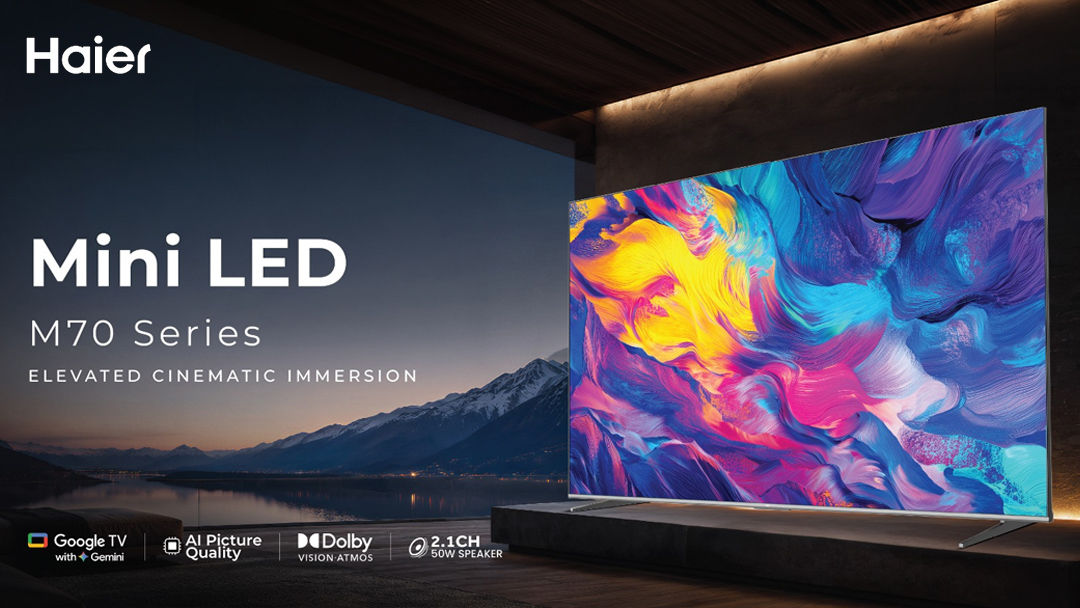
The M70 is the broadest range, starting at 43 inches and extending to 85 inches. It supports Dolby Vision and HDR10+, with Haier claiming up to 93% DCI-P3 colour-gamut coverage. Micro Dimming and AI picture processing are intended to improve contrast, colour and detail.
Audio is handled by a 50W 2.1-channel system with an integrated subwoofer, Dolby Atmos and Total Sonics. The inclusion of a subwoofer is relevant for buyers looking for more substantial built-in sound without immediately adding an external speaker system.
The M70 runs Google TV with Gemini and includes HaiCast screen mirroring, Bluetooth Speaker Mode, 2GB RAM and 32GB storage. Its gaming features include VRR, ALLM, MEMC and a Gaming Bar for accessing settings.
There is an important distinction in the refresh-rate claim: Haier’s detailed M70 announcement describes its 120Hz gaming feature as DLG. It should not be treated as confirmation of a native 4K 120Hz panel. Buyers choosing a TV primarily for high-frame-rate console gaming should compare the supported resolution and refresh-rate combinations. haier.com
M80 Adds KEF Sound and a Claimed 800-Nit Peak Brightness
The M80 sits between the M70 and M96 in starting price, with screen sizes from 55 to 85 inches. Haier lists 4K Mini LED technology, Dolby Vision and a claimed peak brightness of 800 nits.
It also features a 50W 2.1-channel audio system with Dolby Atmos and Sound by KEF. That gives it a more specific audio proposition alongside its display specifications, although speaker wattage and branding alone do not establish how clearly dialogue or bass will be reproduced.
The M70 and M80 overlap across four screen sizes, so a useful comparison will be between equivalent sizes. Comparing only their starting prices would put the 43-inch M70 against the 55-inch M80.
Screen Size Is Only Part of the Upgrade
The lineup gives Haier a presence across a wide spread of Mini LED budgets, with integrated sound serving as a recurring selling point. The M70 targets buyers seeking the technology at a lower entry price, the M80 adds a different picture-and-audio package, and the M96 caters to substantially larger rooms and budgets.
For buyers, the Mini LED label is a starting point rather than a complete measure of picture quality. Backlight control, dark-scene detail, motion and processing will determine how convincing each model looks with everyday content. A comparison at the intended screen size, using films, sports and streaming content similar to what the household watches, will be more revealing than a showroom brightness demonstration alone.