Samsung Electronics is preparing for its most ambitious outing yet at CES 2026, shifting its primary showcase to the Wynn and Encore venues in Las Vegas and promising a pavilion that will be larger and more immersive than anything the company has attempted before. By consolidating its TV and home appliance displays under one roof, Samsung is signalling that the connected home ecosystem, powered by artificial intelligence, is no longer a side narrative but the core of its global strategy. For a company that has long been identified with big-screen launches and headline-grabbing smartphones, this marks a notable pivot toward presenting the home as the real stage for innovation.
The scale of this move matters because CES has always been more than a trade show. Scheduled for January 6 to 9, the event has historically set the tone for technology trends for the year ahead. It is where televisions made the leap to ultra-high definition, where automotive companies first staked claims on smart mobility, and where the early ideas of connected homes gained mainstream visibility. Companies use it not simply to launch products but to frame narratives, and Samsung's decision to expand into the largest premium space at the show suggests it wants to own that conversation in 2026.
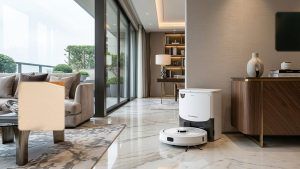
This ambition does not appear out of thin air. Over the past two years, Samsung has steadily laid down the building blocks for an AI-first home. Washing machines that learn cycles, refrigerators that act as command hubs with built-in screens, and vacuum cleaners that can identify and avoid transparent liquids are not gimmicks but carefully chosen examples of how intelligence can be layered onto everyday tasks. The company's SmartThings platform has matured to the point where it is no longer a simple app to control devices but an infrastructure that ties together energy use, security, and lifestyle routines. At CES, expect Samsung to emphasise how all of this comes together in a single narrative of convenience, efficiency, and trust.
Samsung at CES 2026: What We Expect
Given this, Samsung's CES 2026 pavilion is likely to emphasize:
-
AI-embedded home appliances with richer interaction (voice, vision, predictive routines)
-
Displays and TVs that do more than show content—screens that listen, anticipate, personalize, even act as hubs in the home
-
SmartThings and the AI Home platform becoming more seamless, more capable, more privacy-aware
-
Possibly modular home systems or holistic "living spaces" rather than isolated devices
Samsung has already shown plenty of groundwork in these areas. At CES 2025, Samsung formally rolled out its "AI for All" vision, emphasizing that AI should permeate everyday life, not remain confined to premium models or experimental features.
AI, Appliances and the Smart Home
The recent showcase at IFA 2025 in Berlin offered a preview of what is to come. While most headlines were dominated by the launch of the Galaxy S24 FE and a new tablet range, Samsung's sprawling booth told a different story. Under the theme "AI Home: Future Living, Now," the company demonstrated what a home enriched with artificial intelligence might actually look like. Visitors walked through environments where lighting and temperature responded automatically, where dishwashers opened doors at the right moment for optimal drying, and where robot vacuums worked with a new degree of awareness. More importantly, Samsung underlined its commitment to security, with several appliances earning independent certifications from European agencies. This was a quiet but significant reminder that trust will be as important as features in convincing consumers to let AI into the heart of their homes.
Seen in this context, Samsung's expansion at CES is less about grabbing attention with a larger booth and more about showing continuity. The company knows that in the saturated smartphone market, growth depends on redefining the value of the devices that fill our kitchens and living rooms. Its decision to place appliances and televisions side by side in Las Vegas is symbolic of how it wants to present technology as a seamless experience rather than a collection of categories. That also explains why the company has invested in creating living space concepts such as the Smart Modular Home, where heating, cooling, and entertainment systems are integrated into one coherent vision.
For long-time watchers of CES, this represents Samsung at its most confident. The brand has used the platform in the past to introduce new display formats, to flex its muscle in memory and semiconductors, and to experiment with mobile form factors. In 2026, however, the bet is squarely on the home, with artificial intelligence as the unifying thread. The coming showcase is likely to determine not only how consumers perceive Samsung's appliance business but also how seriously the industry takes the idea of AI-driven living. If the company succeeds in translating concepts into usable features, CES 2026 may well be remembered as the moment when the smart home narrative shifted from promise to practice.