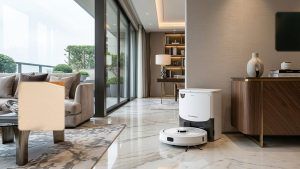
The robotic vacuum cleaner market in India is seeing explosive growth, caught between shifting consumer habits, rising aspirations for convenience, and steadily improving home‐automation infrastructure. According to a TechSci Research report, the Indian robotic vacuum cleaner market was valued at USD 194.88 million in 2025 and is projected to reach USD 352.79 million by 2031, growing at a CAGR of 10.40 %. What was once viewed as novelty gadgets are now part of serious purchase decisions in many homes, and now a new entrant is pushing the envelope: MecTURING has unveiled the R1, India’s first stair-climbing robotic vacuum. The launch signifies not just incremental upgrades but an attempt to leapfrog existing limits of what consumer RVCs can do in Indian settings.
The Stair-Climbing Promise of the R1
The big promise of MecTURING’s R1 is to tackle the one obstacle robotic vacuums have never managed to overcome: the stairs. Borrowing inspiration from ISRO’s Pragyan Rover, which explored the Moon’s south pole in 2023, the R1 brings stair-climbing agility into Indian homes for the first time. It is equipped with a 25,000 Pa suction system backed by a 6,400 mAh battery for longer cleaning runs, while its vibra-based mopping mechanism handles deep stains with precision. Navigation comes from a combination of NavPro5 LiDAR and AIScope object detection, allowing the R1 to avoid clutter and map spaces intelligently. MecTURING is backing the hardware with a 10-year motor warranty, and all of this is being offered at a price under ₹1 lakh (the exact price has not been announced).
Unlike many global rivals that bolt extra sensors onto existing machines, MecTURING stresses that the R1 has been engineered from the ground up to learn from usage, anticipate needs, and adapt to Indian living conditions.
Stair-Climbing Robots at IFA
IFA this year offered a glimpse of what the next generation of home cleaning might look like. Several global brands showcased stair-climbing robots, each bringing its own approach to mobility and convenience. Dreame presented its model with retractable wheel arms designed to tackle uneven steps, while ECOVACS highlighted a concept unit that combined stair navigation with automated bin emptying. Eufy made the heads turn with its stylish-looking robot that uses four independently controlled arms with treaded tracks to climb stairs.
Severin introduced a hybrid design intended to handle both vertical lifts and traditional cleaning with minimal intervention. These global prototypes suggested that the industry was inching closer to overcoming the biggest barrier to full-house robotic cleaning, but few expected a commercial launch in India so soon. MecTURING’s R1 now becomes the first to make this a reality for the Indian market.
Our Take: Novel, But Niche
From a technology standpoint, the R1 is a bold statement. By enabling stair climbing, it directly addresses the pain point of multi-floor homes where buyers were previously forced to invest in multiple devices. But whether India is ready for such a product is less certain. The majority of RVC customers here live in single-level apartments or compact spaces where this capability is irrelevant. Households large enough to justify the need often already employ staff, and cleaning expansive multi-story houses would also demand battery capacities far beyond what even the R1 currently offers.

Then there is the price. At under ₹1 lakh, the R1 sits well outside the mainstream RVC price band in India, which is typically between ₹15,000 and ₹30,000. For most buyers, the product will feel aspirational rather than practical.
What It Means for the Market
That said, the launch is significant. It signals that Indian brands are not content to play catch-up but are willing to set the agenda in emerging categories. Even if the R1 remains a niche choice, it raises the benchmark for what is possible and puts India on the global map of robotics innovation. For now, its relevance may be more symbolic than widespread, but it sends a clear message: the next leap in home automation could well be defined here, not just abroad.