Vapour chamber cooling has become one of the biggest talking points in the smartphone market in Q1 2026, with brands increasingly highlighting larger cooling systems as a key advantage for gaming, video recording, and sustained performance. However, a bigger vapour chamber does not always guarantee better thermal management. To understand how cooling systems perform in real-world scenarios, we compared the iQOO 15R, Poco X8 Pro Max, and Vivo V70 Elite through a series of tests covering 4K video recording, BGMI gaming, CPU-intensive workloads, benchmarking, and cooling recovery. The goal was simple: find out which smartphone manages heat most effectively while maintaining performance.
How We Tested: Benchmarks and Gaming Setup
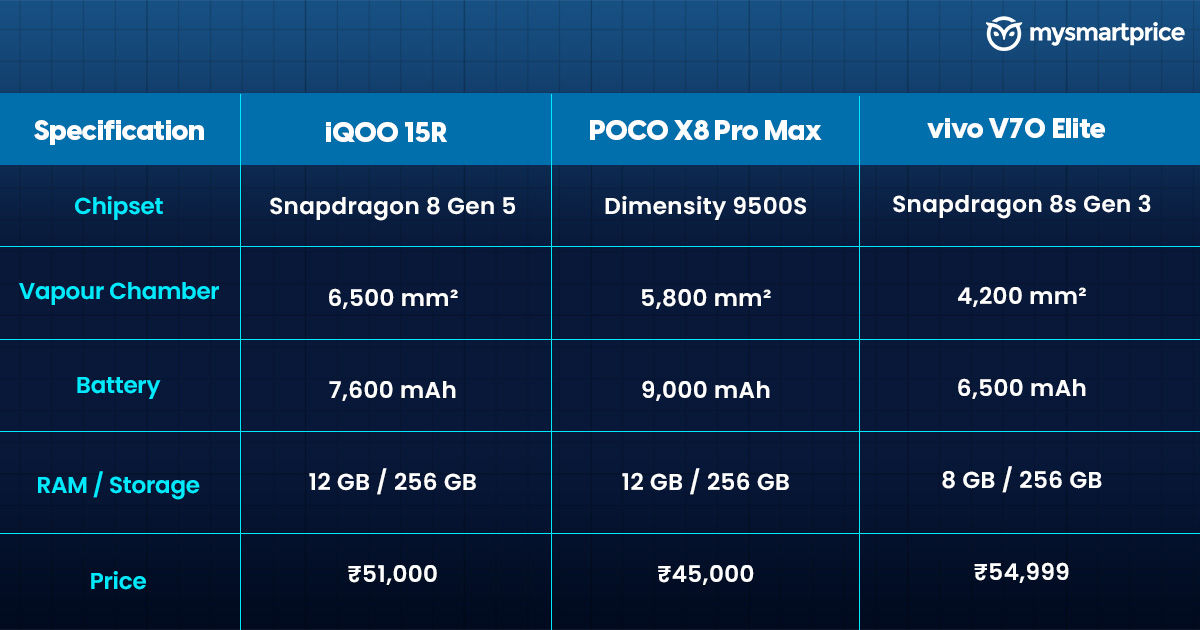
For this comparison, we selected three smartphones that target buyers looking for flagship-grade performance in the premium mid-range segment. All three devices feature powerful processors, large batteries, and dedicated vapour chamber cooling systems, making them suitable candidates for a thermal management comparison. To evaluate their cooling capabilities, we conducted a 90-minute 4K video recording test, BGMI gaming sessions at multiple graphics settings, CPU throttling tests, AnTuTu benchmarking, and a dedicated cooling recovery assessment. Surface temperatures were measured using a thermal camera and thermal gun, while battery drain and performance figures were analysed after each test.
BGMI and 4K Recording: Which Phone Throttles First?
A smartphone cooling system has two jobs. First, it should prevent temperatures from rising too quickly during heavy workloads. Second, it should allow the processor to maintain performance for longer periods without aggressive throttling.
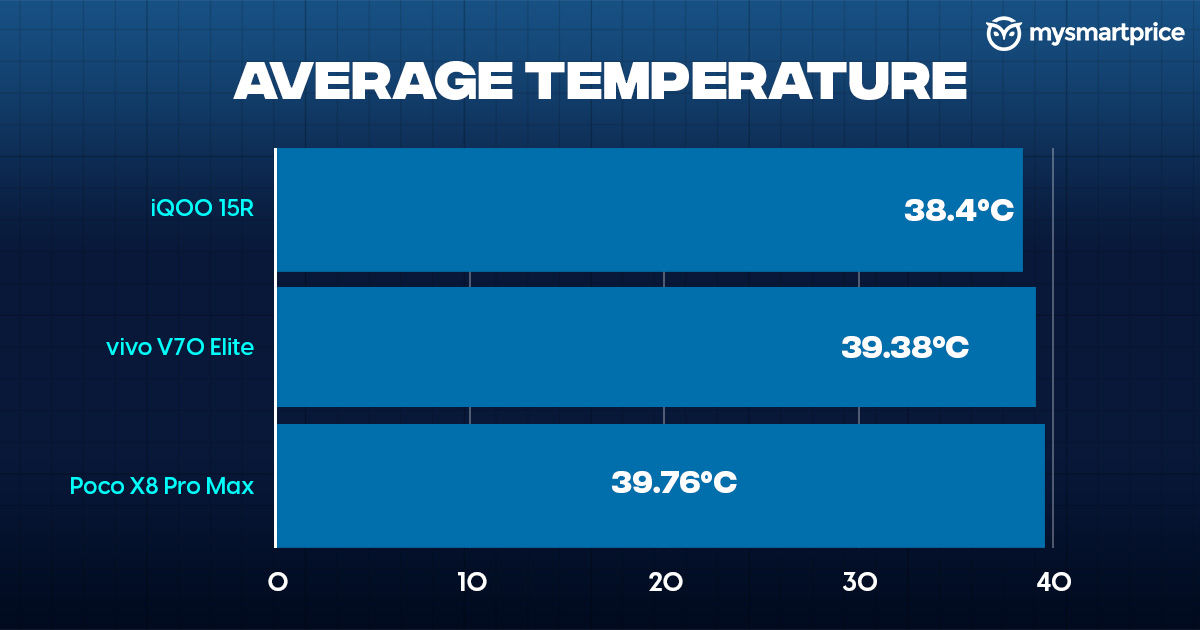
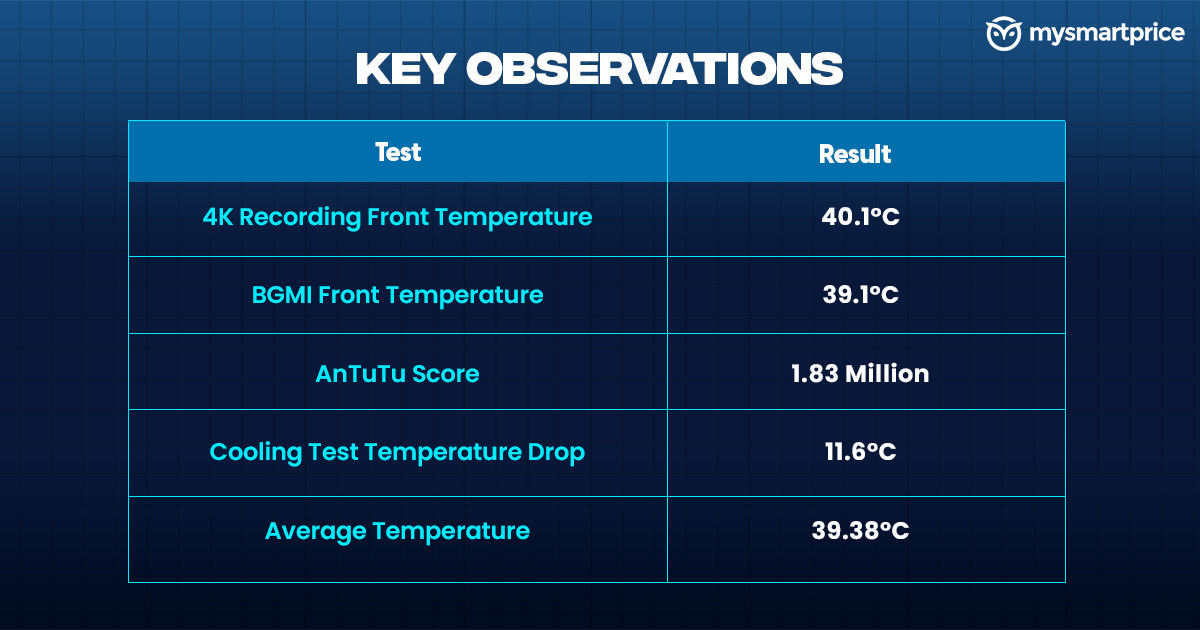
The iQOO 15R emerged as the coolest device overall, while the Poco X8 Pro Max recorded the highest average temperature despite delivering strong performance figures.
iQOO 15R: A Extreme Performance Monster That Refuses to Throttle
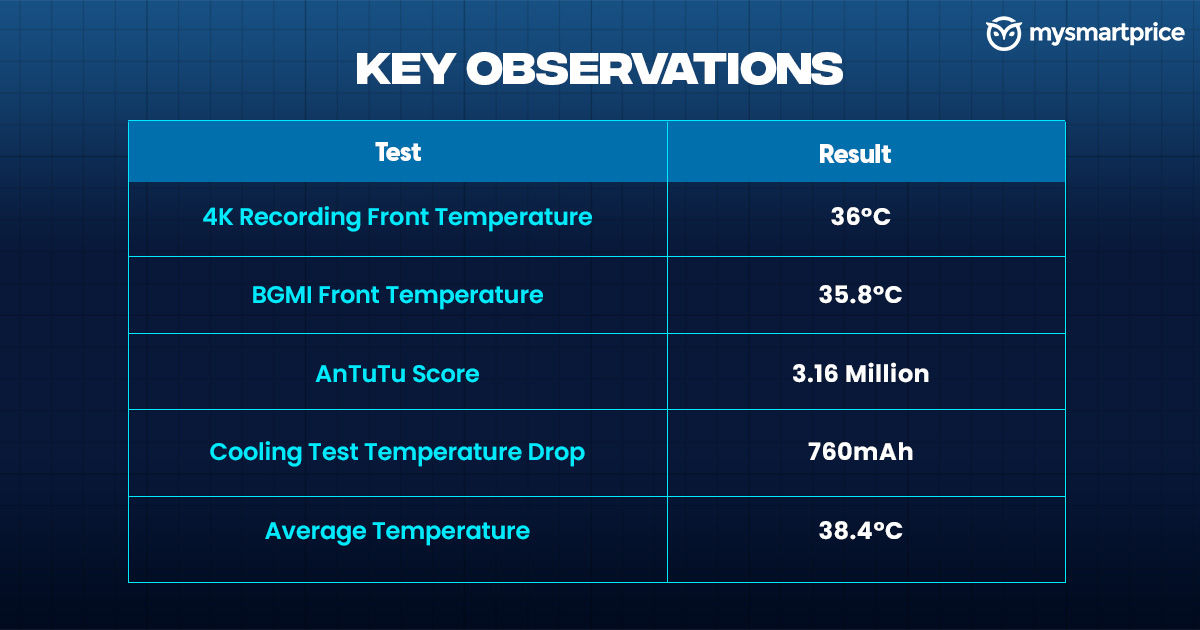
The iQOO 15R enters this comparison with the largest vapour chamber among the three devices. During the 90-minute 4K recording test, it consistently maintained lower temperatures than its rivals. The phone reached 36°C on the front and 35°C on the rear panel, making it the coolest performer in this scenario.
Gaming performance was similarly impressive. We tested BGMI on the iQOO 15R at Smooth graphics with the Ultra Extreme frame rate setting enabled, which unlocks up to 120 FPS gameplay. During the test, the device recorded the lowest surface temperatures while also delivering the highest average frame rates. Even when the workload shifted to higher graphical settings, the phone remained cooler than both the Poco X8 Pro Max and Vivo V70 Elite.
Where things became interesting was the CPU throttling test. Despite having the largest cooling system, the iQOO 15R reduced CPU performance more aggressively than expected to control heat. This resulted in higher throttling compared to its competitors during sustained synthetic workloads. Nevertheless, it still managed to balance temperatures and battery efficiency effectively.
Poco X8 Pro Max: The Go-To Choice for Cool Temperatures and Massive Battery Endurance
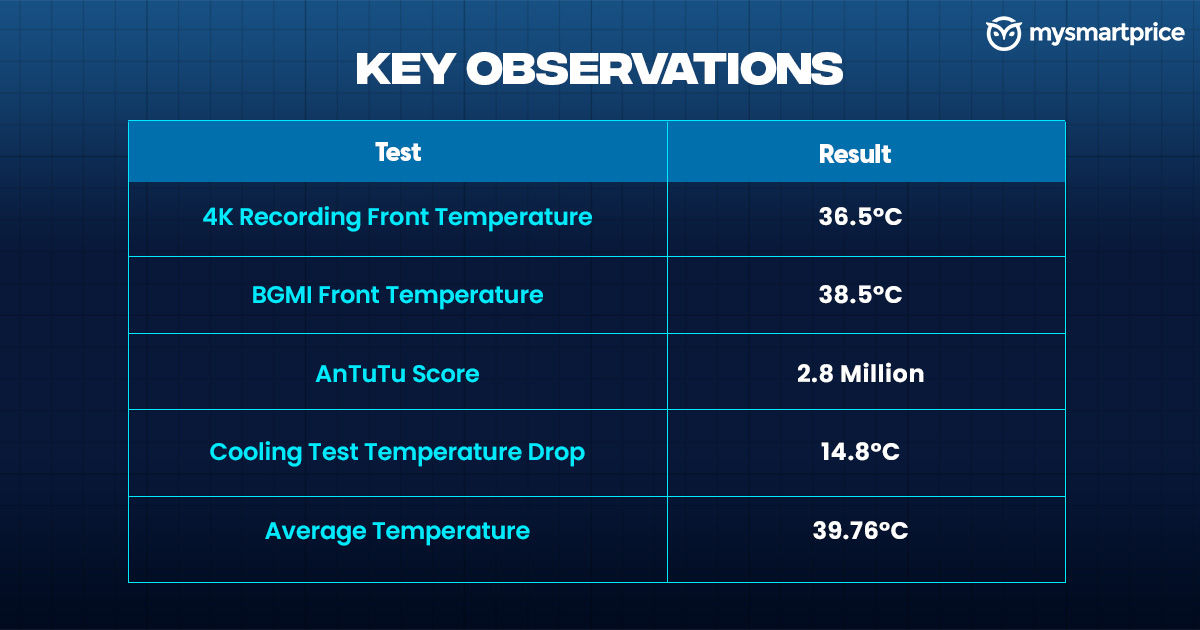
The Poco X8 Pro Max delivered one of the strongest overall performances in the comparison. While it frequently ran warmer than the iQOO 15R, it consistently produced excellent benchmark scores and gaming performance.
During gaming sessions, the device maintained high frame rates while distributing heat effectively across its chassis. Thermal imaging showed that heat spread more evenly rather than concentrating around a single hotspot. However, the phone occasionally reduced display brightness automatically during prolonged stress tests to control internal temperatures.
The biggest strength of the Poco X8 Pro Max was sustained performance. It remained highly competitive across gaming, benchmarking, and CPU-intensive workloads. Buyers prioritising raw power are likely to appreciate this behaviour, even if it comes at the cost of slightly higher temperatures.
Vivo V70 Elite: Intelligent Thermal Control for Casual Gamers
The Vivo V70 Elite had the smallest vapour chamber in this comparison, yet it delivered surprisingly balanced thermal behaviour in several tests.
The phone heated up faster than the iQOO 15R and Poco X8 Pro Max during 4K recording, with thermal images showing widespread heat concentration across the upper half of the device. It also posted the highest temperatures during several camera-related workloads.
However, Vivo’s software tuning deserves credit. During prolonged CPU stress tests, the device prioritised temperature control by reducing processor performance earlier than its rivals. As a result, it often remained cooler during synthetic stress workloads despite having the smallest cooling hardware.
The trade-off is predictable. Buyers receive stable temperatures, but peak performance falls behind the other two devices.
The Cooling Verdict: Which Phone Should Gamers Actually Buy?
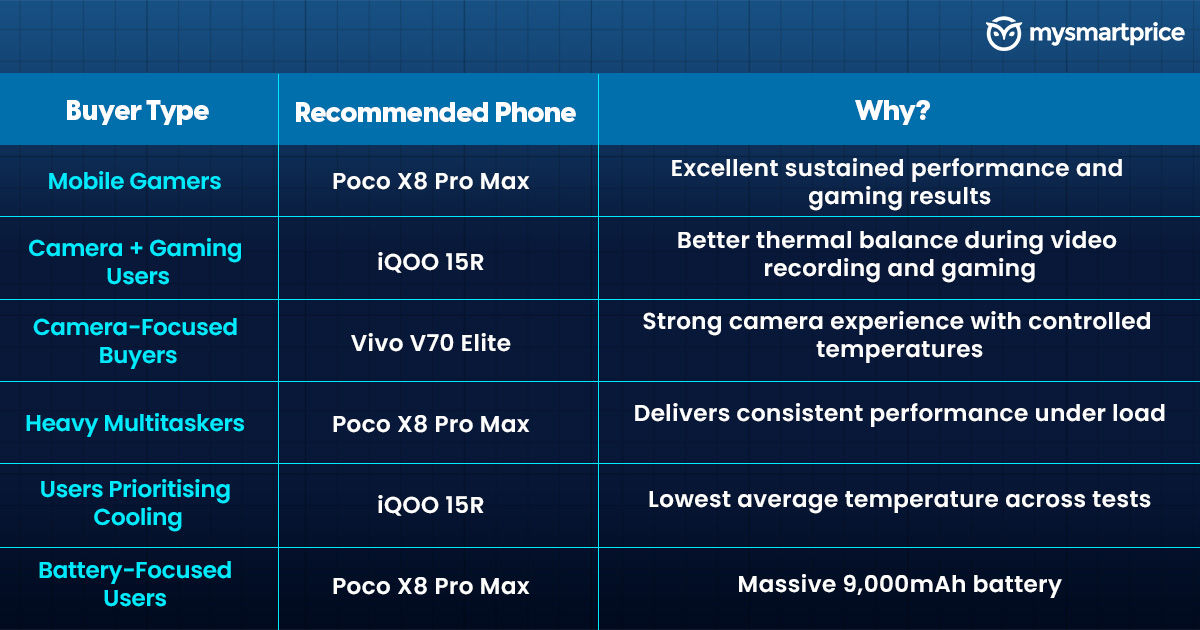
The results show that vapour chamber size alone does not decide the winner. The iQOO 15R benefits from having the largest cooling solution and remains the coolest device overall. The Poco X8 Pro Max, however, delivers the strongest combination of performance and value despite running slightly warmer.
The Vivo V70 Elite takes a different route. Instead of chasing benchmark numbers, it prioritises temperature control and camera performance. While it may not lead performance charts, it remains a sensible option for users who do not spend hours gaming every day.
For buyers looking at the overall package, the Poco X8 Pro Max offers the strongest balance between pricing, performance, and thermal management. The iQOO 15R remains the better option if camera usage and lower operating temperatures are your priorities.