At the start of 2025, Intel launched Lunar Lake laptops at CES, and they truly impressed me. These systems delivered class-leading battery life on the x86 platform and surprised many of us with their graphics capabilities. In my own testing, Lunar Lake laptops comfortably crossed 20+ hours of battery life while offering excellent CPU and GPU performance. The GPU, powered by Intel’s Xe2 architecture, was the standout story. It was a genuine leap in integrated graphics performance. With the success of Lunar Lake setting a new benchmark for efficiency and graphics on the x86 platform, a lot now rides on how Panther Lake takes that story forward. Earlier this month, I was in Arizona for the Intel Tech Tour, where Intel gave us a closer look at what to expect from the upcoming Panther Lake platform, officially branded as the Intel Core Ultra Series 3 lineup. For deeper insights into the architecture and design vision behind Panther Lake, you can also read our exclusive conversation with Daniel Rogers, Intel’s Senior Director of Client Segment Management.
With Panther Lake, Intel is pushing the boundaries further. The company is promising substantially higher performance while maintaining similar levels of efficiency. On the CPU side, Intel is achieving this by adding more cores, introducing three distinct types of cores, increasing cache sizes, and adding a shared side-level cache that improves data access latency across clusters. All of this, Intel says, will be intelligently managed by an enhanced Intel Thread Director that can better predict workload patterns and assign tasks to the most appropriate core type in real time. But perhaps the biggest and most impactful leap comes on the graphics side with the new Intel Xe3 GPU, which promises to take integrated graphics performance to levels that could challenge entry-level discrete GPUs.
What makes Panther Lake particularly interesting is the shift in how Intel is approaching chip design. Instead of building everything on a single piece of silicon, Intel is embracing a System of Chips model where different functional blocks, such as the CPU, GPU, NPU, memory, and I/O exist as individual tiles connected through advanced packaging. This move away from the traditional System on Chip approach gives Intel far greater modularity and flexibility. Each tile can be built on the process node best suited to its purpose, allowing Intel to fine-tune power, performance, and cost depending on the device class. Intel’s Foveros 3D packaging further enables this modular approach, stacking and linking multiple tiles to deliver higher performance and scalability at the system level. This modular design also makes Panther Lake highly flexible from a form factor and application point of view, giving Intel and its partners flexibility to target everything from ultraportable laptops to edge devices and even robotics applications. What allowed Intel to take this leap with Panther Lake? Much of it comes down to the long-awaited Intel 18A process technology, which forms the foundation for many of the gains across the CPU, GPU, NPU, and other subsystems on the platform. Let’s take a closer look at what makes Intel 18A special and how it enables the advancements throughout the Panther Lake architecture.
Intel 18A: The Foundation of Panther Lake
A lot of the magic behind Panther Lake comes from Intel 18A, the company’s most advanced process node and the world’s first to feature both RibbonFET and PowerVia together. This combination represents a major advancement in transistor design and power delivery, forming the backbone of Intel’s next generation of processors.
RibbonFET introduces a gate-all-around transistor structure that allows the control gate to fully wrap the channel. This tighter control over electron flow minimizes leakage and improves switching speed, resulting in higher transistor density and efficiency. Each transistor can operate faster at lower voltages, directly improving both performance and thermal characteristics.
PowerVia changes how power reaches those transistors. Instead of sharing routing space with data interconnects on the top layers of the chip, PowerVia moves power delivery to the backside of the wafer, giving current a shorter, cleaner path. Intel claims this reduces IR drop by up to 30 percent (voltage loss caused by electrical resistance in power lines, which can lower the effective voltage reaching transistors) and improves overall utilization by roughly 10 percent. The combination delivers more consistent power, enabling higher sustained performance under load.
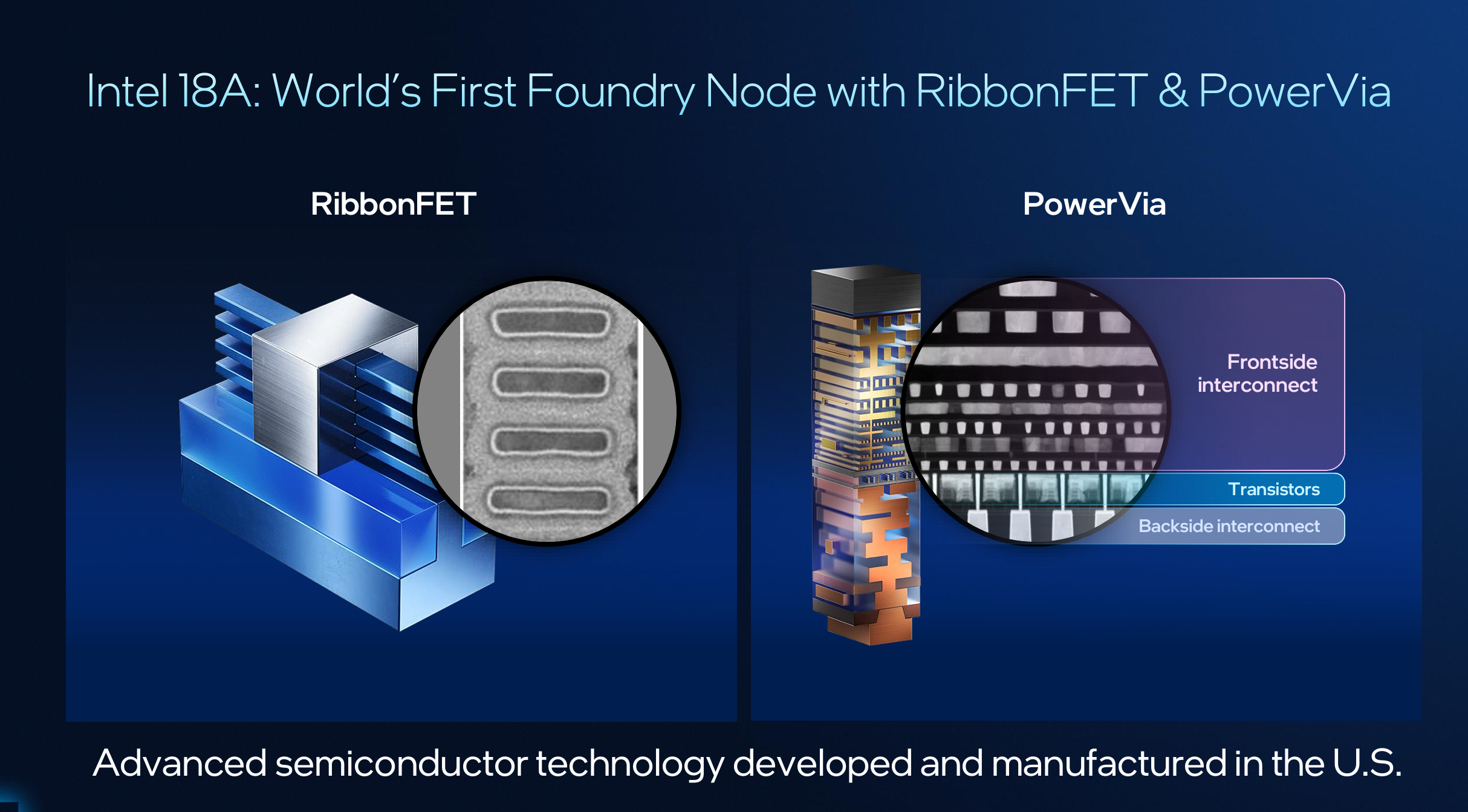
Together, RibbonFET and PowerVia deliver measurable gains over the Intel 3 process. Intel states that 18A offers up to 15 percent higher performance per watt, 30 percent lower power consumption, and around 1.3 times higher transistor density. These improvements allow Panther Lake to deliver more compute capability within similar power envelopes, resulting in thinner, cooler, and longer-lasting laptops.
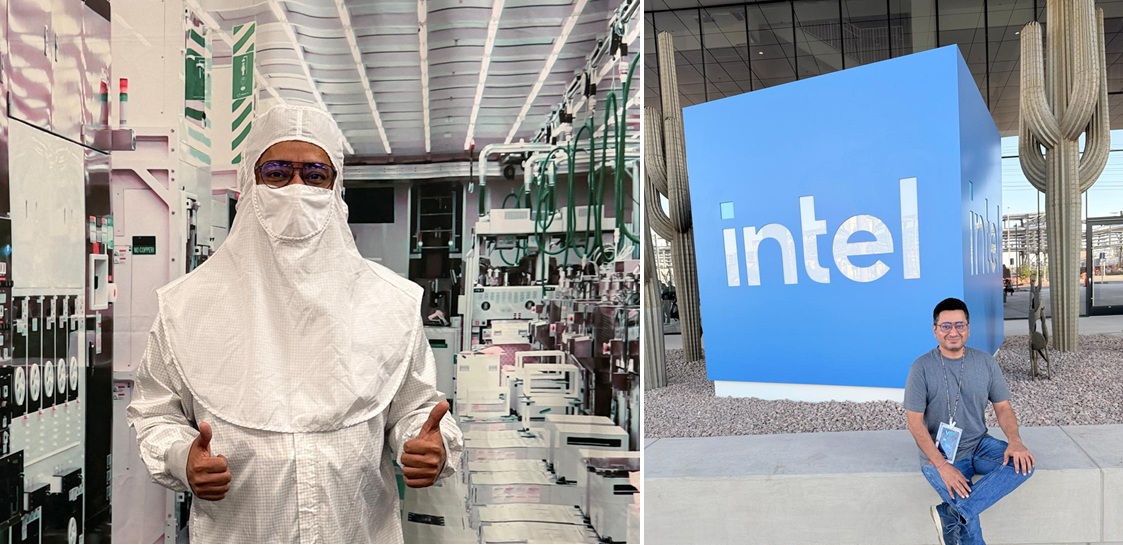
I was fortunate enough to get a tour of the new Fab 52 facility that is producing the Intel 18A-powered chips, during my visit to Intel’s Ocotillo campus in Arizona. Getting an insider look at the world’s most advanced fabrication machines and seeing next-generation computing take shape was fascinating. It truly highlighted the precision engineering behind making such transistor-level innovations viable at scale. At the Intel Tech Tour event in Arizona, the company confirmed that Panther Lake is already in production and on track to enter high-volume manufacturing later this year. This also marks the first client product built on Intel 18A, a milestone that underlines Intel’s push to regain process leadership while expanding U.S.-based semiconductor production.
The CPU Architecture: Three Types of Cores Working in Harmony
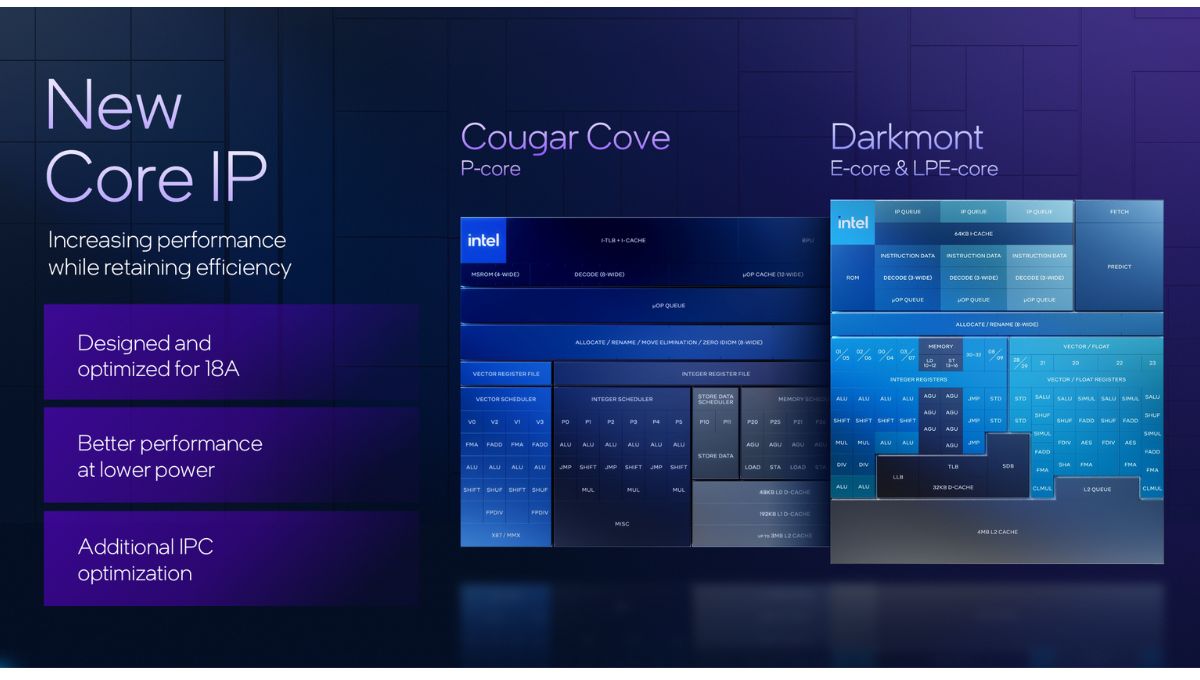
At the heart of Panther Lake lies a new hybrid CPU architecture featuring Cougar Cove P-cores, Darkmont E-cores, and Darkmont LP-E cores. Each plays a distinct role, creating a layered performance structure.
The Cougar Cove performance cores focus on single-thread speed and responsiveness. They bring larger instruction windows, improved branch prediction, and lower cache latency for demanding workloads like 3D rendering, compiling, or gaming. The Darkmont E-cores are tuned for high throughput and parallel efficiency, handling sustained multi-threaded or background tasks. The new LP-E cores manage low-power operations such as system updates, music playback, or syncing, allowing the system to stay active without waking higher-power cores.
An enhanced Intel Thread Director coordinates all three in real time, working closely with the operating system scheduler. It monitors instruction mix, temperature, and power conditions to direct tasks to the best-suited core. Intel claims single-thread performance improves by around 15 percent and multi-threaded performance by up to 40 percent compared to Lunar Lake at the same power levels. Combined with the new side-level cache, this results in smoother multitasking, quicker context switching, and more efficient resource utilization.
GPU Evolution: The Leap in Graphics and AI
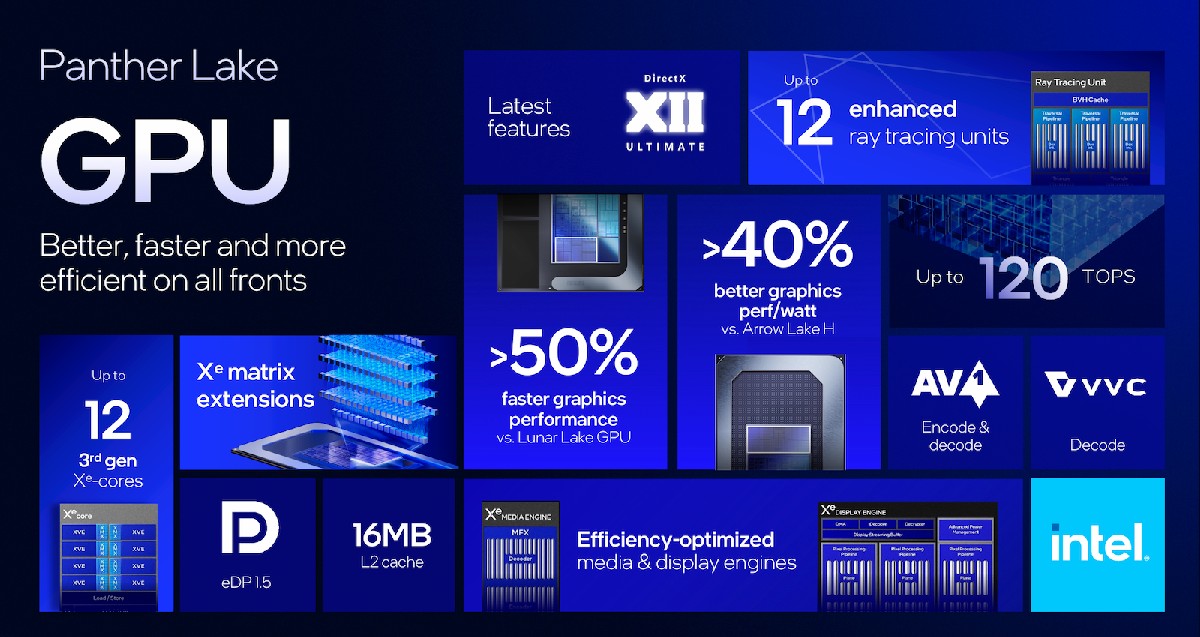
The biggest generational shift comes with the Xe3 GPU, which Intel claims delivers up to 50 percent higher graphics performance than the Xe2 in Lunar Lake and 40 percent better efficiency when compared to Arrow Lake. The Xe3 GPU brings up to twelve Xe cores and twelve ray-tracing units, along with expanded cache and improved AI data type support including FP8 precision.
Intel demonstrated the upcoming Painkiller refresh running at over 100 FPS on an integrated Xe3 GPU with settings maxed out. If that performance carries into shipping devices, integrated graphics could realistically compete with entry-level discrete GPUs.
With Panther Lake, Intel also unveiled XeSS Multi-Frame Generation (MFG), its AI-powered frame generation technology. MFG can scale frame rates by up to 4x, potentially turning a 30FPS experience into 120FPS, and lets users adjust how aggressively it is applied to balance visual fidelity with smoothness. I checked with Intel about the NPU’s role in Multi-Frame Generation, and the company clarified that most of the heavy lifting for MFG will be handled jointly by the CPU and GPU. I’ll be doing a dedicated deep dive on the Xe3 GPU soon, with more of the juicy details on its design, performance scaling, and what it means for integrated graphics. Beyond gaming, Xe3 also takes on a growing role in AI workloads. Intel continues to emphasize system-level AI performance, and I agree with this philosophy. The GPU drives heavy generative tasks like image creation and video editing, while the NPU focuses on the always-on AI jobs that value efficiency and agility over raw power.
NPU 5: Smarter, More Efficient, and Part of a Bigger AI Picture
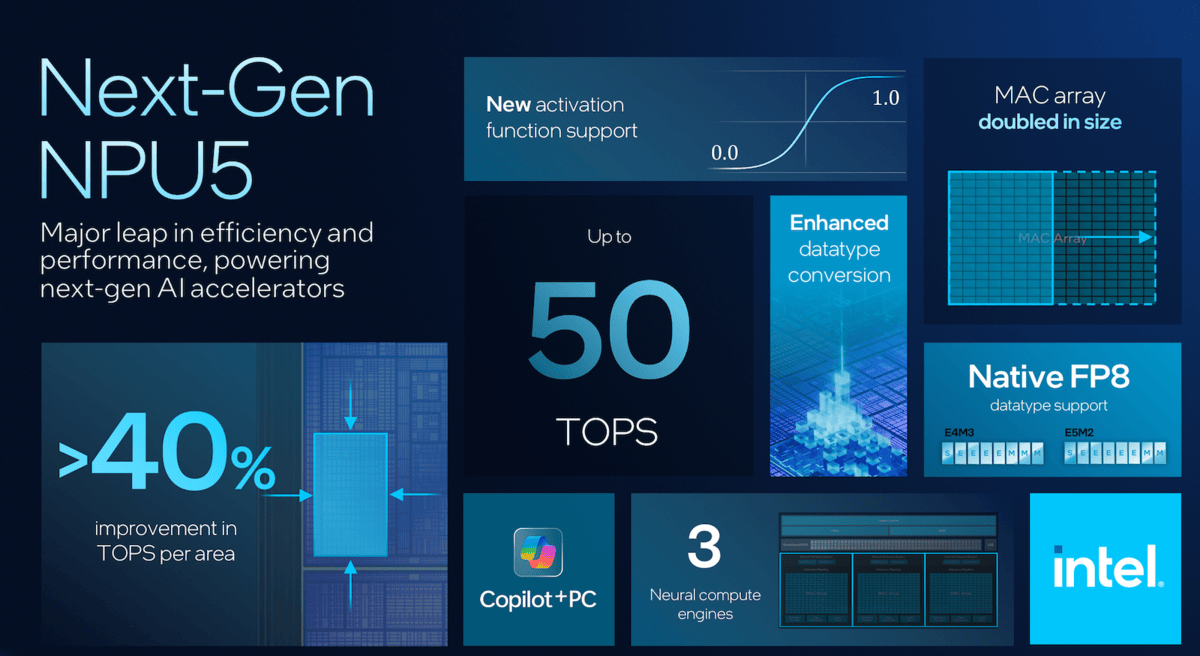
The NPU 5 might not sound like a massive upgrade on paper, with a peak throughput of 50 TOPS versus 48 TOPS on Lunar Lake, but under the hood, it is a more capable and balanced design. Intel claims a 40 percent improvement in performance per area, achieved through a larger MAC array, better data routing, and native FP8 precision. Which should help applications like video upscaling, background noise removal, and AI-based enhancements run faster and more efficiently on-device.
Intel says the overall system-level AI performance for Panther Lake reaches 180 TOPS, up from 120 TOPS in Lunar Lake, a healthy 50 percent generational uplift. This reflects Intel’s unified approach, where CPU, GPU, and NPU contribute collaboratively to AI acceleration.
In practice, this means laptops should be able to handle on-device generative AI tasks such as media editing, image or video generation, and real-time summarization faster and with lower battery drain. The NPU 5 focuses on power-efficient inference, while the Xe3 GPU steps in for heavy AI composition and rendering work, creating a well-balanced and responsive AI experience.
Panther Lake Configurations: Scalable Power for Every Segment
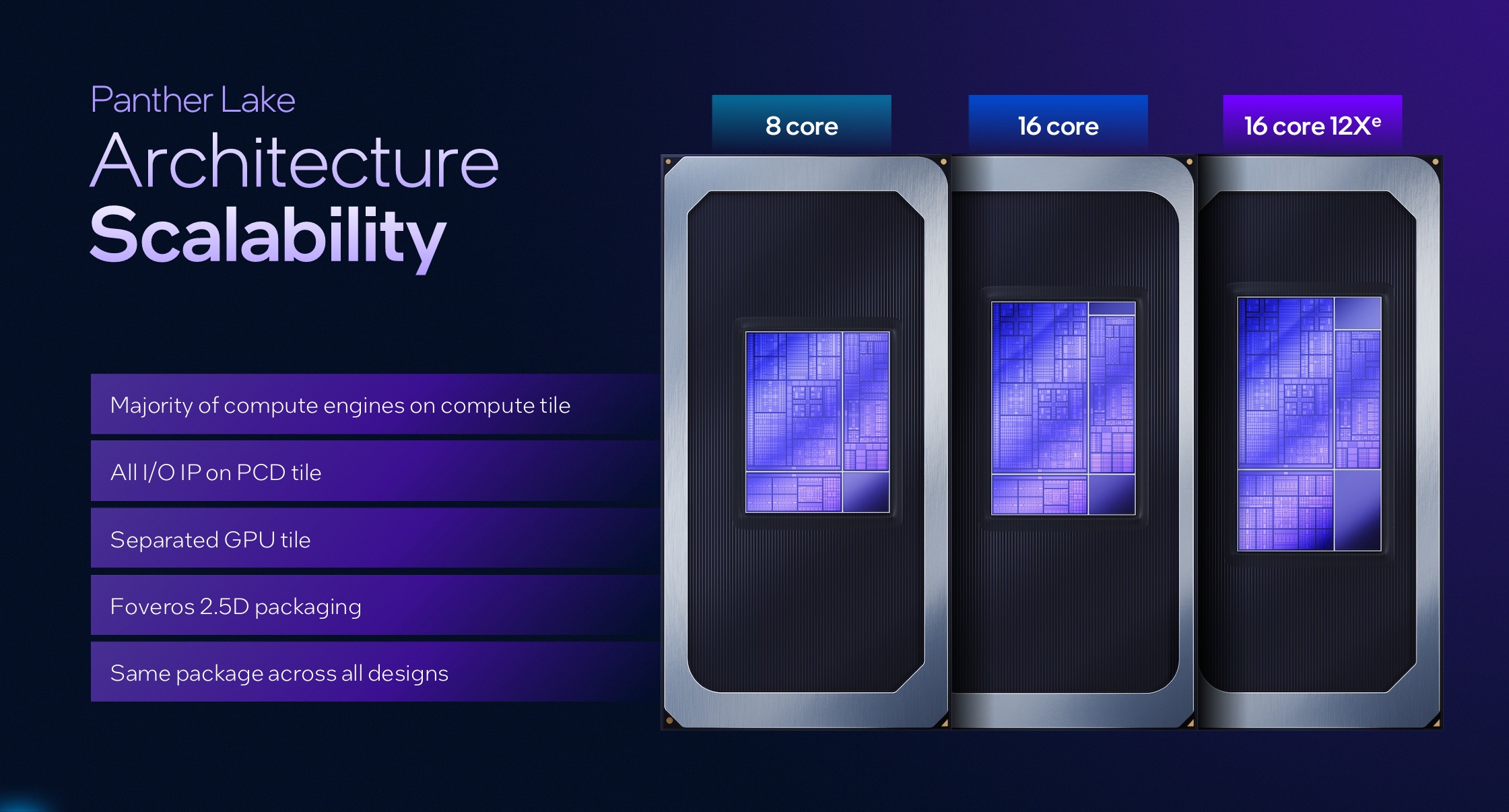
To start with, Intel will offer Panther Lake in three configurations: 8-core, 16-core, and 16-core 12Xe, covering everything from ultraportables to high-performance creator laptops. Given the modular nature of the Panther Lake platform, it’s reasonable to expect many more SKUs to follow, likely spread across the U and H series processor lineups.
The 8-core version combines all three core types with up to 4 Xe3 GPU cores, the NPU 5, and IPU 7.5, supporting LPDDR5X 6800 MT/s or DDR5 SO-DIMM 6400 MT/s memory. This design suits thin and light laptops where battery life and efficiency are top priorities.
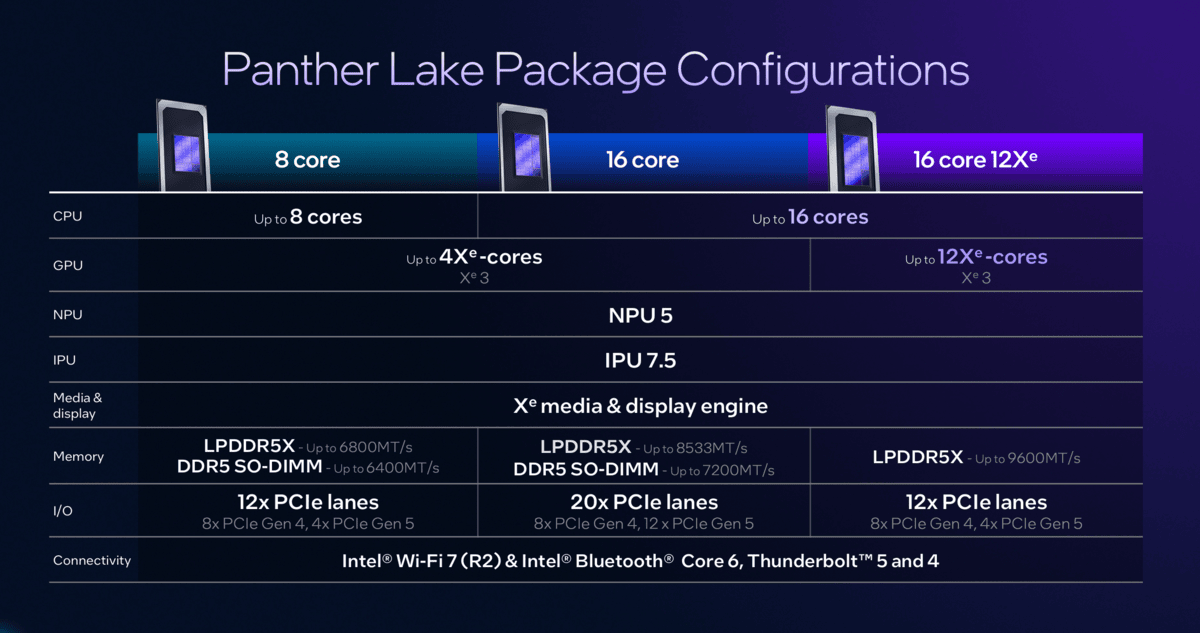
The 16-core configuration scales up compute resources while retaining up to 4 Xe3 GPU cores, offering more PCIe lanes and higher sustained power limits for mainstream and creator systems.
The top-end 16-core 12Xe variant combines the same CPU layout with up to 12 Xe3 GPU cores and LPDDR5X 9600 MT/s support, making it ideal for creative and AI-assisted workloads that benefit from higher GPU throughput without needing a discrete card. All versions include Wi-Fi 7, Bluetooth Core 6, and Thunderbolt 5/4 support.
Why Panther Lake Matters
What makes Panther Lake a defining platform is not just its raw performance but how Intel 18A and the System of Chips approach come together to redefine flexibility. By disaggregating compute into specialized tiles, Intel can mix process nodes, optimize yields, and tailor chips to specific markets far more efficiently than with a single monolithic die.
Intel’s long-standing strength in software optimization gives it an added edge. The company leads the industry when it comes to deep partnerships with ecosystem players, from operating system vendors to application developers, ensuring that new hardware capabilities are quickly and effectively supported. As a result, applications scale seamlessly across generations, almost like a plug and play experience, without developers needing to make major code changes.
I am genuinely looking forward to getting my hands on Panther Lake laptops at CES 2026. After what Lunar Lake achieved in efficiency and graphics, expectations are understandably high. If Intel can deliver these promised gains while keeping max TDPs around the 45W mark, Panther Lake could emerge as one of the most balanced and capable laptop platforms we have seen in years. That said, a lot will depend on how smoothly Intel can ramp up production on the Intel 18A process and maintain healthy yields. If Intel manages to do that and brings a wide range of Panther Lake products across form factors to market, this platform could very well mark a new chapter in Intel’s modern computing journey.