Agentic AI is turning into the killer app, the part of AI that actually does work and gets deployed rather than demoed. And the more I look at where that workload runs, the more it seems Intel has quietly ended up in the right place at the right time. Let me explain…
From Generating to Doing
Two years ago, every AI conversation was about generation. Bigger models, more parameters, write me a poem, draw me a logo. Generative AI was the headline act, and it ran on GPUs, which is why NVIDIA became a key player in tech and why everyone else looked late.
That phase was the demo. What is actually getting bought and rolled out now is different. The momentum has shifted to agentic AI: software that reasons, plans, calls tools, writes, and runs its own code, and chains many steps together to finish a task. Not “answer my question” but “go do the thing.” Coding agents, workflow agents, research agents, support agents. This is the version of AI that ties directly to productivity, to building faster, to automating real work, which is exactly why it is the application people are now willing to pay for. Agentic AI is where the commercialisation is happening, and that is what makes it the killer app rather than a party trick.
Here is the part that interests me, because it changes who benefits. Once you stop thinking of AI as one giant model being trained and start thinking of it as millions of agents doing work, the compute question quietly flips.
Why This is Intel’s Moment
My contention is simple: the shift from generative to agentic is the best thing to happen to Intel in years. The first wave of AI played to someone else’s strengths. This one plays to Intel’s. As the work moves from training giant models to running agents at scale, it is landing squarely on the kind of compute Intel has spent decades mastering, and the company looks ready to make the most of it.
I saw that conviction up close at the post-keynote press Q&A. Asked about demand, Intel CEO Lip-Bu Tan was visibly delighted: customers keep calling him for more CPUs, he said, and keeping up with them will mean committing even more capex. He was not complaining. By his read, it is a good problem to have, a clear sign of healthy demand and a brighter road ahead, and it was easy to see why he felt that way. The backdrop behind him summed it up in four words, “Where AI goes to work,” which, for a CPU maker, is the whole opportunity.

Generative training is GPU-heavy, and it always will be. But running agents is mostly inference plus orchestration: a flood of smaller calls, tool use, branching logic, memory lookups, scheduling, and latency that has to stay low. That is not the dense matrix math a GPU lives for. It is the messy, parallel, efficiency-sensitive work a high-performance CPU was built to handle. And the one thing Intel can still claim without much argument is that it makes the best CPUs in the world at scale, and it knows how to make them efficient.
So the wave is breaking toward Intel’s strengths rather than away from them. That is the dot I want to connect first, because everything else follows from it.
The Logic and the Data
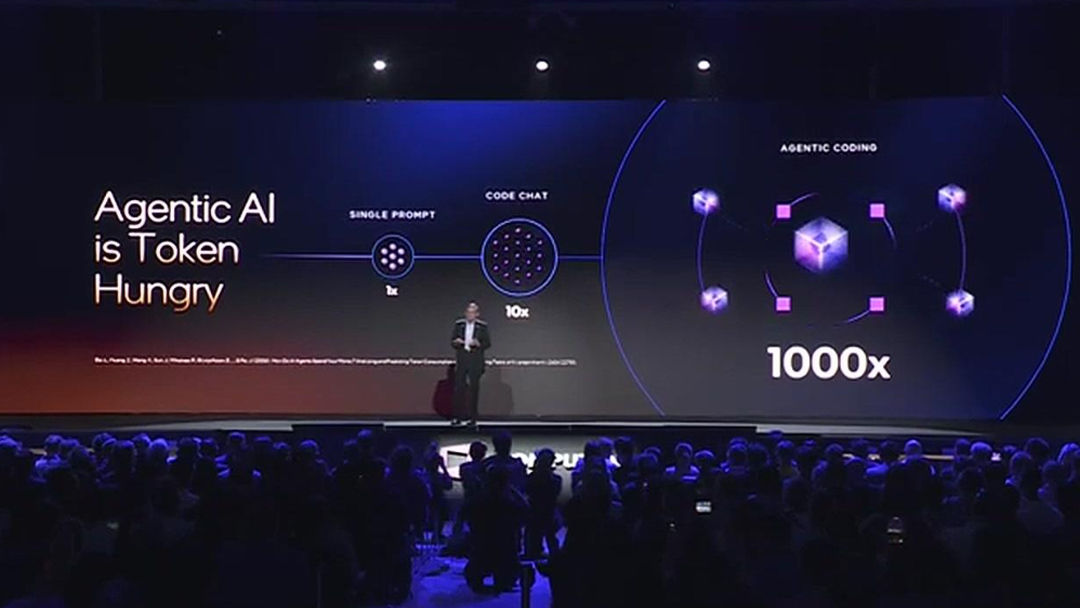
The number that makes this concrete came from Intel’s own Computex slide: agentic AI is token hungry. A single prompt is the baseline. A back-and-forth chat is roughly ten times the tokens. Full agentic coding runs up to a thousand times. Treat the 1000x as Intel’s figure and halve it to be cautious; the direction is the point. Agents burn far more compute than a chatbot, and they do it as a constant stream of work rather than a one-off.
There is a power story underneath this too. Intel pointed to research suggesting AI inference alone could account for nearly 40 percent of data-centre power demand by 2030. When work becomes that voluminous, that continuous, and that power-hungry, the deciding factor stops being peak performance and becomes economics. Cost per token, power per token, tokens per watt at every scale from a few racks to a full floor. And in economics, CPU-based computing tends to win: it is cheaper, scales more predictably, and draws less power. “AI equals GPU” was true for phase one. Phase two loosens that grip, and the more agentic the workload, the looser it gets.
What Intel Actually Said at Computex
The reason I trust this is not just a hunch is that Intel built its entire Computex pitch around it. Tan’s keynote was titled “The Next Era of AI,” and he made the argument head-on: agentic AI, he said, will drive demand for CPUs as AI takes on more complex, multi-step tasks. He called the opening across PCs, data centres, edge, and physical AI “a generational opportunity.” The framing slide that mattered split AI compute into three tiers: a CPU-heavy Data Center that serves applications, a GPU-heavy Frontier AI Factory that trains the big models, and in the middle, an Intelligence Center that serves intelligence, where agents and inference actually run on a balanced mix of silicon.
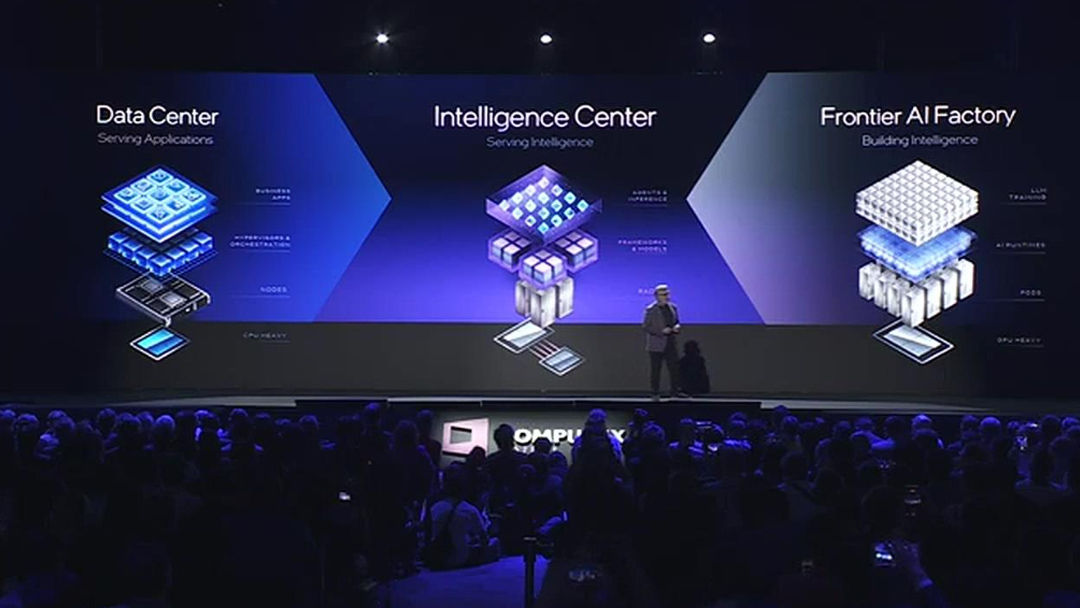
Read that middle tier again, because it is the whole bet. Intel is happy to let the GPU crowd keep the training factory and is planting its flag on the layer where agentic inference lives. That is a confident, and I think correct, reading of where the money is going to settle.
“Picking the right silicon for your needs is critical.”
Lip-Bu Tan, Intel CEO, Computex 2026
To make that real rather than rhetorical, Intel ran a live demo with Perplexity’s Aravind Srinivas, showing hybrid agentic inference on a Core Ultra Series 3 laptop: a local model triages the sensitive material on-device and passes only the rest to the cloud. That is agentic AI being commercialised in front of you, not sketched on a roadmap, and it doubles as a neat advert for why you want capable silicon on both ends of the link.
The product that backs the talk is Xeon 6+, known as Clearwater Forest, introduced by data-centre chief Kevork Kechichian: an all efficiency-core server chip on Intel’s own 18A process with up to 288 cores, 576MB of L3 cache, and a claimed 17 percent IPC uplift, pitched as the most power-efficient server part Intel has built. That is exactly the kind of CPU you want anchoring the Intelligence Center. For India specifically, where data-centre capacity, GCC build-outs, and sovereign-AI projects are all scaling at once, an efficiency-led, cost-sane CPU story is the sensible route.
Two Fronts, Both Looking Good
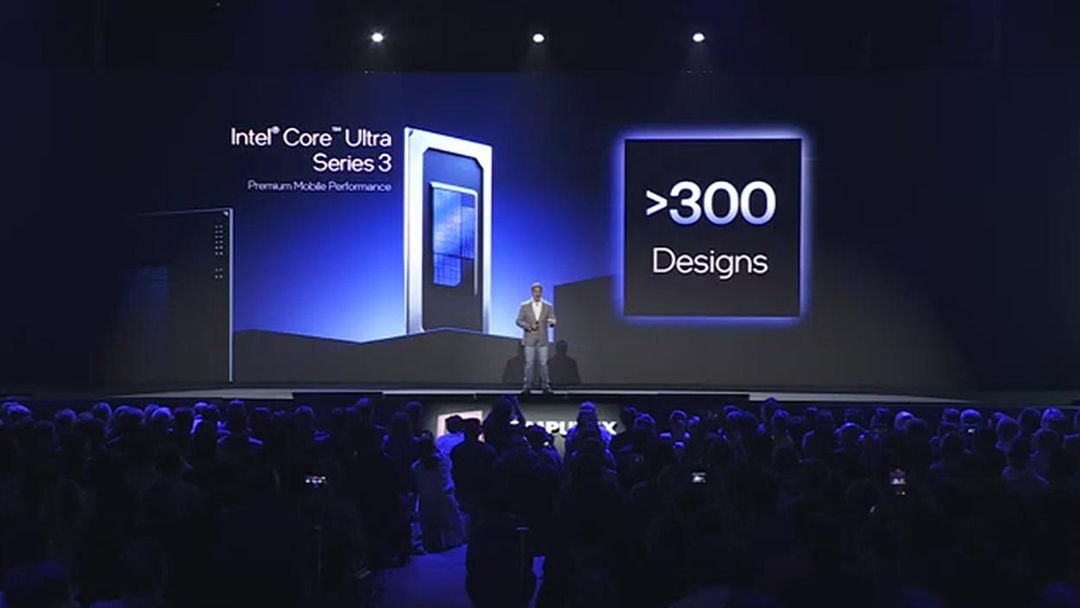
What makes this moment unusual for Intel is that the good news is not confined to the server. On the PC side, Intel showed up with a balanced, modular stack: Panther Lake, branded Core Ultra Series 3, with more than 300 design wins and a genuinely competitive Arc GPU on board, sitting above Wildcat Lake, branded Core Series 3, the leaner part behind 70-plus designs, and the obvious answer to Apple’s 699 dollar MacBook Neo. I spent some time with the Intel Wildcat Lake based Dell XPS 13, which is also the poster boy when it comes to taking on the Apple MacBook Neo head-on. The same Arc graphics that make Intel’s case in handhelds will, I suspect, show up in mainstream laptops before long. It is rare to see both halves of Intel’s business, enterprise and consumer, looking healthy in the same week.
The Agentic AI race is not going to be a cake walk for Intel. AMD has the identical shape, strong CPUs, strong GPUs, and deep ecosystem ties, and it can answer the enterprise pitch with a single launch whenever it chooses. NVIDIA’s RTX Spark, its Arm-based CPU-plus-GPU platform, presses from the premium end and pokes at Intel on gaming, and because it is ARM, it pressures all of x86. Intel’s PC business is squeezed at the 699 dollar floor and the 2000 dollar ceiling at the same time. None of that is settled.
But settling is not the claim. The claim is that, right now, at this moment, Intel is in a good position on both fronts, and on the specific battleground of agentic, efficiency-led compute, nobody has matched its framing yet. For a company that has spent years on the back foot, being early to the right argument is worth a lot.
The Dots Connect, Execution Decides
So here is the line I would draw through all of it. The AI narrative moved from generating content to running agents. Agents favour efficient, scalable, affordable compute, which means they favour CPUs more than the training era ever did. Intel makes the best CPUs at scale and just told the world, at Computex, that it understands exactly this. That is a coherent story, backed by Intel’s own numbers and by the plain logic of the workload, and it is the most convincing story Intel has had to tell in a long time.
What is left is the hard part: execution. The 18A yields have to keep climbing, the efficiency and battery claims have to survive independent testing. Tan closed the keynote with a line from Intel co-founder Robert Noyce: ” Don’t be encumbered by history, go off and do something wonderful”. For the last few years, history was the thing weighing Intel down. The agentic turn has handed it a chance to stop looking backward. Whether it takes that chance is the only question left, and for the first time in a while, it is a question about execution rather than direction.